
By Yolanda Zhou, VI Form
Inverted Airfoils’ Abilities to Prevent Wind Storm Roof Destruction
Student-Submitted Note: This paper investigates a new way to reduce aerodynamic lift created around houses’ roofs in extreme windstorms. Three test models were created in computer modeling software OnShape and simulated in CFD using OpenFOAM. This project was inspired by the concept of “downforce” used to stabilize Formula One race cars. This paper was written for submission to the High School Science Symposium (HiSci) in May 2023 as part of the STEM Fellowship.
Abstract
As severe windstorms increase in frequency and intensity, more residential houses are predicted to be vulnerable to structural damage by severe windstorms towards the end of the 21st century. Wind around the roof exerts a negative pressure that lifts the roof up and threatens the structural integrity of houses. In this paper, a novel method of mitigating lift using inverted airfoils was explored through CFD simulations. The performance of the model was assessed through three criteria: net lift coefficient, effectiveness under different wind directions, and manufacturability. Visual representations of pressure and velocity distribution of the airflow over the model were analyzed to validate simulation data. Single inverted airfoils and round airfoil-shaped roofs were tested for the first prototype. A further iteration of the prototypes improved the model performance. All roof configurations were able to reduce the overall lift of the system when compared to the control group. Single airfoil roof setup was most effective at reducing net lift, while round roof setup was effective in a wider range of wind direction conditions. Rectangular Roof setup combines the advantages of both setups and reduces more net lift than the Revolved Airfoil setup.
Introduction
As global climate change accelerates, the intensity and frequency of wind disasters, such as tropical cyclones and tornadoes, are predicted to increase significantly by the end of 21st century [8]. The increase in the intensity of tropical cyclones is found to be correlated to the rise of Sea Surface Temperatures [8]. Furthermore, Category 4 and 5 tropical cyclone activities, which have wind speeds that exceed 150 miles per hour, are likely to increase in the late 21st century [10]. Such tropical cyclones, although very rare, are catastrophic and account for around half of the economic damage done by all tropical cyclones in the US [6]. In 2013, an EF-5 category tornado hit Moore, Oklahoma. Reaching a speed of over 200 miles per hour, type EF-5 tornadoes are the rarest and most destructive type of tornado on Earth. The tornado caused 24 deaths, more than 200 injuries, and billions of dollars for repairing the destroyed houses and facilities [3]. Overall, tropical cyclone frequencies, intensities, and damages are projected to increase as the global climate continues to get warmer [10]. High School Science Symposium 2022
During windstorms, roofs and windows are the most vulnerable components of a house. A windstorm usually destroys a house in two ways. First, windstorms create vortices that generate an upward lift on the roof. As the air flows above and underneath the roof, the wall facing the wind stalls the wind, generating a significant increase in pressure and aerodynamic lift in the region. When the roof cannot withstand the lift from the wind, it apart from the rest of the house [4]. Fallen debris such as roof coverings, broken window glass, and trees collide with surrounding houses, causing significant damage. When debris in the wind breaks a window, it is also likely for the strong wind to rush into the house, drastically increasing the internal pressure in the house and thus blowing the roof off [4]. and their frequencies are predicted to increase. Figure 1 demonstrates the level of destruction brought by the punishing wind.
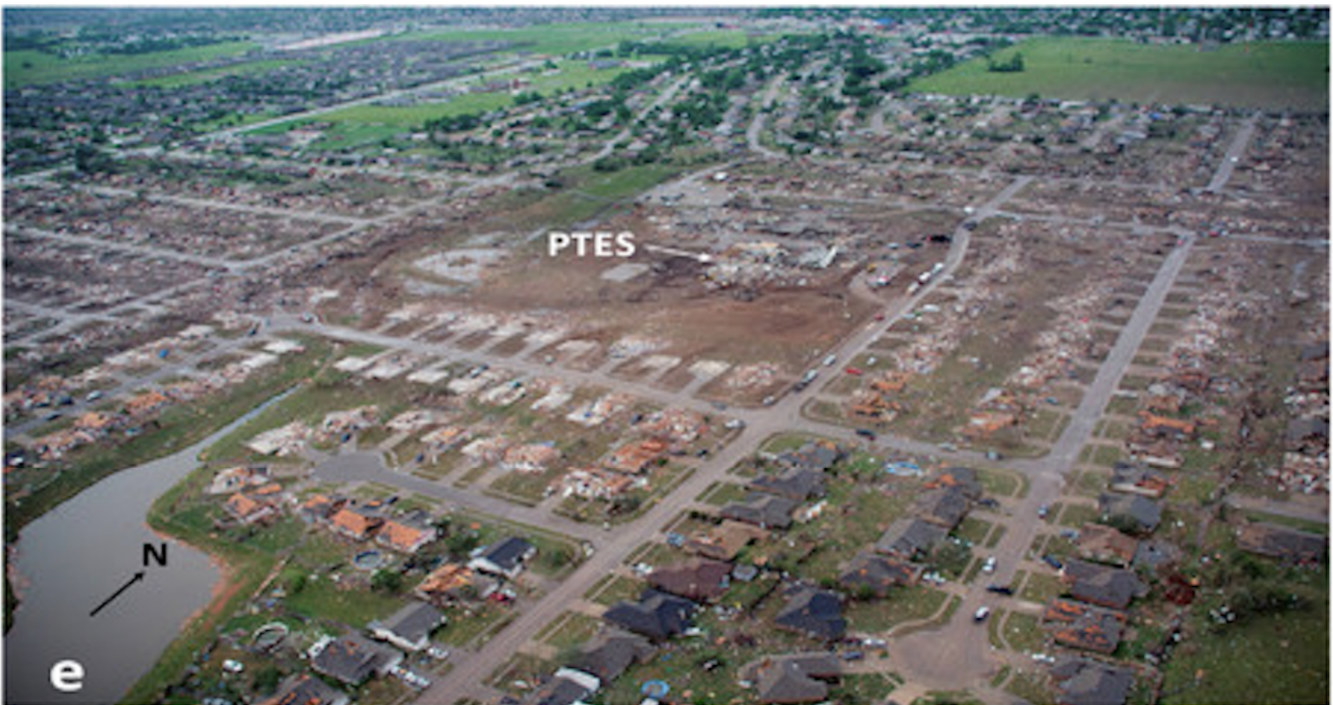
Figure 1. After the EF-5 tornado strike in Moore, Oklahoma in 2013 [3]. Buildings in the path the tornado were in ruins. The wind-torn houses contrasted with the houses untouched by the tornado.
Past works have been done to use aerodynamic devices to mitigate lift brought by fast-traveling winds. Variously shaped gadgets, such as blocks, corners, and blocks with holes in the middle, were placed on test models and tested in wind tunnels the performance to mitigate the lift force created by fast-traveling winds [7]. Perforated parapets, or hole-patterned materials, have been tested extensively as a low-cost and effective solution to wind damage under low wind speeds [2]. More tornado-resistant building methods were also attempted by layering construction plywood at various orientations to enhance the structural integrity of the houses in EF 3 tornadoes [1]. However, very limited work has been done to stabilize houses in higher-level tornadoes and hurricanes. The goal of this study is to explore the possibility and effectiveness of using inverted airfoils to generate downforce to stabilize the roof under a wind speed of 200 kilometers per hour.
Methodology
High School Science Symposium 2022 3 The idea of using inverted airfoils is inspired by Formula One (F1) cars with inverted airfoils installed around the car to increase its stability while traveling around corners at high speeds [9]. As shown in Figure 2, downforce is an aerodynamic concept that can be interpreted as the opposite to lift, which is the force that enables planes to fly. The flow speed above the inverted airfoil is slower than the flow speed below. The difference in flow speed results in pressure difference, where the pressure above the inverted airfoil is greater than the pressure below, hence a downward force is generated.

Figure 2. An illustration of velocity around an inverted airfoil. The red region underneath the inverted airfoil indicate high velocity and low pressure, whereas the blue region above the airfoil indicate low speed and high pressure [5].
A similar concept can be used to prevent roofs from being blown off houses in major hurricane and tornado disasters. When inverted airfoils are mounted on top of a houses’ roofs, the airfoil generates downforce, and, theoretically, is capable of keeping the roof of the building from being torn away by the wind. For this experiment, NACA 9612 and S1223 airfoils were chosen for their ability to generate high downforce [11].
To test the performance of the airfoil roof models, Computational Fluid Dynamics (CFD) simulations were run on the experiment house models. The CFD tests were run with OpenFOAM, an open-source CFD software. CFD is an efficient and cost-effective method to run experiments without worrying about the long timespan of model construction in physical experiments or the cost of setting up facilities for testing [12]. The performances of the experimental house models were compared using the criteria listed in Section 2.5.
TO CONTINUE READING, CLICK HERE FOR A FULL PDF VERSION.
Yolanda Zhou is a VI Form boarding student from Quincy, MA. Yolanda enjoys watching Formula One (F1) races in her free time.


 LEO
LEO 