
By Sherry Mi, IV Form
Suffering in Chinese Buddhism and Italian Christianity: Comparison Between Northwestern Chinese Mogao Grottoes and Italian Christian Artworks
Student-Submitted Note: I conducted this individual research in the Summer. Inspired by my pre-COVID travels to the Mediterranean region, I became greatly interested in European art history while constantly being influenced by Chinese art and culture. My research is a response to my childhood wonder about religious art.
INTRODUCTION
Visual art is one of the easiest ways to communicate, while the spread of a religion depends on the diffusion of its beliefs, which solely depends on communication. For this reason, artists have created countless religious works in the past millennia. Furthermore, the use of religious symbols increased as religions, usually including scriptures, holy figures, and taboos, were systematized. Symbols convey essential religious ideas to the viewers, including suffering.
In my 2020 visit to the Mogao Grottoes in Northwestern China, I also noticed that Buddhist stories of sacrifice and suffering were also one of the most depicted images. Religious beliefs, I conjectured, supplement images of suffering, delivering an important lesson about pain to the followers: Why is pain present? How can one cope with it? Notably, religious art only represents the opinions of its artist, probably on behalf of society, but not God. Opinions may change over time.
I soon discovered that these images were produced inconsistently as the religion evolved. I recorded my discoveries in Buddhist and Christian art in the following analysis. As the religion developed, religious art deviated from images of suffering. The reduction of such images hinted at a transformation of the invisible relationship between religion and society.
What force could drive this palpable change? I noticed similar trends in the development of Chinese Buddhist and Italian Christian art: images of suffering were abundant for one historical period, but declined as the next period began. I also wondered if Buddhist and Christian artists interpreted suffering similarly by making similar artistic choices. This analysis is a possible answer.
The following essay introduces Buddhism and Christianity’s origin and their development in China and Italy respectively. Then, it conducts three case studies: each study compares a mural from the Mogao Grottoes and an Italian artwork on their interpretations of suffering.
The geographic names in the essay are from the modern administrative map unless specified: for instance, “Italy” refers to the geographic area of modern-day Italy, and “Rome” refers to that of Italy’s capital; the “Roman Empire”, however, is the territory ruled by Roman emperors from 27 BC to 476 AD.
CULTURAL BACKGROUND
Siddhartha Gautama (c. 563-c. 483 BC), also known as Shakyamuni (Sanskrit: “the sage of the Shakya clan”) or the Buddha (Sanskrit: “Awakened One”), founded Buddhism in India around the 5th century BC. Buddhists define life as an eternal cycle of suffering and rebirth. The only way to escape this cycle is through enlightenment: one needs to abandon their desires because they are the source of pain.
Buttressed by the fundamental Buddhist ideas, Mahayana Buddhism aims to illuminate large communities and extricate them from suffering. It was introduced into China during the Eastern Han Dynasty (25-220 AD). It then accommodated domestic Chinese beliefs, such as those in Confucianism and Taoism, and transformed into Han Buddhism, a type of Mahayana Buddhism that rulers and society widely accepted.
Buddhism coexisted with its art: the religion was known as xiangjiao (像教), literally “the religion of image”, during its early development in China. Followers created Buddhist art both as a product of their reverence and as a medium to edify more civilians about the religion. Some artworks illustrate the stories of Buddha Shakyamuni in his previous and current incarnations; others visualize scenes in Buddhist scriptures.
Along with the fall of the Eastern Han Dynasty came a tumult that lasted for more than 160 years (c. 220-386 AD). It ceased in the Northern Wei Dynasty (386-534 AD, Map 1) when Buddhism thrived and was “utilized as a theocratic power for ideological and social control of the predominantly Chinese population”. The court encouraged civilians to carry out Buddhist practices rather than to stir further social instability.
During the Tang dynasty (618-907 AD, Map 2), Buddhism and Buddhist art remained popular before the An Lushan rebellion (755 AD). The following essay will name the Tang dynasty before the rebellion “Early/High Tang” because it developed from the early stages to its acme: Under the influence of social stability—relative to the Northern Wei dynasty—and cultural prosperity, Buddhism underwent secularization and thus welcomed more followers.
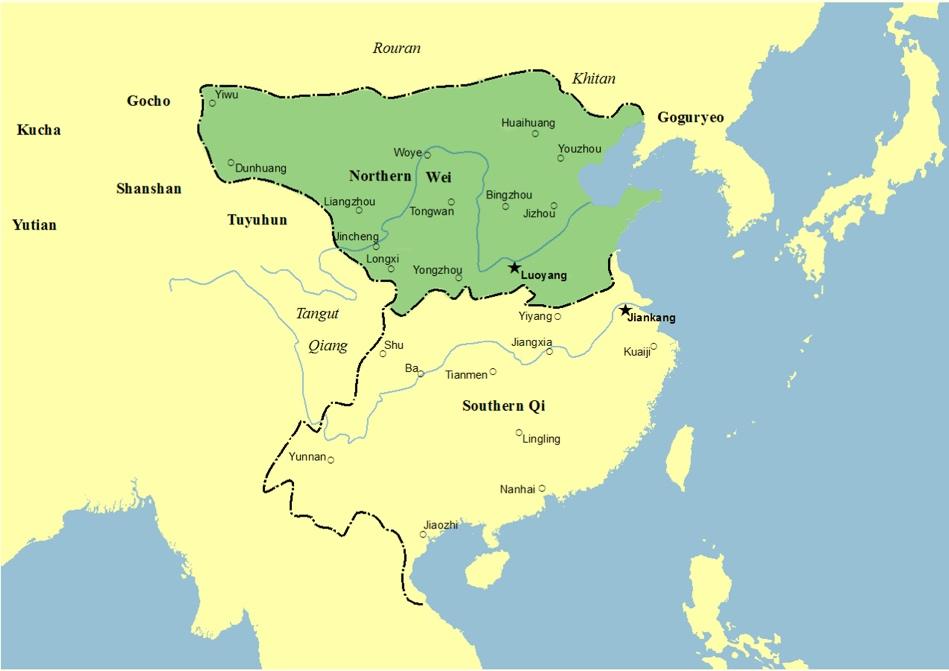
Map 1. The Northern Wei territory is highlighted in green.

Map 2. Map of Tang dynasty. Tang rulers opened the dynasty to the Silk Road, allowing more trade in northwest China.
Both dynasties reigned over Dunhuang, a city located in the modern-day Gansu province (Map 1-2). As a key city on the Silk Road, Dunhuang fostered Buddhist communication through visual arts. There, Buddhists constructed the Mogao Grottoes, a group of 492 caves on the east cliff wall of Mingsha mountain. The caves were built from the 4th century AD until the 14th century AD. Most of them have interior painted murals and statues, while the artists are unknown. The murals analyzed in this essay date to the North Wei Dynasty and the Tang Dynasty.
Similar to Han Buddhism, Christianity was also a foreign religion to the Roman Empire. It developed in the modern-day Middle East, which centered on Jerusalem. Its teachings centered on the Holy Trinity, including the Father, the world’s creator; the Son, Jesus Christ; and the Holy Spirit. In the New Testament, Christ is the leader of Christianity and the Savior of humanity. Christ paid for humans’ sins through suffering and Crucifixion.
Before the early 4th century AD, Christianity was banned in the Roman Empire; many Christians were tortured or martyred by the government. In 312 AD, Christianity was legitimized by Constantine I (r. 306-337 AD) in the Roman Empire and has since then dominated the region. The fall of the Western Roman Empire in 476 AD embarked on the so-called “Middle Ages”. Different from the preceding antiquity and the succeeding modern times, the Middle Ages supported control over freedom.
In 1054 AD, Christianity branched into Roman Catholic and Eastern Orthodox (Map 3). Italy, specifically the Vatican City in Rome, remained the center of the Roman Catholic Church. As visualizations of the Bible, medieval artworks imparted Roman Catholic teachings to the predominantly illiterate European population. The Catholic Church stratified and controlled society until the Renaissance. The revived Classical philosophy enhanced Christianity: the rise of humanism attributed the religion to more personal dignity and attention to humanizing characteristics, which were again reflected in artworks.
TO CONTINUE READING, CLICK HERE FOR A FULL PDF VERSION.
Sherry Mi is a IV form boarding student from Shenzhen, China. Sherry is interested in biology and art history. She loves playing the piano and doing traditional Chinese dance in her spare time.


 LEO
LEO 