

26.2 & My First (and only) Marathon: The Struggle is Real
By Veronica Barila, School Counselor
26.2 & My First (and Only) Marathon: The Struggle is Real
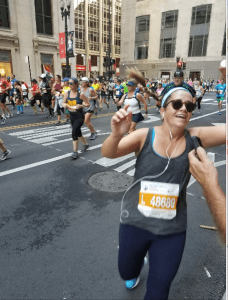 Most people would argue that coming in 31,897th place is nothing to brag about. When you run a race and finish a hard three hours behind the the winner, I can see how some folks would feel disappointed by their performance. However, finishing the Chicago Marathon, my first (and only) marathon, was never about winning, timing, or even competition. Instead, I embarked on a journey to cross the finish line healthy, to feel every step, and to accomplish something that always seemed impossible.
One of my favorite running songs by Ryan Mountbleu, “75 and Sunny”, boasts the lyrics, “You better believe I’m living for the moment, but my moment is the whole damn thing.” This refrain became my motto as I trained, reminding me that this experience wasn’t just about the joy and pride of finishing the race. It was equally about the pain, frustration, and disappointment that comes along the way. Throughout this process, I anticipated and relished the moments of suffering, knowing that those emotions were equally important to the positive ones that balanced everything out. (more…)

Christianity Meets Judaism
By Lora Xie, IV Form
Christianity Meets Judaism
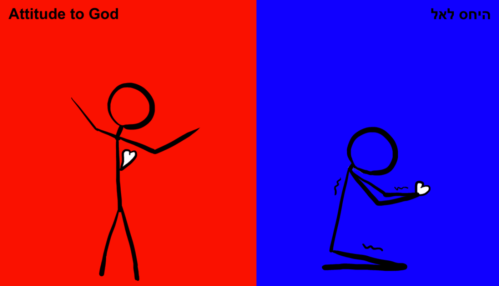 In the form of a book of doodles and quotes, I attempt to vividly illustrate the differences between Christianity and Judaism by juxtaposing their respective interpretation of some of the most important and interesting concepts in these two religions.
Click on the link below to view Lora’s book on Christianity and Judaism:

How the Adolescent Brain Works: In Annotated Diagrams
By Hannah Hassara, Katherine Gao, Kennedy Petties, Ryan Yang, Mary Flathers, Nathan Laudani, Cecily Bradley, David Ragone, Caitlin Lochhead, Teresa Meyer, and Steven Sinchi, V Form
How the Adolescent Brain Works: In Annotated Diagrams
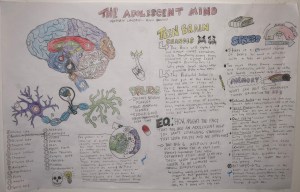
Editor’s Note: In the culminating assignment of the Biology 30 unit on Learning and the Brain, the students created Annotated Diagrams of their brains and how their brains learn new information. An Annotated Diagram is a formal sketchnote that aims to demonstrate understanding of the information by demonstrating how the information was processed. The following question was posed: “How might the fact that 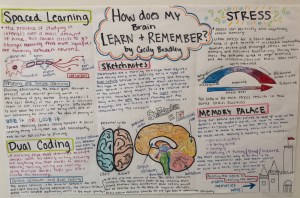 you are an adolescent help you craft learning strategies that work for you and are effective?”
Scroll down for large images of the Annotated Diagrams. (more…)

The Absurdity of Life: Dissonance in Sub specie aeternitatis
By June Hyunjoo Seong, V Form
The Absurdity of Life: Dissonance in Sub specie aeternitatis
One often falls upon the conviction that their present moment is absurd or the composite of the absurdity of moments makes their life absurd. In that this overwhelming conviction has and does consume a great majority of man, the conclusion has been made that life, as in the entirety of earthly existence, might be absurd. When one comes to view this conclusion on a more particulate basis, during which the conviction of the majority is dismantled, one can see the obvious discrepancy between the state that is life and the absurd that is the conviction in contention. (more…)

A Portrait of This Artist’s Portraiture
By Lulu Eastman, VI Form
A Portrait of This Artist’s Portraiture
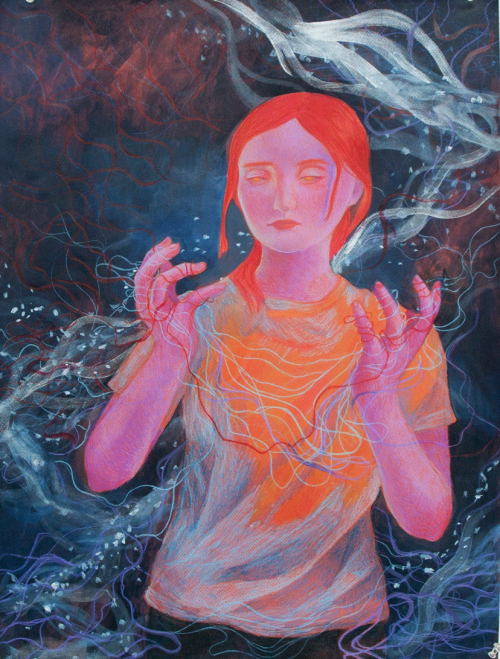 This year in Studio III, my AP concentration is portraiture. I love to convey images of humans in my art, whether they are real people that I know personally or figures from my imagination. In my portraits, I capture the subject’s personality or identity to share this aspect with the viewer. The most common mediums I use in my art are pencil, colored pencil, and acrylic paints. (more…)

Newton’s Law of Synchronicity?
By Kyle Rubin, VI Form
Newton’s Law of Synchronicity?
Sir Isaac Newton’s third law of motion, which reads, “For every action, there is an equal and opposite reaction,” can be applied outside of the scientific realm and into the philosophical realm in that every action is done for a reason. With this in mind, synchronicity exists in that one thing can provide context for another, whether they have a direct correlation or not.
Synchronicity provides context for how or why some things occur. It explains how two things, whether physical or conceptual, may seem related even though they have no discernable connection. Newton’s third law of motion covers similar bases to synchronicity, in that the third law gives insight into the opposing side of an action. Newton provides the reason for why a reaction will happen, similar to how synchronicity describes why events appear similar even though they may not be explained by conventional standards. (more…)

Are Year-Round Islands Off the Coast of Maine Economically Sustainable?
By Emily Taylor, IV Form
Are Year-Round Islands Off the Coast of Maine Economically Sustainable?
Editor’s Note: Emily created this presentation while attending the Waynflete Sustainable Ocean Studies Summer Camp through partial funding from The Matthews Fund. (For better clarity images, click here for Google Slide presentation)
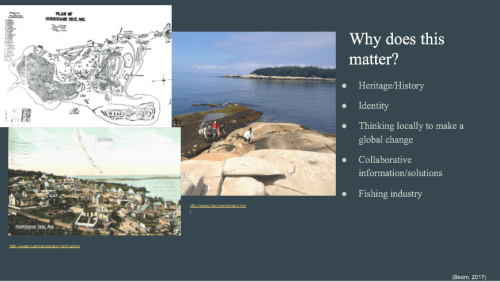
Hurricane once was… now is not. We don’t want this happening to the current year round islands… but why?
I wanted to figure out why this mattered, not only to me but to everyone in Maine and everyone who cares about Maine.
Year round island communities are something that have been a part of maine for a very long time. Holding on to these islands almost maintains the heritage, history, and identity of Maine.
In order to look at islands around the world on a global scale, figuring out how these small Maine islands work on a local scale will help to make a global change. Also, the collaborative information and solutions for islands around the world could be a useful database.
The fishing industry is very prevalent and important on the islands of Maine, so the island communities are important to preserve.

The Long and Winding Road of Brantwood Camp
By Summer Hornbostel, VI Form
The Long and Winding Road of Brantwood Camp
Editor’s Note: Names have been changed for privacy purposes
The beeping of my watch’s alarm woke me with a start. Snuggling back into my sleeping bag, I enjoyed
The Saskatchewan girls and me (missing one who is hiding in between me and the girl to the right of me)
thirty more seconds of rest. The cool, misty air of the morning drifted into the cabin, causing goosebumps to run up and down my body. 6:30 am and the first full day of camp lay dauntingly ahead of me. I tiptoed into the main room of the cabin, where twelve campers slept peacefully. I regretted having to wake half of them for their morning shower. The walk to the wayside, or bathroom, through the cool woods was quiet; it was too early in the morning, and in the term, for chit-chat.
Sitting on the wayside porch, timing the girls’ showers on my handy dandy watch, I tried to get to know the campers who were waiting to shower.
“Are you excited for your first real day?” “How did you sleep?” “Yeah, I had a tough time falling asleep, too” “I know, I’m tired, too” “Is this your first year?” (more…)



 LEO
LEO 