
Hosting the NACLO National Linguistics Competition
By John Camp, English Faculty & Director of Student Enrichment
Hosting the NACLO National Linguistics Competition
Alternate title: “When a Freshman Stops By Your Office and Two Weeks Later You’re a Site Host and Proctoring a Three Hour Linguistics Competition for Seven Students!”
While toiling over thesis statements and parallel structure in the writing of my IV Form students, I heard a knock on my office door and saw a smiling student. III Former Clara Hua introduced herself to me and asked if I knew anything about the NACLO linguistics competition. I said no, and then Clara explained it all to me. She wondered if I, through my Enrichment position, could potentially make St. Mark’s a site host so that she could compete. Since I am fascinated by cool ideas and I love when students want to compete in academic challenges, I told Clara that I would look into it. Soon, I sojourned down a rabbit hole of links and queries through the world of linguistics. Through NACLO (the North American Computational Linguistics Olympiad via http://nacloweb.org/), I learned how to establish St. Mark’s as a NACLO high school site and myself as a site coordinator. I emailed Clara to tell her, and while she set off to advertise the competition among students, I realized that I needed to know what the heck, in fact, a computational linguistics competition actually is! (more…)

Bee Keeping & Legitimately Fun Facts About Bees!
By Reily Scott, III Form
Bee Keeping & Legitimately Fun Facts About Bees!
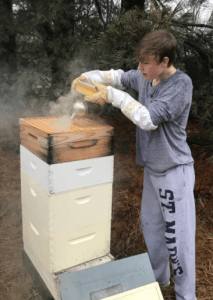 Ever since kindergarten, I have been beekeeping with my mother, but we aren’t the first in our family. Our beekeeping tradition goes back four generations to my great-grandmother Charlotte Ames, but I am the first male beekeeper in my family. My sister, on the other hand, does not want to involve herself with bugs in any way. She will go days without using her bathroom if there is a ladybug somewhere inside.
I have loved bugs all my life. When I was three or four years old, I would find stinkbugs, because my old house had an abundance of them, and stuff them in my matchbox cars and drive them around town. Though I couldn’t get my hands on bees to put them in cars, I still loved them anyway. (more…)

Project Based Learning in The Global Seminar: The Zamibia Presentation
By Alicia Souliotis, Andrew Cheon, Elise Gobron, and Tommy Flathers, III Form
Project Based Learning in The Global Seminar: The Zamibia Presentation
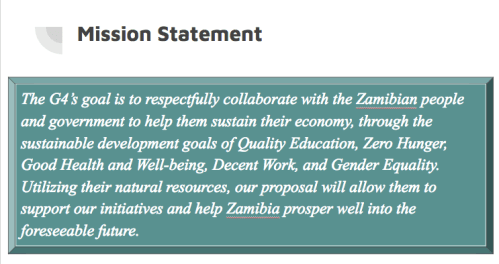
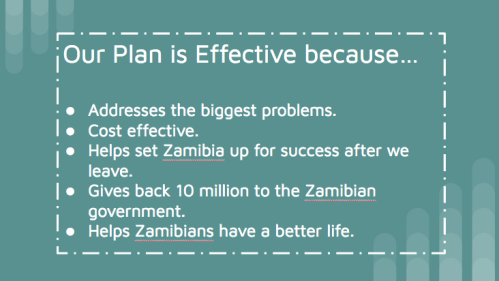
Editor’s Note: All III Formers took part in The Global Seminar’s project to create a proposal to improve the state of the fictitious country Zamibia. The students collaborated in groups as United Nations Development Programme Sustainable Development Teams. The artifact below is part of the presentation that the students delivered to their classmates, teachers, and visitors.
Please click here for entire presentation.

Creating an Online News Source in Writing Workshop
By Emma Viens, IV Form
Creating an Online News Source in Writing Workshop
Editor’s Note: For this assignment, students were tasked with creating an online news source format in a personalized genre/style/theme. It required seven articles, including an editorial, MLA citations, and sections. A title with a pun on their names was encouraged (hence Emma’s title!).
Click here or on any image to see the full News Source.


School Schedules’ Impact on Teenage Brains & Adolescent Sleep
By Helen Huang, Reese Hornstein, and Aditya Mynampaty, IV Form
School Schedules’ Impact on Teenage Brains & Adolescent Sleep
Editors’ Note: In the IV Form Writing Workshop course, students responded to various prompts after listening to a podcast on adolescent sleeping patterns and the brain.
Helen Huang–
With the early start times and little free time, the current St. Mark’s schedule ineffectively addresses how teenagers get their sleep. Sleep is essential to functioning efficiently throughout the day. Why do teens, whose brains are developing and growing, subject themselves to sleepless nights on a regular basis? Schools like St. Mark’s have tried to account for the little sleep teens get by starting classes at 8:00 or 8:30 am, but kids still arrive to class tired and mentally unprepared from insufficient sleep. The St. Mark’s schedule ineffectively addresses how teenagers manage their sleep pattern. Teenagers do not start waking up until around 9:00 or 10:00 am, and until then, their bodies and minds are not fully alert and ready to absorb information (Rogers 5). Therefore, changing the start time of classes by an hour may not be enough to help adolescents get an adequate amount of sleep. (more…)

Finding My Voice: Detaching from Anorexia
By Katherine Ewald, V Form
Finding My Voice: Detaching from Anorexia
My sister Addie once shoved her sweat-infused, post-lacrosse tournament sock in my mouth just to shut me up. I can still taste that sock to this day. She didn’t do this because she was a jerk, rather because I was an extremely obnoxious child. Ever since starring in my first musical at my London preschool at the age of three (literally – I played the role of “Star of Bethlehem”), I have been a singer. Between voice lessons three times a week, chorus twice a week, an endless string of musicals, and my countertop Madison Square Garden-esqe renditions of whatever song was stuck in my head, my sisters never caught a break. Ergo, sweaty lacrosse sock in the piehole.
Most likely to get a much-needed break from the sound of my voice, my sisters eagerly headed to the east coast for high school. Since then, I’ve known that I wanted to do the same, and I did. Having had parents, sisters, and many an extended family member who attended prep school in New England, I expected a seamless transition to my new way of life. This was far from the case. (more…)

Self-Paced Learning in Latin III and III Honors
By Jeanna Cook and Dr. Heather Harwood, Classics Faculty
Self- Paced Learning in Latin III and III Honors
The Classics Department is trying something new this year: self-paced learning. We kicked off this departmental goal almost accidentally as we planned for separate courses in separate places this past summer. Dr. Heather Harwood was working on revamping the Latin III Honors course to better support students who continue with the language in Advanced Latin Readings thereafter. Jeanna Cook was looking for a way to restructure the Latin III course to better serve incoming students who place into Latin III. In our first department meeting of the year, we realized that we were attempting to solve different problems, but that we had designed curricula that pulled from the same methodology. Self-paced learning, assisted by the module structure in our LMS, Canvas, offered a common means by which we hoped that we could achieve our individual course goals. (more…)

The Pitch Project TV Show Winner: “The Second Reality”
By Summer Hornbostel, Pete Nugent, and Hailey DuBose, VI Form
The Pitch Project TV Show Winner: “The Second Reality”
Title: “The Second Reality”
Logline: If the first reality fails, there will always be the second one.
Elevator Pitch: “The Second Reality” is a show about alternate realities, and how the decisions that characters make affect their futures. If you think about it, every decision that we make can have multiple different outcomes, meaning that there are multiple different realities that we could possibly live out. In our show, “The Second Reality”, there is no such thing as one reality. You live one reality, but some people are given the chance to go back and change their biggest mistake, thus leading to their second reality. However, characters don’t know that they have the opportunity to go back, otherwise they might live their first reality without care. While living their second reality characters are able to remember their first one in order to justify it as actually being reality.
Synopsis: In our show, “The Second Reality”, we explore what it would be like to have the opportunity to go back and change our biggest mistake. In the show, we follow four stories of four different people going through various times in their lives. They have to deal with the everyday struggles in life that we do, but there’s one catch. They’re able to go back and change their biggest mistake. As soon as the characters make a mistake that negatively alters their own life and the lives of others, the universe (more…)



 LEO
LEO 