

Video–How to Sell the Story: St. Mark’s Beyond the Classroom
By Drew D’Orsi, V Form
Video–How to Sell the Story: St. Mark’s Beyond the Classroom
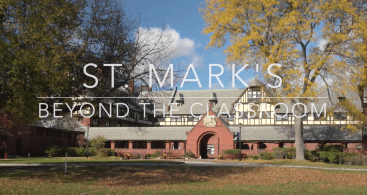
Click on Image for the Video
In my fall St. Mark’s Saturdays course, “How to Sell the Story,” the Admission Office assigned the class a project to create a short admission video. Throughout this experience, we learned how a school sells its product of education and how it engages prospective students and families in order to “sell the story.” My group approached this project by thinking about what sets St. Mark’s apart from other prep schools. What immediately came to mind was the people of St. Mark’s and the opportunities that we have outside of the academic curriculum. Therefore, we came up with the idea of “St. Mark’s: Beyond the Classroom.” My group members (Lizzie Provost, LaQuan Mckever, Kaela Dunne, Jeff Koo) and I were pleasantly surprised that just within our small, five-person group were were able to discover such diversity and to have each member articulate a different aspect of our school community.
Into the Mystic with Thunderhorse: a Q & A
By Shep Greene, Steven Landry, George Littlefield, and Cole Schmitz, VI Form
Into the Mystic with Thunderhorse: a Q & A
LEO: How did you form the band and who are the members and their roles?
Thunderhorse: Our band consists of four members: Steven Landry, George Littlefield, Cole
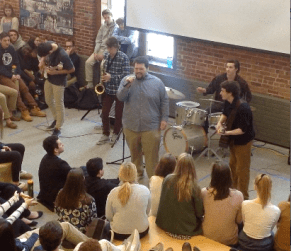
Click for “Into the Mystic” live
Schmitz, and Shep Greene. Steven is on the vocals and has been singing since his middle school acting career. He is a member of the Marksmen and choir. George is the drummer, and he has also been playing since middle school. Cole plays the tenor saxophone and has been for seven years. A very talented musician (he is the only person to win the Massachusetts Association for Jazz Education’s “Most Valuable Player” two years in a row), he has been integral to the Jazz Band and now serves as its vice president. Finally, Shep plays the guitar. He has been playing since eighth grade, but started getting serious about it sophomore year. (more…)

“I Simply Speak Best in Metaphors”–Creative Writing at SM
By Alex Colon, VI Form
“I Simply Speak Best in Metaphors”–Creative Writing at SM
Editor’s Note: The Rise of the Short Story and News That Stays News are VI Form elective courses that constitute a key part of St. Mark’s creative writing program. In the fall, students examine the integral parts of a successful short story in order to craft their own. In the spring, students explore poetry, both originally in English and in translation. In News That Stays News, students attempt to define poetry, experiment with form, and establish a personal voice.
Alex Colon’s short story, “Completely Undone,” was composed while using the second person pronoun (you) perspective as the driving force of the story. This is a particularly difficult task, as one risks alienating the reader. For Alex’s second piece here, a poem entitled “The Morning Inconspicuous,” the assignment was simply one of form: write a sestina. However, a sestina is a very complex form of obsession, where the six words at the ends of the lines in the first stanza are repeatedly woven, in a given order, throughout the poem.
Completely Undone
Your heart beats slow- abnormally slow. You are healthy and lean, but your heart is beating along like you are on your deathbed. You must have been in love at some point because there is no other reason why your heart should beat so slow. Your feet struggle to pick themselves up. With every step you are putting yourself in danger. (more…)

I and Other: Thought to Address, with Nods to Kant and Sisyphus
By June Seong, IV Form
I and Other: Thought to Address, with Nods to Kant and Sisyphus
It is of ever more pertinence to address the striated homogeneity, be it through race, sex, or socioeconomic background, that divides the boarding school community. Upon closer observance, it would not be a stretch to conclude that such phenomena in schools is directly representative of the striations that exist in American society today. Andreas Wimmer directly hits at this in his study, “Beyond and Below Racial Homophily: ERG Models of a Friendship Network Documented on Facebook.” He states that such homogeneity, or better phrased, homophily, a principle that states that “birds of a feather flock together,” “might be produced by micro mechanisms other than the psychological preference for same-race alters, including and most importantly the segregation of everyday lives into different domains, which reduces opportunities to meet individuals” (Wimmer 3). (more…)

An Inspiring Visit to Cambodia
By Ryan Yang, IV Form
An Inspiring Visit to Cambodia
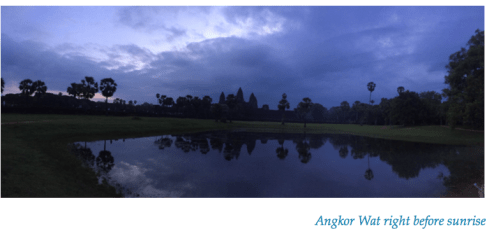 I first came across the country of Cambodia when I had to read a book called The Clay Marble by Minfong Ho for a social studies class. It was about the life of a twelve-year old girl and her friend in war-torn Cambodia after the fall of the Khmer Rouge in the early 1980s. Since then, I’d been curious to learn more about this small country with a big history. This past summer, I final got the chance to see, learn, and experience it first hand.
I had read about the iconic temples, the rich history and culture, traditional street food—it all seemed like a typical Southeast Asian country that I have previously visited. Having spend a week there, I now know that it’s all of that and more. Cambodia is a country with a turbulent history, yet one full of hope for a better future. Not only do the Cambodian people respect their history and culture, they embrace advancements in technology and strive to become more modern. (more…)

Video Oral Arguments: Literature on Trial
Students on Film (in order of appearance): Charlotte Wood, Jenny Deveaux, Joey Smith, Amanda Christie, Josh Loveridge, Gabe Brower, Janelle Carmichael, VI Form
Video Oral Arguments: Literature on Trial
Editor’s Note: This is a highlight reel from Ms. Matthews’ Literature on Trial class (2016 VI Form fall semester English). The course is divided into two sections. In the first half, the focus is on trials, plaintiffs, prosecutors and defendants, reading works of literature and brainstorming criminal or civil wrongs committed by characters in the text. Students work in trial groups to gather evidence, prepare witnesses, and put on their best case. The second half consists of appellate work where students focus on the after effects of a trial, reviewing lower court records for Constitutional issues, drafting briefs for appeal and preparing for a final oral argument.
Please click here or on the images for the “student attorneys” in action! 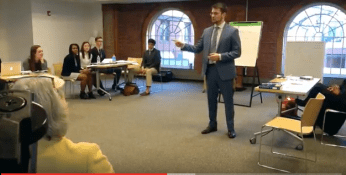
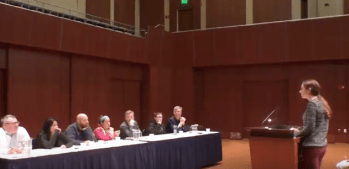 (more…)

Facing the Big Bad Wolf
By Grace Gorman, VI Form
Facing the Big Bad Wolf
My mom has always described me as “fearless.” To some extent, when she recounts my fearlessness, she is referring to my willingness to try new, courageous things. However, I also possess another kind of fearlessness – the determination to face whatever comes with strength and bravery. The way she retells it, she first recognized my fearlessness during a family trip to Busch Gardens amusement park.
That day, I was unable to go on many rides with my siblings because I was too small. However, this all changed when we arrived at The Big Bad Wolf. This ride was notorious for being the fastest and most thrilling at the park, and no matter how much my mom tried to convince me that I should not go on it, I was determined. Despite measuring tall enough to ride, right before stepping into the suspended seat, my stomach dropped, filling with fear and uncertainty. Nevertheless, I proceeded and, with my mom sitting next to me, we climbed the long, steep track. As we were hurled through the air, my mom screamed, “Gracie, are you okay?” I joyfully hollered back, “I want to do this again!”
From that moment on, I have been considered the most adventurous child of my family. At four years old I gleefully jumped off the high diving board at a local pool, at eight years old I began riding horses, and last year I snorkeled in the middle of the ocean, where I swam right next to a Barracuda and touched stingrays. While my mom might use these examples to describe my fearlessness, these are not the moments during which I consider myself to have been the most fearless. My most fearless times were after my sister died. (more…)

The Future Is Female
By Dr. Heather Harwood, Classics Department Head
The Future Is Female
The women’s movement in America informed much of my development from a girl to a woman and has defined my identity as more than any other social or cultural event. Growing up in the 1970’s I watched and listened with a child’s wondering eyes and ears as the role of women in society blossomed and evolved all around me. I was exposed to children’s programs like Free to Be You and Me, a musical entertainment project that promoted radical gender and racial equality. I also remember watching the television program Mary Tyler Moore with my parents, a show considered progressive at the time, that followed the life of a young single woman making her way in the traditionally male dominated world of television journalism. In high school, I chose topics for research papers on women’s issues, from the Susan B. Anthony and the Women’s Suffragist Movement to Roe Vs. Wade to the Equal Rights Amendment. (more…)



 LEO
LEO 