
On a Life as an Asian-American & Embracing That with Open Arms
By Lindsay Nielsen, VI Form
On a Life as an Asian-American & Embracing That with Open Arms
The worst activity of my freshman summer was taking six-hour classes of drivers’ ed for five days straight. The only thing that made it bearable was that our teacher let us watch the world cup instead of parallel parking videos, and we were let out early on the last day because my teacher’s daughter suddenly went into labor. Before she got the call, my teacher passed out our graded permit tests. “So..” she said, “it looks like Peggy Chen got a perfect score. Please raise your hand and grab your test” Pause. Let me tell you three things. 1. I knew no one in this class. 2. I did not earn a perfect score and 3. When she told the class Peggy Chen scored a 100, every single person, including the teacher, looked at me expecting me to raise my hand. After trying to tell them my last name was actually Nielsen, a shy, Asian, Peggy Chen out-stretched her hand from the corner of the room to claim her test.
Believe it or not, this is a usual occurrence for me. And definitely not as weird at the week before when a middle-aged woman walked up to me in Best Buy asking how the definition of a 4k tv differed from a curved model. “I’m sorry,” I said. “I don’t work here.” A few awkward stares were exchanged. “Oh…” she said. She looked at me puzzled as if all Asians roaming electronic stores were automatically employees. She then walked away.
Race wasn’t always a prevalent component of my life, but once I knew others were attentive to my race, it started an onslaught of experiences relating to being Asian in what was to me: a largely Caucasian world. In my personal experience, I will explain how I went from of state of oblivion, to self-hate, to self love all in a short period of 18 years. (more…)
The School of Athens’ Tableau Vivant . . . & Memes!
By Keely Dion, Cooper Sarafin, Dylan Sotir, & Charlotte Wood, VI Form and Reevie Fenstermacher, IV Form
The School of Athens’ Tableau Vivant . . . & Memes!
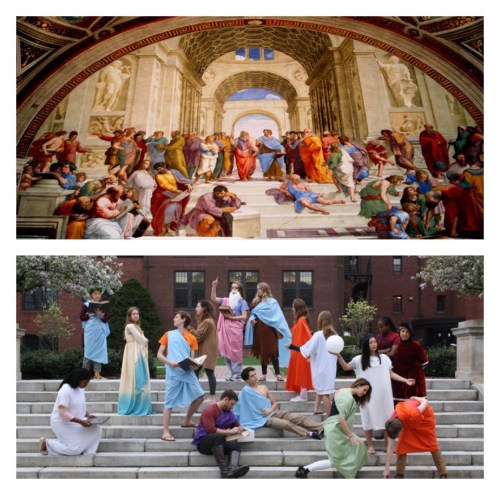 Χαιρετε! Over the course of this school year, we, the Greek II class have put together our Classics Diploma Project, an analysis and celebration of Raphael’s The School of Athens. Our inspiration for this project came from many different places. In class, we’ve read the works of great Greek writers, such as Aristophanes, Plato, and Xenophon, three authors who present different accounts of Socrates’ life. Charlotte Wood, one of the students in the class, had traveled to Rome in the summer of 2015, and while she was there she saw Raphael’s Rooms in The Vatican. She was awestruck by the scale, perfection, and beauty of each work, The School of Athens in particular. She then began studying the work in Art History, and her love for it grew. Once the class started learning about Plato and Aristotle, she shared her enthusiasm for the painting, and the class appreciated the work as much as she did. We then decided to frame the project around Raphael’s awe-inspiring masterpiece.
(more…)

An Analysis of Alienation: The Natural Estrangement of the Individual
By Cooper Sarafin, VI Form
An Analysis of Alienation: The Natural Estrangement of the Individual
Total Estrangement
Alienation is a natural state of human beings. We are set in an environment that leaves us with a sense of inadequacy and ineptitude and no matter what extent to which we alter our facades and wear a mask of falsity; we will never be able to cross the glass ceiling that is our expectations. From the very moment we are conceived, we are being classified and divided among throngs of opinions, preferences, and expectations. We are expected to live up to this normality of society, the ever prevalent quest to “fit in”. To be amidst the general populace and succeed in a manner relative to the ideas of said society and government that preside over our specific demographic. We are expected to succeed in the realm of capitalism and to move further up this hierarchy and supersede the ranks of the proletariat in turn for the bourgeoisie. We are expected to develop social relationships with everyone we meet and to be liked by them. We are expected to achieve great things and to do what has never been done before. In the aftermath of all this expectation, what is left for us to expect for ourselves other than that which has been told to us? In that we are governed by these (more…)

Patriotism Is My Life and Flag: I Support the Troops
By Abby Peloquin, VI Form
Patriotism Is My Life and Flag: I Support the Troops
Patriotism, to me, is far more than saying “I am an American” or putting a flag on your front porch. To be a patriot is to understand the past and present of this country, both good and bad. It is learning the history of our nation, from the pilgrims to George Washington to WWII, and accepting that even the greatest countries have their faults. It is seeing a veteran in Walmart and, although you’ve never met them, saying thank you. Patriotism is putting your hand on your heart for the Pledge of Allegiance every morning at 8am, even when you don’t quite understand the words yet. Being a patriot is a lifelong journey, and the people who understand that more than most are the members of our armed forces. (more…)

What Is Cancer: Looking Through the Multiplex Lens of Immortality
By Tony Banson and Tommy MacNeil, V Form
What Is Cancer: Looking Through the Multiplex Lens of Immortality
Cancer is a disease that has touched the lives of many around the world (Figure 1). It is a disease that afflicts both the young and old, and the rich and poor. The American Cancer Society estimates that there will be 1,688,780 new cancer cases diagnosed and 600,920 cancer deaths in the United States in 2017 (Cancer Facts & Figures 2017). Biologically, this disease arises from one’s body when normal, healthy cells begin to grow uncontrollably. Because of genetic and environmental factors, the subset of cells no longer cooperate with evolution’s safety controls, bypassing important regulatory checkpoints of the cell cycle. With the advent of technology and medicine, humans are living longer and the cells that make up our bodies have more time to mutate in ways that can cause havoc.
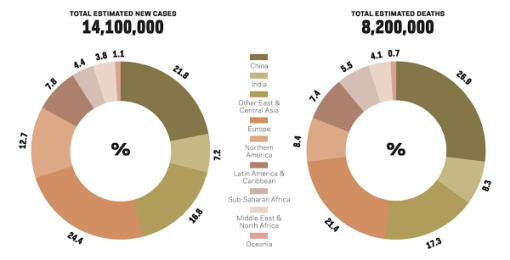
Figure 1 which indicates total number of cancer cases and deaths globally in 2012.
From a personal standpoint, cancer has touched the lives of many of our loved ones. (more…)

This I Believe: Let’s Get Realigious
By Tom McKeown, V Form
This I Believe: Let’s Get Realigious
Religion comforts many people and has for most of human history. However, an omnipresent and omniscient being is inconceivable to some, while it frightens others. Religion offers answers to questions that cannot yet be answered through human conception like, “What happens after death?” However, I don’t believe a person needs religions to live a satisfied life.
As a child, I was taught that I would be satisfied with my life if I pursued something that I am passionate about. This always left me asking myself the question which passion is the right one? I was raised Roman Catholic and went to church every Sunday. I attended Sunday school after mass and often went to church functions during the week. I was surrounded by people sharing the same belief, and after my childhood I realized how many different religions were practiced and had existed. This epiphany made me feel small and significantly unsure of the lessons I had been taught. (more…)

20% Time (Genius Hour) With Freshmen: Civic Action
By Ms. Casey Pickett’s III Formers
20% Time (Genius Hour) With Freshmen: Civic Action
Editor’s Note: In Ms. Casey Pickett’s III Form English classes, her students pursue 20% Time (or “Genius Hour”) projects. Below are Ms. Pickett’s instructions, a student’s reflection, and several artifacts from the experience. Please keep scrolling!
Purpose:
The purpose of the project is to give you time to pursue something that you are passionate about, interested in, or something you’ve always wanted to do. It is a time for you to be creative and to take ownership of your learning AND your education. If it is important to you, it has value.
Essential Questions:
What does it mean to be a citizen (global, local, digital)?
What are civics? Why is it important that we are civically engaged?
How can I be a voice for and/or create social change?
Please click here for the full assignment explanation.
A Reflection by Paige LaMalva
As a student, I feel as though there isn’t enough time after academics and athletics to pursue something a student is interested in. At a school like St. Mark’s, for example, we are in class from 8:30am-3:00 pm and then at sports from 3:30-5:00 pm, which is followed by a short period of time to relax before study hall at 7:30 pm. With the 20% Time project, my fellow classmates and I were permitted to explore a topic of our interest. For me, I chose to research pancreatic cancer. Without the 45-minute block per week working on this, I wouldn’t have learned why pancreatic cancer is called “The Silent Cancer.” (more…)

Ugandan Human Rights
By Charles Brookby, III Form
Ugandan Human Rights
Editor’s Note: In The Global Seminar classes, each student wrote a research paper in February and March that was used as the foundation for a 4-5 minute speech presenting an argument (direction and specificity) relating to the following question: How does the global community respond to the abuse of human rights? And how should the global community respond? This speech won the Ely Speech Prize (founded in 1890): an annual competition for Third Formers.
In 1961, a man by the name of Joseph Kony was born. As a child, Kony grew up in Odek, Uganda where he was well educated, and in his adult life became a healer in his ethnic tribe of the Acholi people. As he grew up, Kony was exposed to horrific terror on his people conducted by the Ugandan government at the time. Kony joined an organization known as The Holy Spirit Movement in 1986. He quickly climbed the ranks, and became one the leaders, then ultimately took control and changed the party’s name to The Lord’s Resistance Army. For over 25 years, countries and the UN have been, frankly, oblivious to the horrendous actions of Joseph Kony and the LRA. Ugandan children have been taken, used, and killed at the hands of Kony and his men. Eventually, the International Criminal Court and UN peacekeeping programs have gotten involved in an attempt to stop the LRA. Though progress has been made, the LRA is still active and in power near northern Uganda and neighboring countries, and justice towards their actions has not been dealt. (more…)



 LEO
LEO 