

International Brain Bee Neuroscience Competition
By Samantha Wang, IV Form
International Brain Bee Neuroscience Competition
What is Brain Bee?
Brain Bee is a neuroscience competition for teenagers from around the world. The initiative of this competition, according to its founder Dr. Norbert Myslinski, is to find better solutions for brain disorders. Every year, Brain Bee is first held at the state level. Winners of each state then compete in the country’s Regional Brain Bee, and one representative from each Regional Brain Bee will be sent to the International Brain Bee World Championship. This competition assigns a variety of tasks to its participants. The first part of the Brain Bee is to answer multiple-choice questions, which have around thirty questions about either the brain’s structure and function or pathology and treatment of brain disorders. Participants are then given brain models, where they are asked to distinguish parts of a brain and state the functions they perform. The last part involves the most interesting task I have ever experienced in any competition: four “patients” with different brain disorders, with acting from the volunteers of the organization, tell the specific life experience with their diseases. The participants are asked to diagnose their neurological or psychiatric conditions. (more…)




Serving Up Equality: The Quest in Women’s Tennis
By Tate Frederick, IV Form
Serving Up Equality: The Quest in Women’s Tennis
With the rampant gender inequality in professional sports, tennis could easily be considered one of the least sexist due to its recently equalized prize money. In fact, the World Economic Forum recently wrote that “the Women’s Tennis Association [is] pushing the women’s game and pioneering gender equality” (Edmond). Contrary to public perception, the professional tennis circuit still has to make significant improvements in order to achieve gender equality. The financial distribution still heavily favors men, some of the rules perpetuate sexist values, and unfair stereotyping of female players is frequent.
 Despite the fact that prize money became equal in 2007, women still make far less than male players. On the Forbes’ list of top-earning athletes, Serena Williams only comes in 51st, behind five male players, even though she has won more grand slam titles than any player, regardless of gender, in history, and holds endorsements with companies such as Nike, Gatorade, and JPMorganChase (Wang). Williams has earned tens of millions of dollars less than Novak Djokovic even though she has won many more titles than he has (Macur), due to the overall amount of prize money. If Williams, arguably one of the greatest athletes of all time, can’t achieve equal pay in comparison to her less-winning counterparts, where is the hope for women in less acclaimed positions? By maintaining this inequality, the tennis circuit is discouraging and discrediting the achievements of women in the sport. (more…)

On Sherman Alexie’s “Clean, Cleaner, Cleanest”
By Cara Mulcahey, IV Form
On Sherman Alexie’s “Clean, Cleaner, Cleanest”
The short story “Clean, Cleaner, Cleanest” focuses on the grueling conditions motel maids face every day. It follows the
life of a motel maid named Marie who despises cleaning but does it for the money it provides. Marie gets physically assaulted by her coworkers, sees horrific sights in motel rooms, cleans revolting messes guest leave behind, and does not complain about the dehumanization she faces on a daily basis. Sherman Alexie, the author of “Clean, Cleaner, Cleanest,” utilizes Marie’s self vs. self-conflict about her job as a way to display the horrors motel maids face every day and why they should be appreciated in society.
Marie loathes being a hotel maid because cleaning repulses her and her coworkers have mistreated her. While she had gotten used to cleaning abhorrent bathrooms, making beds, and vacuuming, the idea of cleaning people’s leftover (more…)

Green Sea Turtle – Chelonia mydas & Marine Turtle Exhibition
By Cadence (Catie) Summers, IV Form
Green Sea Turtle – Chelonia mydas & Marine Turtle Exhibition
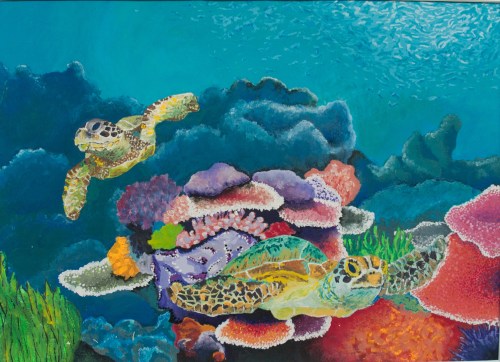
Green Sea Turtle – Chelonia mydas
Stage in Maturity – Adult (more…)

Reflections On The Lunar New Year
By Samantha Wang, IV Form, Helen Huang, V Form, Ryan Yang VI Form, and Thomas Li, III Form
Reflections On The Lunar New Year
Samantha Wang from Nanchang, China
The Lunar New Year, celebrated as the most important festival in many Asian communities all over the world, is coordinated by the cycles of the moon. It is at the beginning of a year, and the date varies every year.
As the most significant holiday in China, the Lunar New Year is traditionally the time for family reunion and to honor ancestors. In my hometown, people follow a series of traditions to celebrate this meaningful festival: first, we clean our homes and put up red decorations, a symbol of good luck in the Chinese culture. This tradition is based on the belief that cleaning the house at this time of year will “sweep away” accumulated bad luck from the past year. Cleaning also makes the house ready to let the good luck enter again. People celebrate in other ways, such as dressing in new clothes, visiting relatives, going to temples and praying to the Buddha, setting off firecrackers, giving out red envelopes, and honoring ancestors. (more…)

La Fille du Régiment and Experiencing an Opera
By Kendall Sommers, III Form
La Fille du Régiment and Experiencing an Opera

Gaetano Donizett wrote La Fille du Régiment, and it premiered at “Opera Comique” opera house in Paris in 1840. The two-act show first premiered at the Metropolitan Opera house in New York in 1902. It was the composer’s first show in French and became a huge success following its release. On February 11th, 2019, St. Markers attended La Fille du Régiment for the annual opera trip. The show follows a young woman, Marie, who grew up in the French army after being taken in by Sargent Sulpice. Leading with a background of her adoption and the climate in which she grew up in, one surrounded by men, viewers can understand her mannerisms and apparent personality. Opera-goers are introduced quickly to Marie’s love interest, Tonio, who is an Austrian that meets Marie by saving her life. The regiment is opposed to their courtship because he is an Austrian and an enemy to them, but Marie resists this fact. Traveling through the regiment’s campsite, a wealthy woman, the Marquise of Berkenfield, reveals that she is Marie’s aunt. She whisks Marie off to her Chateau to force manners onto her and guide her into an arranged marriage in order to salvage her family’s generational wealth. She demands that Marie leaves her lover and family, the regiment, behind. (more…)

Native Americans in the Western Film Genre: An Evolution
By Colin Capenito, VI Form
Native Americans in the Western Film Genre: An Evolution
Whether it be a science fiction film that brings us on a journey to a distant galaxy or a fantasy movie that introduces us to knights and dragons, films can show locations and characters that do not exist in reality. However, film also has the ability to inform us about our own world. Film can remind us of forgotten history, give us new perspectives on historical events, and familiarize us with cultures different from our own. Because of this, the accuracy of the history and cultures portrayed within movies is crucial; if a film is truthful in its depictions, we are more knowledgeable of, and can make better decisions about, the world.
While not all films in the western genre are based on true historical stories, they feature settings, themes, and groups that did exist in the past. One group often portrayed within the genre is Native Americans. There is a history of stereotyping Native Americans in popular culture. Carlos Cortés lists some of these stereotypes:
…antiwhite antagonists (usually villainous); as sexual threats and conveniences; as noble savages; as victims (often passive) of prejudice and discrimination; and as stalwart (sometimes antiracist) heroes.[1]
In the real world, Americans have mistreated Native Americans throughout history. However, Native American treatment has evolved over time. In the early twentieth century, the government wanted assimilation for Natives, working to mold them into Americans, which entailed Natives being forced to abandon their culture.[2] During the presidency of Franklin D. Roosevelt, the government made positive strides in terms of Native American treatment, though termination policies in the 1950s, which included the U.S. government being able to cease protection of Native tribes, undid some of these positive changes.[3] But, groups like the American Indian Movement (AIM) rose in the late 1960s and 70s, helping to bring about policy changes and spark awareness over Native rights.[4] (more…)



 LEO
LEO 