

Remote Student: An Emulation of Kincaid’s “Girl”
By Yolanda Zhou, III Form
Remote Student: An Emulation of Kincaid’s “Girl”
Editor’s Note: In Writing Workshop, III Form students read and analyzed Jamaica Kincaid’s “Girl.” They then composed their own emulations of the story to capture life as a St. Mark’s boarding, day, or remote student while employing the style of Kincaid’s writing. This piece describes Yolanda’s experience as a remote student during the COVID-19 pandemic.
Wake up at nine or ten in the morning, do your morning routine: brush your teeth, wash your face, eat breakfast, and then do your homework; make good use of the time zone difference: assignments due 12am there is next day’s 1pm your time, so be sure to sort out which ones you’re doing first; don’t leave your stuff till those three to four hours because you’ll be sleeping late at night and won’t get much time to do them; but do use this time effectively if you feel overwhelmed; use the “Modules” function and “Week Overview” in each course on Canvas to sort out every assignment in the week using the academic planner; it shows you everything that’s due this week so you don’t have to waste time or miss assignments; color-code your planner: use red for unfinished homework and black for completed ones; don’t procrastinate, it does no good to you; focus on one assignment at a time; eliminate outside distractions; get everything done as quickly as possible so you have some free time for sports, instrument practice, or relax; How am I supposed to balance all these things with so much homework?; you’ll have plenty of time to do so if you listen to and follow instructions; don’t miss your classes, don’t forget to do your homework; email your teacher and explain if missed your class; create alarms on your phone and calendar if necessary; make sure your Wi-Fi connection at home is stable for your online class; install Zoom and log in with your St. Mark’s email address and password, that is where you go to all your classes; install multiple VPNs on your phone and computer before school starts so you’ll know which ones work and which ones don’t; set up everything your teachers ask you to set up in the beginning of the school year; use passwords and accounts that are easy to memorize, you don’t want to forget your login information the first day of school; this is how you interpret your schedule; this is how you deal with internet issues; this is what an asynchronous class look like; this is how you find the links to the synchronous sessions; this is how to find the replays after classes; this is how you explain to your teacher if you missed your class; this is how you write an email if you submitted your homework late; this is how you should reach out to your advisor; go to bed immediately after class, your classes will end early in the morning; don’t do your homework after your last class, you won’t be able to wake up the next day; do your homework earlier, don’t save them till 1 o’clock in the morning; play sports and work out every day, it helps alleviate pressure and keeps you in shape; look for something to motivate you if you feel bored, like watching Formula 1; treat your homework seriously; don’t submit things later than they should be; But what if I submitted an assignment only a few minutes late?; you think anyone is in the mood of caring whether you’re late for a minute or an hour?; late is late, don’t find excuses for yourself; there’s no guarantee that submitting things late will leave bad impressions to your teacher or if they’ll deduct points in your work, so you’d better get them in on time; maintain high quality and efficiency when you’re working; take a 5-minute break for every hour of work; push yourself so you can learn; balance it with relaxation and exercises so you don’t go crazy; reach out for help whenever you need them to whoever can help you; good luck in your time at St. Mark’s!
(more…)
Spontaneity and Bread: A Remote Chapel Talk
By Nick Haugen, VI Form
Spontaneity and Bread: A Remote Chapel Talk
Historical Pottery: Cultural Unity Vessels
Featuring Work From: Tate Fredrick, Austin Hunt, Jasmine James, James Kral, Sarah Mattson, and Maisie Pierce
Historical Pottery: Cultural Unity Vessels
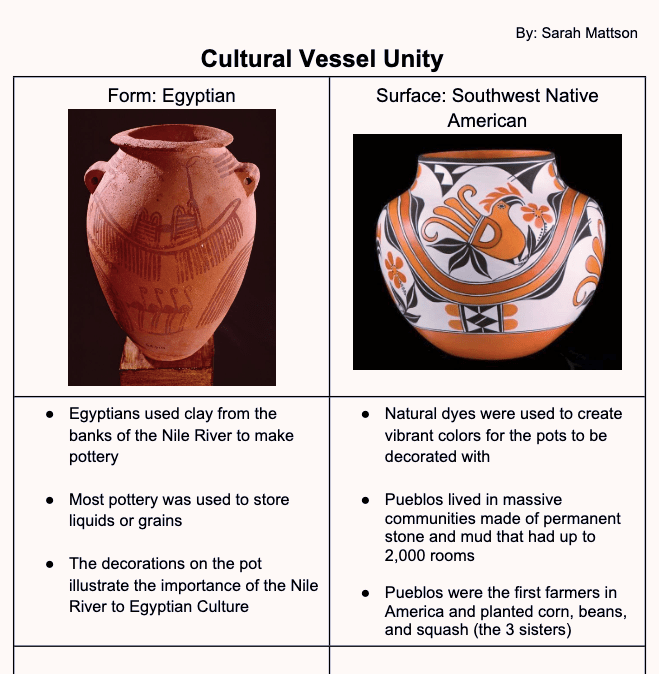
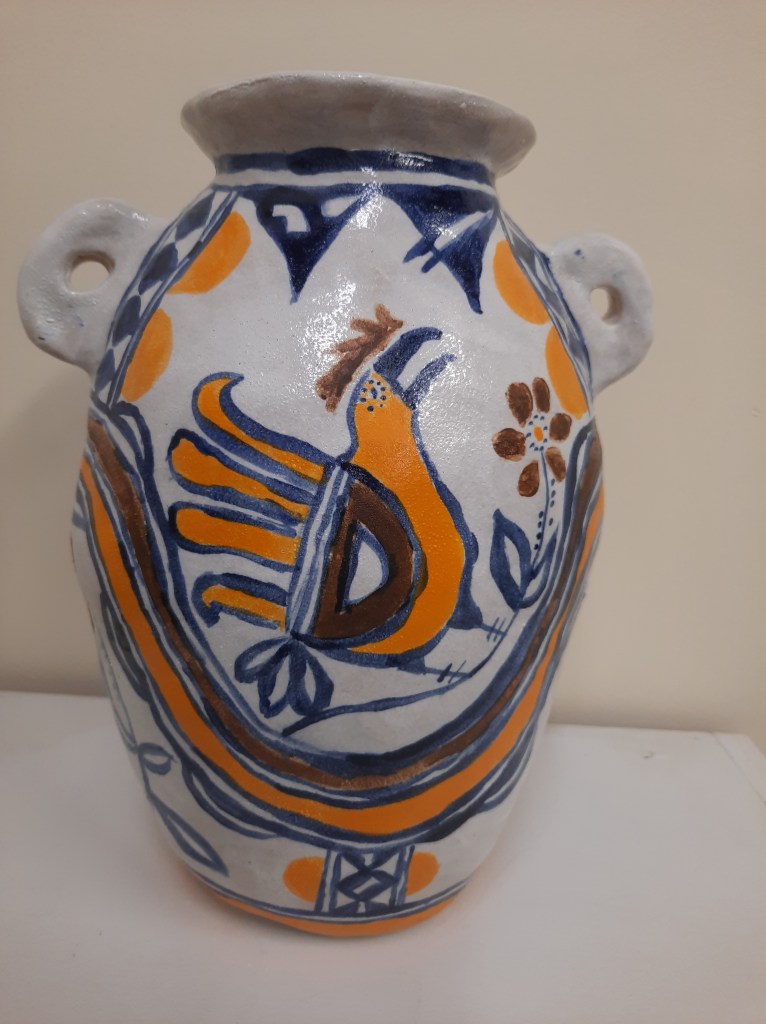
Instructor’s Note from Ms. Aggie Belt: Studying pottery from around the world teaches us about cultures far and near. Using the hand-building technique of coiling, students build a 10 inch tall vessel influenced from two specific cultures. From one culture they chose a form to reproduce, and from the other culture they chose a surface design to reproduce. Uniting these two cultures makes a unique vase. The Posters summarize their research and vases that informed their Unity Vase.
Sarah Mattson, III Form:

La Plage: A French Poem
By Abby Griffin, V Form
La Plage: A French Poem
Instructor Note from Dr. Downing Kress: As a class we read “Le Pont Mirabeau” by Guillaume Apollinaire. In this poem, the poet visits the Mirabeau bridge in Paris and, as he watches the Seine river flow by underneath the bridge, he is reminded of the passage of time and reflects on a love that is no more. I then asked the students to write their own poem about a special place that is significant to them – one that evokes emotion, memory, sensations, etc. Abby decided to write her poem about the beach in the form of a “calligramme,” a form of poetry often used by Apollinaire. The shape/spatial arrangement made by the poem’s text reflects the subject of the poem and plays a role in its meaning.

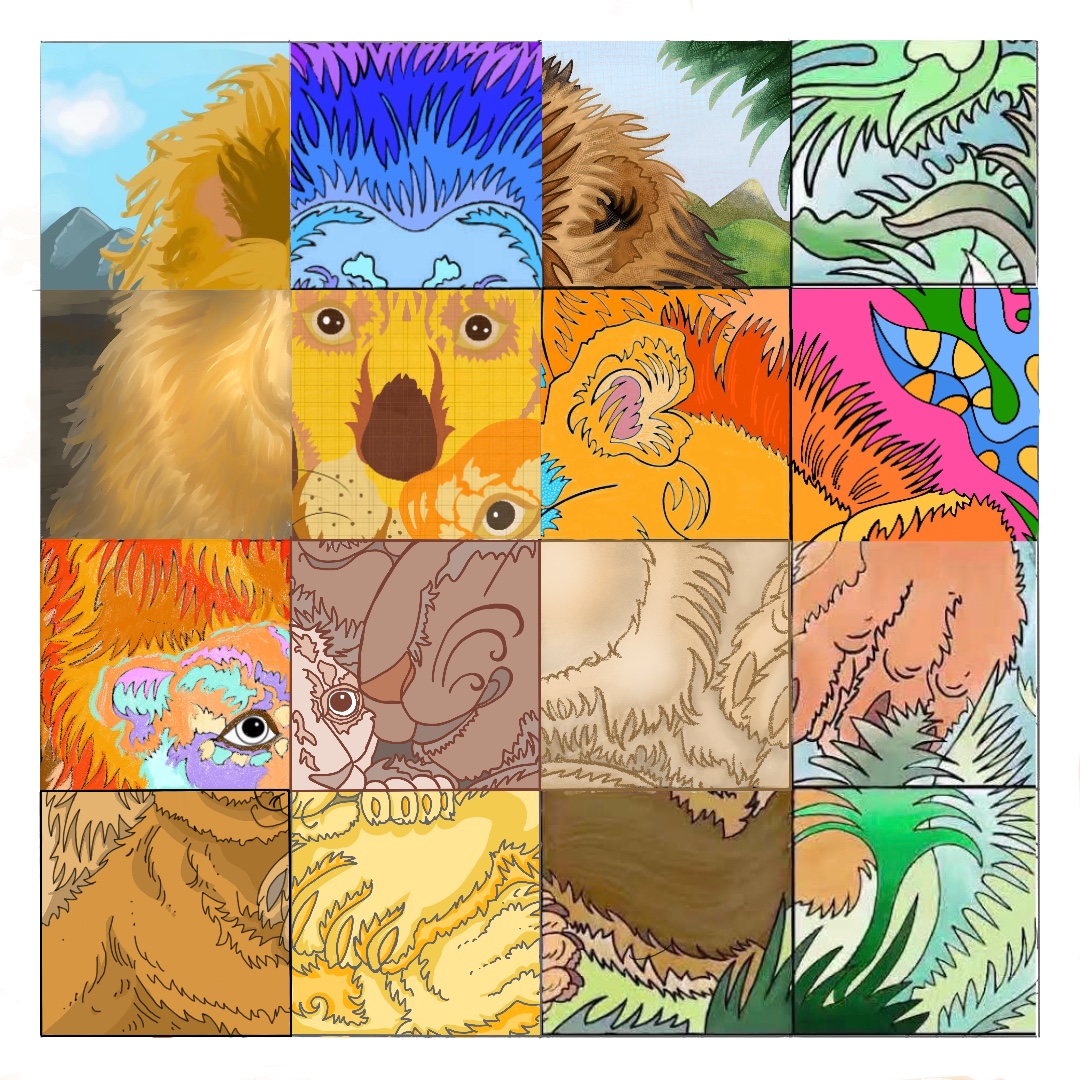
Together: A Community Mural
By Members of the Community Art Club: Emma Lu, Cathy Shi, Grace Li, Grace Lee, Ingrid Yeung, Lily Luo, Sua Yoo, Taylor Zhou, Julie He, and Yolanda Fan.
Together: A Community Mural
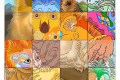
Introduction: The community art club is a recently formed club where multiple passionate artists bring together aspects of community and acts of service to our artwork. Our recent project was a community mural where each person drew one part of a larger image, which were later combined to make this piece. The mural is meant to represent that the individual qualities that each person brings to St. Mark’s is what builds the community as a whole. Without one piece of the drawing, it may not even look like three complete lions! Each artist drew their part of the picture with a different style and color scheme, which shows the diversity that each person’s creativity brings to our community.

Getting to Know Atoms: A Chemistry Infographic
By Keyao (Coco) Xia, III Form
Getting to Know Atoms: A Chemistry Infographic


Science Site Analysis: A Mountain School Project
By Kendall Sommers, V Form
Science Site Analysis: A Mountain School Project
Student Note: This fall, I took a semester off from St.Mark’s and attended a semester school in Vershire, Vermont called The Mountain School. It’s a school focused on outdoor education and connection. We had two required courses, English and Environmental Science. After each unit in e-sci, we would have a final reflection where we wrote chapters on all the topics we had covered. The point of this project was to have a book at the end of the course containing all the content we had learned. Included below is my 3rd chapter, my science site. This unit was a little different from the others; we picked a place in the woods on campus and analyzed it over the course of the fall months. The idea of this project was to learn to be independently observant and develop our scientific analytical skills. Also, it connects to the school’s mission statement regarding building a connection to a place. The project below included my description of my site, my map and timeline I created, and my hypothesis regarding the history of the site.
Chapter 3: Science Site Analysis
Directions: To get to my center point you must first sign out on the board with a faculty member (rule number 2!) and then begin walking on the inner loop clockwise. Continue along the loop until you reach Siberia, then take a left onto the trail leading up to pine top. Here, the grass will be a bit taller and you will see a tree on the left of the path with a really long branch that turns up at a right angle. Now, walk uphill on this path until you reach another path going off to the right. Follow this path downhill for about 60 paces until you reach my site’s center point! You will know you have arrived if the trees around you are mainly coppiced white pines and to your right (south west) there is a clearer section of the woods with no canopy, but filled with ferns. The site is on a hill facing the SE, so check your compass. Also, far to the left you will see the canopy begin to change, but most of the area around you should be filled with those big coppiced white pines, white ash trees, and sugar maples. Are you there? Wonderful! There is so much more at my site to discover, let’s dive in!
(more…)
Custom Shoes with the Fifth Form Fellowship
By Leila Frederick, VI Form
Custom Shoes with the Fifth Form Fellowship
Editor’s Note: This project was made possible with the support of the Class of 1968 V Form Fellowship. At their 25th reunion, the Class of 1968 created a fund to provide grants to V Form students for independent study during the school year or, more commonly, during the summer between V and VI Forms. Their intent in establishing this fund was to reward independent thinking, ingenuity, and planning and to encourage the student exploring non-traditional fields of inquiry or using non-traditional methods of investigation.
This past Summer I utilized the Fifth Form Fellowship grant to pursue a new art medium: painting custom shoes. I’d held an interest in painting shoes for a while, mostly because I had been seeing more and more Youtube videos of artists starting to paint wearable art. Being a bit of a sneaker fan, I watched a lot of those videos, especially over quarantine. Thanks to this grant, I was able to purchase some preliminary shoes, paints, brushes, and shoelaces to begin working on some shoes of my own!
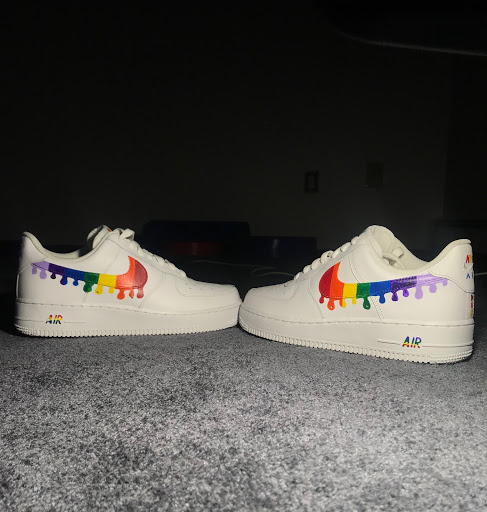
I began by starting an Instagram account (@first_soup_productions) in order to easily communicate with customers. When someone was interested, they would directly message me with some general ideas.
(more…)


 LEO
LEO 