

Lindsay Nielsen Photography: Remarkable in the Unremarkable and Exceptional in the Unexceptional
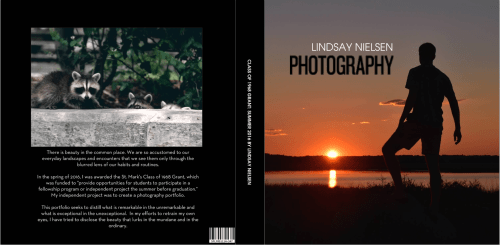 My first camera was a $200 Nikon Coolpix that I bought with all of my babysitting money the summer I turned 13. I had always loved photography and the idea of capturing moments we can’t get back. When I got older, I started watching Youtube videos and teaching myself how to take more advanced pictures. My mom was always asking me where her Canon DSLR was, because I would constantly borrow it to take photos of our two Vizslas. During sophomore year my godfather, Joseph Ratner, gave me his old Nikon D3100 and I was elated. It was my first serious camera, and I had every intention to make the most of it. Photography has always been a passion of mine and it was an amazing moment hearing that I was one of the recipients of the Class of 1968 Grant. I built this portfolio the summer after my junior year and I will continue to use my camera to capture everything around me.
The Individual’s Perception & “Knowing” God
By Lucy Cao, VI Form
The Individual’s Perception & “Knowing” God
The controversies over the existence of God or the validity of religious beliefs derive from a lack of tangible proof. Religious doctrines, unlike mathematical equations or scientific formulas, are usually proposed without a sequence of logical inferences backed up by repeated and consistent observations. Therefore, the question lingers whether a consensus is attainable among us regarding a universally accepted proof of a deity. My answer is no. Nevertheless, we can still know God. Religious and spiritual experiences rely on the self. The uniqueness of each individual’s perception of God makes it impossible to establish a defined path to the objective knowledge of God. However, we can know God through a subjective point of view, and the validity of the knowledge of God should not be diminished by its subjective nature. (more…)

Maturity and Youth: Connection in “For Esme, with Love and Squalor”
By: Helynna Lin, V Form
Maturity and Youth: Connection in “For Esme, with Love and Squalor”
In J.D.Salinger’s novel, The Catcher in the Rye, the rebellious teenage protagonist, Holden Caulfield, leaves school and wanders in New York City, trying to resolve his hatred towards the ingenuine, superficial adult world and his nostalgia of youthful innocence. The theme, conflict between youth and maturity, is continued in Salinger’s short story, “For Esme, with Love and Squalor.” The story takes place in an English town where American soldier Sergeant X prepares himself for battle and meets Esme, a 13-year-old girl who has recently lost her parents in war. They have a good conversation, at the end of which they promise each other to exchange letters. After D-Day, Sergeant X experiences a mental breakdown and loses the courage to live, but the arrival of Esme’s letter brings him strength to continue living. In this story, the wartime and battlefield are representative of the dark sides of society, and the two characters are symbols of adults and adolescents. By describing the connection between Esme and Sergeant X, Salinger proposes that youth and maturity can resolve one another’s struggles and fight against the downsides of society. (more…)

Striving for a Cure at the Ben Towne Center for Childhood Cancer Research
By Katie Hartigan, VI Form
Striving for a Cure at the Ben Towne Center for Childhood Cancer Research

As my eyes scanned the people seated at the conference table around me, I admired each one of them immensely. To know that I was sitting in a lab meeting with the faces behind the statistic “93% remission rate for children with acute lymphoblastic leukemia” was astonishing to me. I stared up at the projector screen taking in the jargon that I partially understood, trying to decipher each scientific discovery and hoping that one day my name too would follow some great breakthrough displayed on a similar projector screen.
In the spring of my junior year, I was selected to travel to Seattle that upcoming August to work at the Ben Towne Center for Childhood Cancer Research at the Seattle Children’s Research Institute. (more…)

The Mask: Art Inspired By The Loss of My Grandfather
By U Jin Jo, IV Form
The Mask: Art Inspired By The Loss of My Grandfather
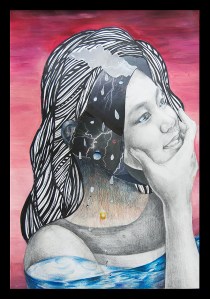 “Do you ever wish you could just take off your mask and show people what is going on inside of you?”
I have been asked this question multiple times before. However, I never really understood what it meant before I experienced the death of someone whom I loved. In fact, his absence is still hard to believe today.
My grandfather – my best friend, my mentor, my everything – passed away two years ago when I was in 7th grade. The pain of the loss was unbearable for my 13-year-old self. However, having to tough through each day of school, I maintained the bright smile on my visage and carried my sadness within me. Day after day, I became more tired of burying my feelings inside. Eventually, I could no longer hold back the tears that flooded inside of me. I needed to show people what was going inside of U Jin Jo.
For this piece of art, I wanted the background to be important without having too much information because I wanted the focus to be on the inside. Hence, I used red acrylic paint and created a gradation behind the person. For the hair, I used a black felt-tip pen for the hair-like patterns. Under the mask of the girl, I wanted the section to express an entirely different feeling than the rest of the page because it is the focus of this piece. I looked through fashion magazines and cut out images of thunderstorms, clouds, and tears to create an ominous collage. Everything else was done in pencil. (more…)

La Crise des Réfugiés: Une Comparaison
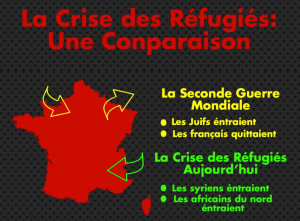 that makes a comparison between the refugee crisis during and after the second world war and the current crisis in 2016. You may identify some guiding questions of your own.”
The Future of Libraries and the St. Mark’s Library
By Coco Zephir, Head Librarian
The Future of Libraries and the St. Mark’s Library
 Libraries are ever changing in both form and function. One aspect currently at the center of library innovation is user-experience (UX). UX focuses on meeting the needs of patrons to improve their experiences by making them more impactful and meaningful. UX is a reiterative process that involves constant conversation with your community. Libraries using UX are implementing human-centered design, or design thinking, to better understand their patron base. Human-centered design, “focuses on defining and then resolving concerns by paying attention to the needs, aspirations, and wishes of people” (Peet 2016). (more…)

Get Well Soon: Dialogue in the Style of Hemingway’s “Hills Like White Elephants”
By Mei Mei Arms, IV Form
Get Well Soon: Dialogue in the Style of Hemingway’s “Hills Like White Elephants”
Editor’s Note: The purpose of this creative writing assignment in IV Form Writing Workshop was to build a better comprehension of implicit and explicit facts in writing pieces and to become acquainted with a specific creative writing style. Students chose to emulate the writing style of one of three short stories read in class: “Harrison Bergeron,” “Hills like White Elephants,” or “Cathedral”. Students were expected to employ the same literary devices that the authors of the original short stories used. Those who chose to imitate “Hills like White Elephants” were expected to convey a message without directly stating it.
The room held flowers, cards, balloons, bears, and stale air. The flowers had long since lost their sweet aroma to the cruel hands of time. Cards sat unread. Those shiny stiff “get well soon” balloons still bobbed halfheartedly in a corner by a window. Along the bed sat bears, tens of them, their kind bead eyes meant to make you feel some sort of happy, but were left collecting dust with (more…)



 LEO
LEO 