

Dodge Poetry Festival Reflection: She Felt (x-Prosaic-x) Poetic
By Anuoluwa Akibu, V Form
Dodge Poetry Festival Reflection: She Felt Prosaic Poetic
On October 18, 2018, she came in wanting to improve her poetry. She felt prosaic. However, to her surprise, she entered a world far more different than she envisioned, a world of discussion rather than lecture, of insight rather than instruction. Instead of organized workshops to scrutinize her work in, she was given a program complete with introductory statements of the poets and a schedule of the events, the venues in which they were held, and the attending poets and the freedom to choose what she attended.
Prior to the Dodge Poetry Festival, she simply felt uncomfortable with her poetry, as she could not identify her voice in it. She forced strange words on a paper for outward validation and ignored her internal articulation. Her so-called “self-expression” was, in truth, silencing her. This was weird for her because creative writing has always been one of her passions, yet she was creating barriers between it and herself.
Of course, her voice was not entirely lost, but the Dodge Poetry Festival was an opening to an overcoming of this feeling of mediocrity, and she wasn’t disappointed. (more…)

What My Brain Learned via the Dissection of Another
By Julian Yang, V Form
What My Brain Learned via the Dissection of Another
Before walking into class on Monday, I was filled with curiosity and excitement. It has been six years since I saw an 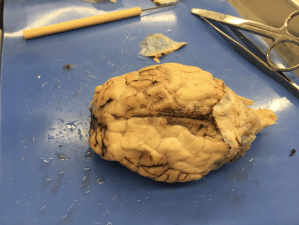 actual brain, and I was barely engaged at that time – although there was a parent who worked with brains and explained the information to us, no actual dissection was involved. The closest I got was holding the brain in my hand
My anticipation began to build during the “instructing” phase. Two feelings stirred inside me: one, I would be able to see everything that I learned in the past two weeks, and two, I was going to feel like a surgeon while using the scalpel. I made sure, however, to be careful: the way it sliced during Ms. Lohwater’s demonstration was enough to curb my excitement. (more…)

The Bastion of Childhood: Belknap Camp
By Tom Paugh, VI Form
The Bastion of Childhood: Belknap Camp
 Attending summer camp on the shores of Lake Winnipesaukee has been a consistent source of joy in my life. Just as King Arthur relied on Camelot to protect him from forces of evil, I have had Camp Belknap a bastion that protected my childhood development from the judgments and cruelties of the greater world. At times, camp feels to be surrounded by a force field that prohibits all malice from the outside world from invading camp. Camp has provided me with a supportive environment and the ability to grow up in a safe environment, as I have spent nearly half of my life under the pines. During my time at my Camelot, I have transitioned from camper to a member of the leadership, learning incredibly powerful lessons that transcend daily athletic and creative activities. (more…)

Post-Apocalyptic Literature Discussion Posts
By CJ Schumacher, Lucy Zheng, Stephanie Moon, and Robby Harper, VI Form
Post-Apocalyptic Literature Discussion Posts
Editor’s Note: This explanation is about “E-Portfolio and/or Discussion” posts in Ms. Hultin’s VI Form elective, The Dystopian Flood: Post-Apocalyptic Literature–“Posts are due every week or two weeks. Posts must be typed, relatively error-free, and published on your Google Sites E-portfolio or Canvas discussion page. Each post should be a minimum of 300 words. Occasionally, E-portfolio assignments will have more specific instructions. In these assignments, your answer should explore and analyze the material from class. E-portfolio posts are thoughtful, but informal responses that demonstrate your thinking on a topic.”
CJ
Robots are either created to serve humans or to emulate them. They are meant to either be companions or house maids. In “Robbie,” Robbie is created to serve, but he ends up proving that despite his lack of human characteristics; he is equally human in terms of human connection. After being thrown away by the Weston family, he risks his life to save Gloria, his only friend. Just because Robbie cannot talk does not mean he is unable to form human connections or have emotions. Ex Machina tells a different tale. Ava is the closest thing to artificial intelligence and is built to be the next evolution of the human race. However, her own genius is what keeps her from forming human connection. She is too smart to see forming an emotional connection as important. Ava manipulates Caleb into feeling as if he is forming a real connection with her. She gets him to tell her personal things about himself and shows him interest and care, which in turn gets Caleb to fall for the idea that he and Ava have a genuine connection. However, Ava abuses Caleb’s trust and uses him to help her escape and subsequently kill her creator. She leaves Caleb locked away, desperately picking up the broken pieces of his heart. In this story, Ava abuses the human need for connection for her own benefit. (more…)

The Epistemological Theories of Descartes, Hume, and Kant As Well as The Implications for the Existence of God
By Lora Xie, V Form
The Epistemological Theories of Descartes, Hume, and Kant As Well as The Implications for the Existence of God
Editor’s Note: This is the assignment from the Advanced Religion course–“In whatever way is most helpful to you (prose, outline, diagram, drawing), tell the story of Descartes’ Rationalism, Hume’s Skepticism, and the Kantian synthesis. You will share this in class and also hand it in. You will be graded both on the effectiveness of your method and on your evident understanding.

Click on this Image to Enter Slideshow!
Link to Slideshow:
https://docs.google.com/presentation/d/1-usiBKsrTmdWRX_Zzk1GDdzXFtaOc_NWRJnUj4Nqwd4/edit?ts=5bc653e0#slide=id.g43a807e277_0_746 (more…)

Delinquency: It Comes from Within (Rebel without a Cause Juxtaposed with Cycle of Outrage)
By Matt Walsh, VI Form
Delinquency: It Comes from Within (Rebel without a Cause Juxtaposed with Cycle of Outrage)
Although its production was fraught with promiscuity, Nicholas Ray’s Rebel Without a Cause promotes a moralistic Cold War agenda. Protagonist Jim Stark, portrayed by James Dean, is a new kid in town with a history of delinquency. Because his parents struggle to exert authority over Jim and are quick to forgive him for his wrongdoing, Jim, albeit well-intentioned, finds himself associated with a group of delinquents. Included in the group is Judy, a sixteen-year-old girl whose misbehavior is driven by her father’s reluctance to reciprocate her love for him. Jim also develops a friendship with Plato, whose absent parents make him the most delinquent of the three protagonists. Rebel Without a Cause blames their misbehavior on their lack of emotional connection with their respective parents, and likewise, James Gilbert’s 1986 book A Cycle of Outrage suggests that many Americans viewed a stable domestic setting as the panacea for all forms of juvenile delinquency. Nonetheless, the film Rebel Without a Cause suggests that only emotional connections between children and parents can curb the epidemic of juvenile delinquency whereas A Cycle of Outrage suggests that the public viewed delinquency as an epidemic that originated outside of the family. (more…)

Cerberus: In Dramatic, Dark Lines for Studio Art
By Helen Huang, V Form
Cerberus: In Dramatic, Dark Lines for Studio Art
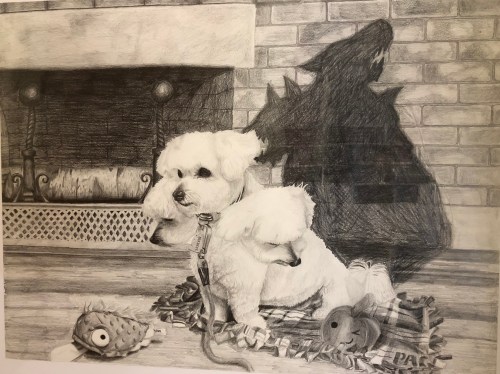 This pencil drawing is one of many pieces I am making for my concentration in Studio III. In my concentration, I am focusing on mythical creatures in the modern world. For this particular piece, I chose the idea of drawing the Greek mythological creature, Cerberus, but with a modern twist. I made the dog cute and fluffy and set him on a soft blanket with his toys near a fireplace. I wanted to make the whole composition seem cozy and welcoming, which is the opposite of what Cerberus in Greek mythology is like. The shadow of the dog, drawn with dramatic, harsh lines, is a reference to the true nature of Cerberus: scary and foreboding, which contrasts with the cuteness of the dog, drawn with soft, careful lines. I purposely chose this composition because I wanted to show that mythical creatures can evolve into what we want to see them as. Personally, I enjoy the idea of having a cute three-headed dog rather than a scary one, and therefore in my perspective, Cerberus looks like the dog in the piece. (more…)

The Islamic Art of the Calligraphic Manuscript By Muhammad Taqi (1695)
By Jenny Tang, V Form
The Islamic Art of the Calligraphic Manuscript By Muhammad Taqi (1695)
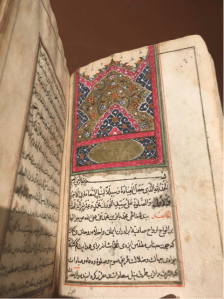 Most people, upon hearing art, think of visuals. They recall famous paintings and sculpture. Art, however, has many more facets. Islam, for instance, regards calligraphy and book-making
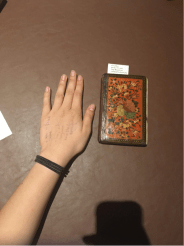
as the highest form of art. For this reason, a calligraphic manuscript was chosen for this assignment. The manuscript also presents visual elements worth studying. The piece is created by Muhammad Taqi in Persia of 1695 during the era of the Safavid Empire. It is stored in Carnegie Mellon University’s rare books collection. The manuscript has a floral painting cover, a first-page design, and calligraphy. It contains namaz (daily prayers) and verses for Ramadan (the Month of Fasting) written in Arabic[1]. Given its size of 13 by 9 by 1.3 cm, it was probably carried around for prayers. The calligraphic manuscript exemplifies Islamic art by using the elements of floral arabesque, geometry, and calligraphy. Analyzing the manuscript unveils Islamic art’s root in both religion and secular, global influences. (more…)



 LEO
LEO 