

Alternative Transformations in “Venus and Adonis”
By Tate Frederick, VI Form
Alternative Transformations in Venus and Adonis
The transformations within the story of Venus and Adonis represent multiple characters straying from traditional stereotypes. While traditional Ovidian transformations are included in the story, such as Adonis becoming a flower and Atalanta and Hippomenes morphing into lions, the most significant transformations occur when the characters deviate from the way their gender is typically perceived in Roman culture. Inclusion of these interesting character transformations also offers a new perspective on the division and dynamic of power within this story. These special kinds of transformations occur when Venus becomes a hunter and when Atalanta takes control of her own fate.
It is Adonis’ status as a hunter that convinces Venus to transform into a different version of herself so that she can spend as much time with him as possible; this metamorphosis turns Venus into a fierce hunter, which is antithetical to the Venus that the audience would expect. Since Venus is captivated by him, and more specifically his beauty, she knows she will have to sacrifice some of the practices and qualities she has grown accustomed to. For example, Venus is used to staying in the shade to avoid tan skin, which is considered less beautiful, as well as increasing and cultivating her own beauty, or maintaining a plumper figure, which is also considered the ideal image: “adsuetaque semper in umbra indulgere sibi formamque augere colendo” (10.534-5). Following her infatuation with Adonis caused by Cupid’s arrow, Venus is willing to change the location of her usual haunts and her appearance despite her previous values, such as traditional beauty, in order to best suit herself to be a hunter. This new persona best equips her to spend her days with Adonis. She prepares to have tanned skin and a slimmer, more athletic figure.
(more…)
The Fight Club Path
By Sydni Williams, V Form
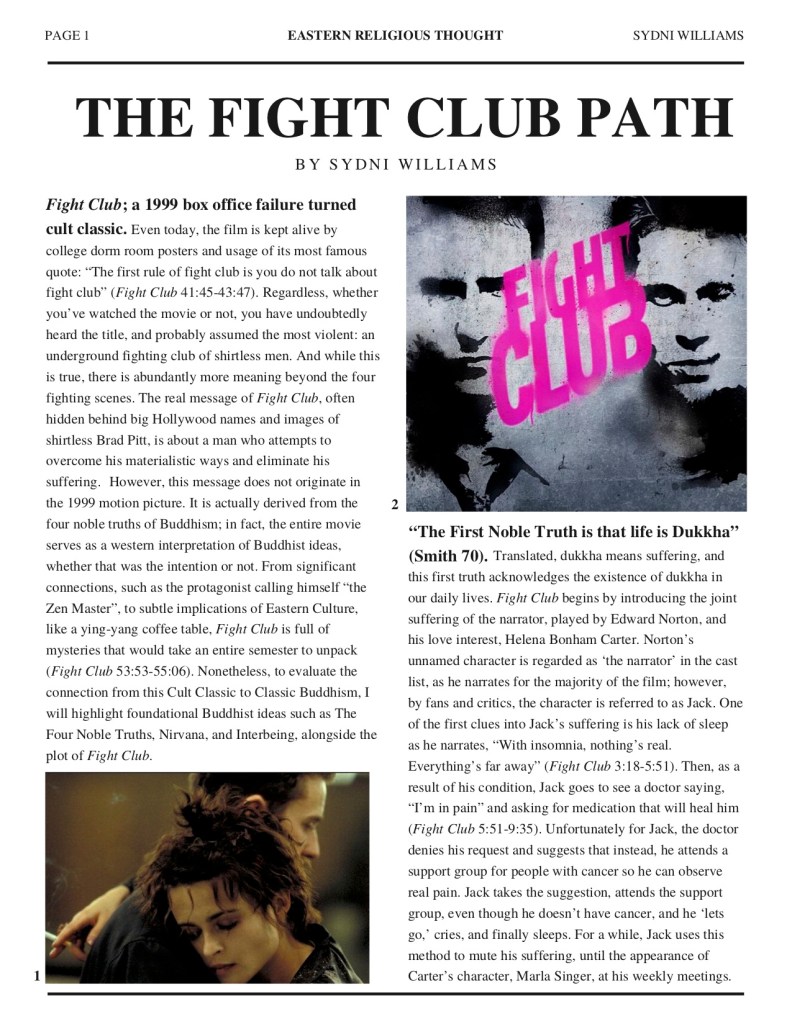
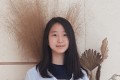
The Fight Club Path
Once Home, Always Home
By Sua Yoo, III Form
Once Home, Always Home
The day was hectic. After spending half of the afternoon in the shopping mall looking for a neat set of clothes, I had to dig around the house to pack the luggage in preparation for a two-month-long stay. I should have felt no burden since I was lucky enough to move to the United States in the middle of a chaotic pandemic. Yet, exhaustion conquered excitement; the whole new life that kept me awake for weeks was blocked by immediate tiredness, and the only wish I had in my mind was to stop thinking about all that I have been through.
As I frantically searched my closet, what instantly came into my sight was not the packing list I had in hand, but the NLCS school uniform that I had been wearing for the past four years. It was signed with at least a dozen handwritten messages from the people who were once precious to me. Peering at each mark on the shirt, I recalled which was made by whom, what that person meant to me, and what kind of person I was to them. Throughout my time atmy old school, NLCS Jeju, I was constantly influenced by the community there and the relationships I formed.
(more…)
Minecraft St. Mark’s: An Engineering Final Project
By Blake Gattuso, Nate King, Aditya Mynampaty, William Osborne, VI Form; and Tommy Flathers, V Form
Minecraft St. Mark’s: An Engineering Final Project
Minecraft. What was once just a video game to us became this Engineering team’s means of production due to the COVID-19 pandemic. The original goal of our group was to build a platform (Image 1) through the Cross Country team’s “Grove of Champions.” It would encourage spectators to make the hike into the course and allow them plenty of space to stay out of the way of the race while also providing a great, elevated place to take pictures of the runners. We went to work designing the platform, buying the materials, and we finished construction of the deck’s main frame; we expected to finish our observation platform once we returned from March Break. COVID-19, however, interrupted our plans. As we could no longer congregate at school, we did what engineers do and looked for another solution. Could we build the deck virtually?
(more…)
“Waves”: A Short Story
By Yevheniia Dubrova, VI Form
“Waves”: A Short Story
Editor’s Note: The following short story was submitted as a final project in “The Rise of the Short Story: Creative Short Fiction Writing.”
Before Pat was born, my mother and I used to talk. She let me sleep in her bed when dad worked night shifts, and although I never really understood what his job was, I knew it was some kind of important thing because he worked a lot, and that says something. It didn’t bother me much back then, and sometimes, I even wished he would stay at work more often so that I could sleep at my mom’s. She left orange peels on her nightstand until they dried out and wrinkled up. My dad would say they look like pork rinds and throw them away, but it smelled like Christmas, and I liked it. Her bed was solid and soft at the same time, and I swear I could drown in her heavy blankets and crisp linens. We rarely cuddled — mom doesn’t like cuddling — but she talked to me about all sorts of things, and her voice would always put me to sleep, even though I tried to stay awake for as long as possible to listen to her some more.
She didn’t talk much about her youth, except for that one time she told me about finding her mother’s book on childbirth. She saw the pictures. The pictures must have made a lasting impression on my mom because she swore to never have a baby. I asked her if the real thing was as bad as the pictures. She said if she had known it would be that bad, she would never have had me in the first place. She then brushed my hair with her fingers and said she was glad she had me after all, but that birth thing was really bad.
“Can you imagine? All that pain and blood? And with a head like yours… Oh, sweet Jesus Christ, I thought you were going to rip my hips apart!”
(more…)
Classical Diploma Mosaics
By Illia Rebechar and Emily Taylor, VI Form
Classical Diploma Mosaics
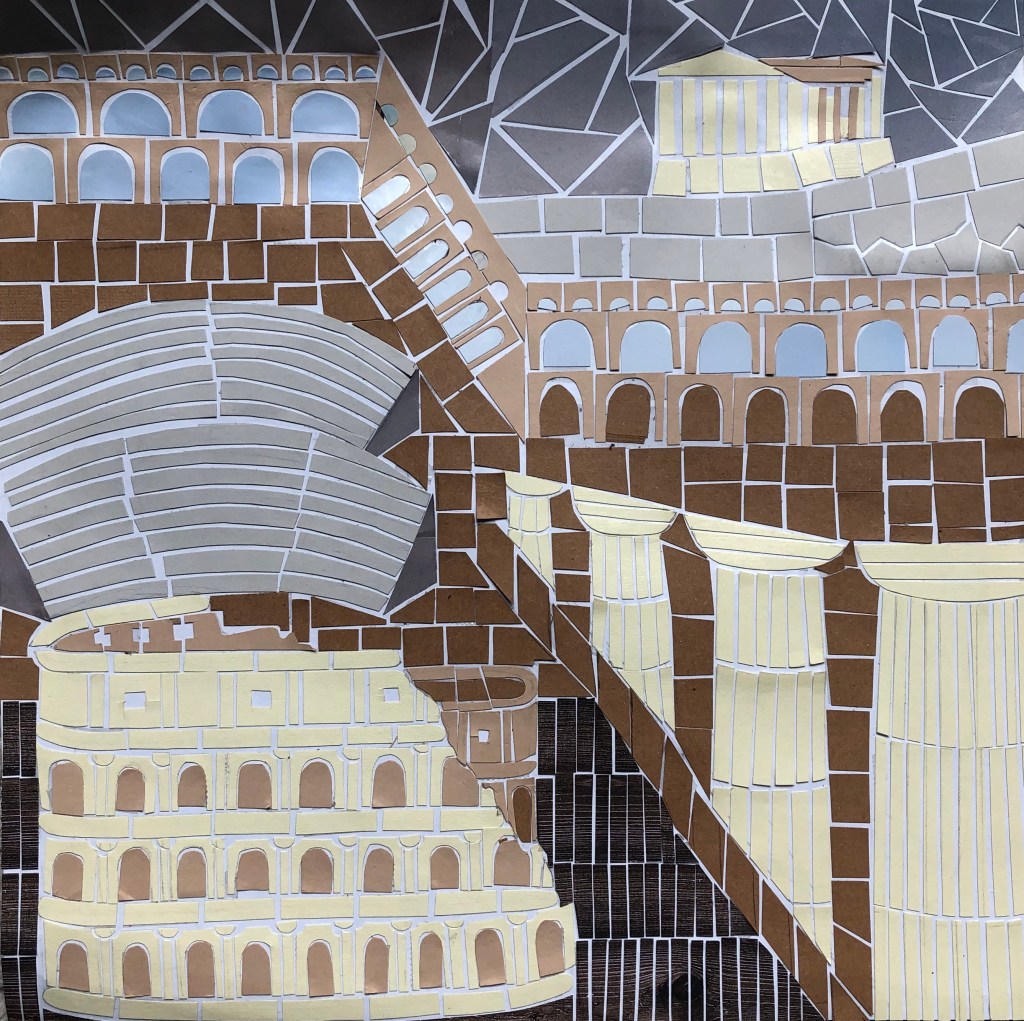
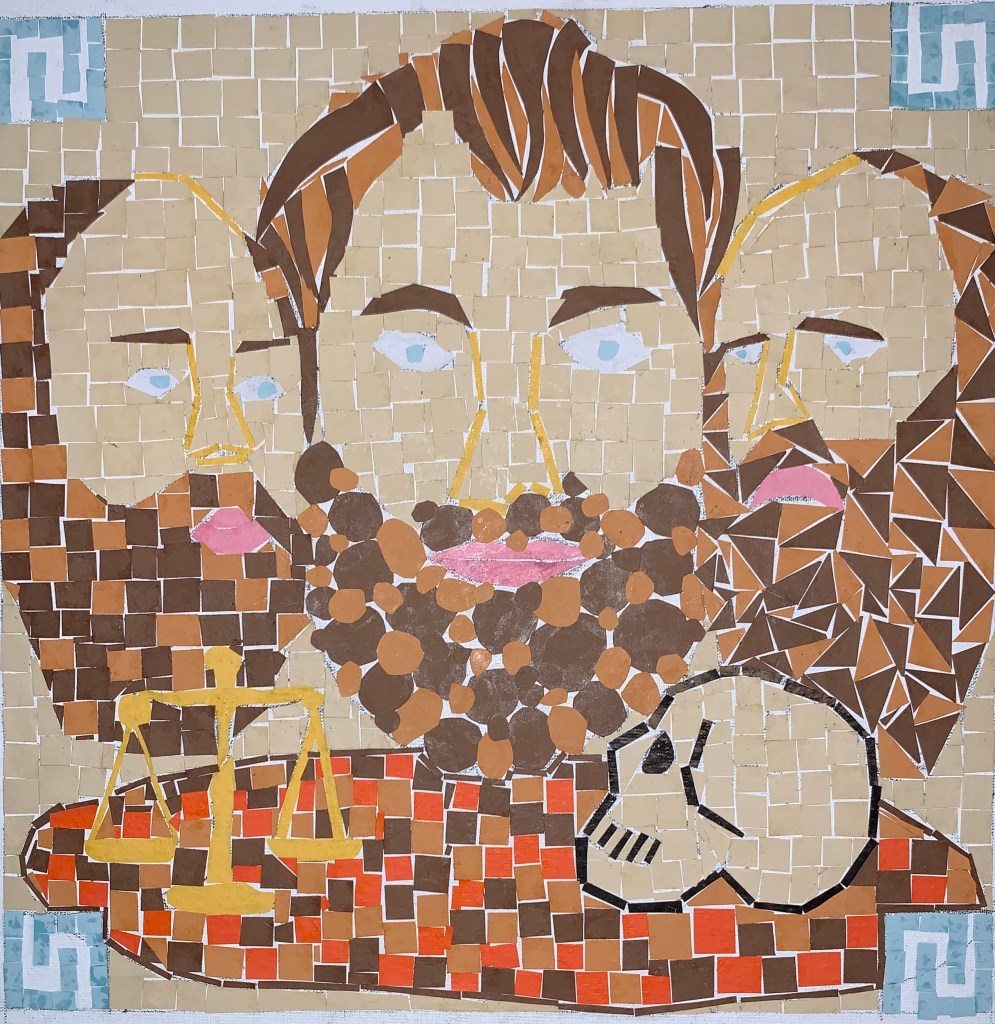
Note: Each year students who are taking Greek II and have also taken three years of Latin work together throughout the spring to present a project at the end of the year to receive their Classical Diplomas. This year the project was driven by the question: How is the study of Classical languages and cultures still relevant to the 21st-century learner? Students worked through rounds of brainstorming over Zoom and ultimately ended with a project that would use a classical art form, mosaic pieces, to communicate the relevance of classical influences all around us.
The Impact of Black Sesame Pigment on Drosophila Melanogaster with Alzheimer’s Disease
By Ally Bauer, VI Form
The Impact of Black Sesame Pigment on Drosophila Melanogaster with Alzheimer’s Disease
My project for the STEM Fellowship was studying the impact of black sesame pigment on drosophila melanogaster with Alzheimer’s disease. Alzheimer’s Disease is a neurodegenerative disease that affects over 44 million people worldwide. One of the hallmarks of Alzheimer’s Disease are amyloid-beta plaques that form in between the neurons and disrupt cell communication and function. Black sesame pigment, derived from black sesame seeds, has been proven to reduce the aggregation of these plaques in vitro studies. Drosophila melanogaster, or fruit flies, are wonderful model organisms that are utilized for their quick reproduction rate, easily manipulated genome, and the relation its genome has with humans. For my experiment, I was able to track the progression of memory loss in flies with Alzheimer’s disease. I had multiple groups to show me if greater concentrations of black sesame pigment would slow the progression of memory loss in the flies. Although the results of the experiment proved my null hypothesis to be correct, I now have a greater understanding of Alzheimer’s Disease, the scientific method, and having control over what I learn and how I learn it. I am incredibly grateful for Ms. Lohwater, Mr. Loomer, Mr. Valitutto, and the five other STEM Fellows who have mentored me, shaped my project, and problem solve throughout the year.

The Journey: Structuring Travel Between Limol and Daru, An Advanced Studies in Global Citizenship Capstone
By Illia Rebechar, Kian Sahani, Naila Strong, VI Form; and Lina Zhang, V Form
The Journey: Structuring Travel Between Limol and Daru, An Advanced Studies in Global Citizenship Capstone
Note: This capstone was completed for Advanced Studies in Global Citizenship, a course required for completion of a Global Citizenship Diploma.
The capstone project assigned to the class was presented as an opportunity to develop an “empathetic response to a global challenge.” Our group, made up of Illia Rebechar, Kian Sahani, Naila Strong, and Lina Zhang, focused particularly on Papua New Guinea, and we looked into health and healthcare as our challenge. In order to build upon our culturally-relative mindsets, we had to move through the project using the design thinking process. This was comprised of five fluid steps: empathize, define, ideate, prototype, and test. Due to the limits of COVID-19, we were unable to “test” our prototype. We were able to learn more about Papua New Guinea and approach challenges we are not familiar with.



 LEO
LEO 