
Home » Posts tagged 'Research' (Page 4)
Tag Archives: Research

CAR T Cell–Giving Cancer Patients New Hope
By Grant Gattuso and Frank Hua, VI Form
CAR T Cell–Giving Cancer Patients New Hope
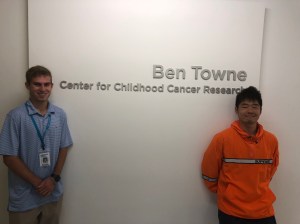 This past summer we had the opportunity to work in a cancer research lab in Seattle for four weeks— a very unique experience, especially for high schoolers. We worked in Dr. Michael Jensen’s ‘82 lab in the Ben Towne Center For Childhood Cancer Research, which is affiliated with Seattle Children’s Hospital. The lab focuses on CAR T Cell, a immunotherapy that gives cancer patients a new hope. (more…)

Autism-Vaccine Controversy: Video
By Izzy Kim & Riya Shankar, VI Form and Haley Dion & Laura Drepanos, V Form
Autism-Vaccine Controversy: Video
Editors’ Note: In Advanced Biology, students were encouraged to tell the story that they felt compelled to relate about their Public Health issue (click here for assignment). In this video, the students integrated a given Case Study with relevant information gathered through independent research. Their integration of the Case Study with additional research reflects an advanced understanding of, and ability to convey, scientific content.
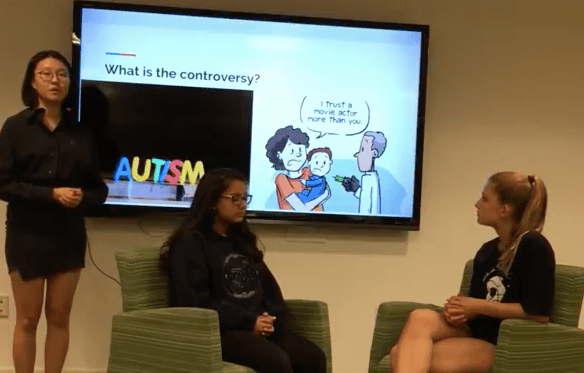
Click on Image for Video

Autonomous Navigation and Decision-Making Process Using Machine and Deep Learning
By Jeongyong Chris Yang, VI Form
Autonomous Navigation and Decision-Making Process Using Machine Learning and Deep Learning
Abstract
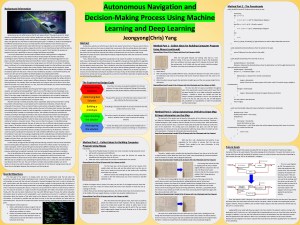
Please click the image to download/see the poster. Zoom in to read specifics.
Autonomous vehicles are self-driving cars that do not require human drivers. They use sensors that are attached to the vehicle as their vision to detect their environment. After the vehicle detects other objects or signals, computer programming (coding) allows them to react to the situations adaptively. Even though the sensors do not need to be improved, the millions of situations the cars can face on roads create difficulties for people to build a sophisticated computer program that makes the autonomous vehicles completely safe on roads.
First, I decided to build an algorithm pseudocode to help resolve this problem. During this process, I built mazes and followed the instructions based on the algorithm manually to check whether the algorithm is effective. I mainly used three different models for my mazes, each with different difficulty levels to ensure that the algorithm works every time. Then, I decided to record the information (velocity and displacement for both x and y directions) about the vehicle on the map so that the following vehicles can get a picture of the map automatically. However, if the subsequent vehicle detects a different or an altered map with its sensors, the new information will also be recorded on the map. Finally, the final vehicle will follow the path set by the first vehicle, but the map will guide the car with the most efficient path after completely learning and optimizing the possible paths.
Melatonin’s Effect on Learning and Memory in a Tauopathy Model of Alzheimer’s Disease in Drosophila melanogaster
By Sophie Haugen and Sada Nichols-Worley, VI Form
Melatonin’s Effect on Learning and Memory in a Tauopathy Model of Alzheimer’s Disease in Drosophila melanogaster
Abstract
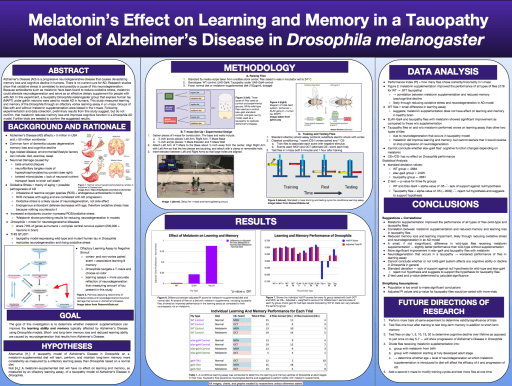
Alzheimer’s Disease (AD) is a progressive neurodegenerative disease that causes devastating memory loss and cognitive decline in humans. There is no current cure for AD. Research studies show that oxidative stress is correlated to and possibly a cause of this neurodegeneration. Because antioxidants such as melatonin have been found to reduce oxidative stress, melatonin could alleviate neurodegeneration and serve as an effective dietary supplement for people with with AD. In this experiment, a tauopathy Drosophila melanogaster group
Please click on the image to download/see the poster. Zoom in to read specifics.
that express human tau (MAPT) under gal4in neurons were used to model AD in humans. This study measured learning and memory of the Drosophila through an olfactory vortex learning assay in a t-maze. Groups of flies with and without melatonin supplementation were tested in the t-maze. Following experimentation and data collection, preliminary results from this study suggest, but do not confirm, that melatonin reduces memory loss and improves cognitive function in a Drosophila AD model. Further trials are needed to confirm the suggested results.
Click here for full LAB REPORT. (more…)
Constructing a Flowchart in Biology
By Amy Wang, V Form
Constructing a Flowchart in Biology
Editor’s Note: The following description of the assignment provided by Ms. Kimberly Berndt, STEM Faculty–
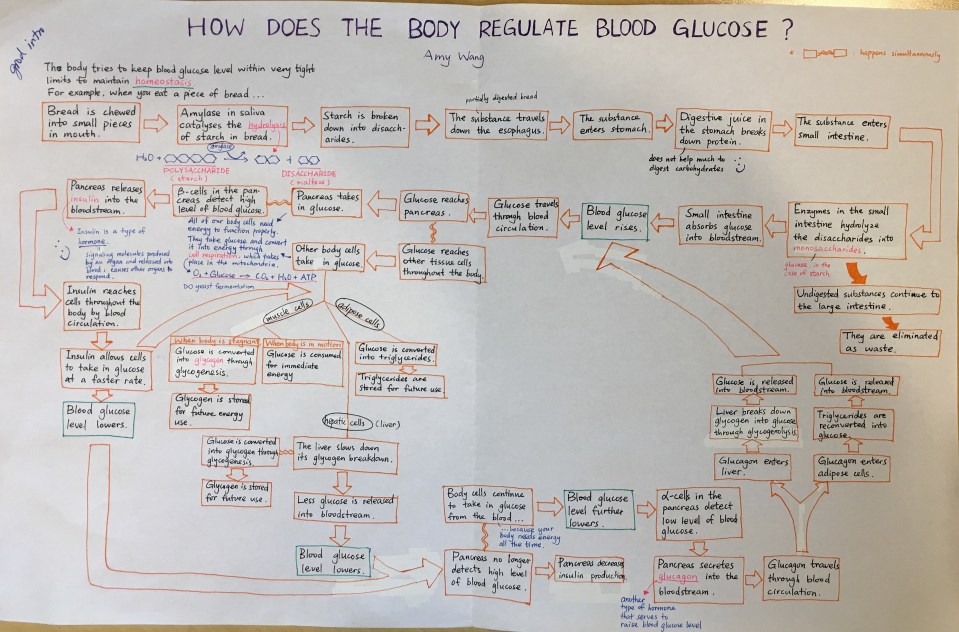
It can be challenging to understand the complex physiological mechanisms and pathways we explore in Biology. One effective strategy to synthesize, organize, and review information is through visual thinking. We employ visual thinking in a number of ways. In this assignment, students were charged with constructing a flowchart to illustrate their current understanding of how carbohydrates are metabolized.
An effective flowchart takes a complex process and simplifies it in a manner that makes the information more accessible. Flowcharts can be found in many Biology textbooks for this reason. However, the process of constructing a flowchart can be an even more effective tool for learning. Constructing a flowchart requires multiple intellectual tasks. (more…)

Words, Legacy, and Memory: What We Can Learn From the Inscriptions on Civil War Monuments
By Mo Liu and Katherine Wass, VI Form
Words, Legacy, and Memory: What We Can Learn From the Inscriptions on Civil War Monuments
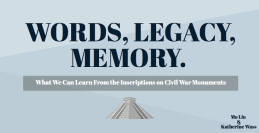
In the first month of History Research Fellowship, we looked at symbols and memories, specifically
Click image for full Piktochart
those tied to the Civil War. We were particularly drawn to the difference in sentiments in the North and the South in the decades following the end of the Civil War and how they are reflected in the monuments. With access to the 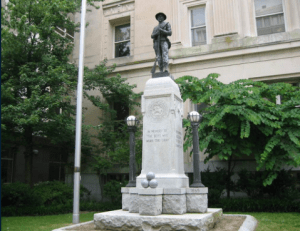 monument database in Maine and North Carolina, we picked these two states to be the representative of the Union and the Confederacy, respectively.
Katherine and Mo’s fullInfographic can be found here (more…)

Words, Words, Words
By Mr. Jonathan Golden, Systems and Information Services Librarian
Words, Words, Words
I love words. What’s not to love?
It’s amazing to think that nearly the totality of human knowledge and understanding is expressed through a set of squiggles. What’s even more amazing is that each of us, every day, hears or reads sentences that we’ve never heard or read before and we are able to understand them.
Come to the library and pick a random book, flip to a random page, and read a random sentence. Ludwig  Wittgenstein did not hold words in such high esteem. He argued that words merely express facts and are therefore devoid of any sort of value. Everything other than facts, everything that we care about, and everything that makes life worth living must exist outside of language. Language, according to Wittgenstein, is insufficient to capture the meaning outside of pure facts. He concludes his famous Tractatus Logico-Philosophicus with the statement, “Whereof one cannot speak, thereof one must be silent.” It’s hard to take a bleaker view on words.

I Built a Canoe!
By Reily Scott, III Form
I Built a Canoe!
Over the summer, I ordered some blueprints, bought some wood, and started on my
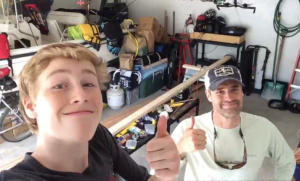
Click the image for a time-lapse video of the project!
seventy-hour journey to buoyancy. For the past three summers, I have built something alongside my dad. Projects have varied from a toolbox to a blacksmith forge. I knew I wanted to build something, so I looked online, but nothing inspired me. After some deep thinking, I decided that my solution should consist of something with fishing because of my dad; oh, and I love the joy of using dangerous power tools! My dad and I searched online for unique canoes that we could construct. Eventually, we came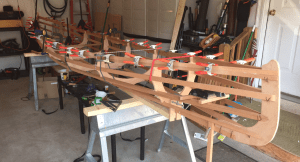 upon a method known as “skin on frame”. This method helped Eskimos construct their boats. Basically, it consists of a seal skin pulled tightly over a wooden frame. Since we were not planning to go to the top or bottom of the world to hunt and skin a seal, we purchased a small tarp of polyester in substitution. (more…)


 LEO
LEO 