
Home » Posts tagged 'Independent Projects' (Page 6)
Tag Archives: Independent Projects

STEM Fellows: Fragile X Syndrome in Fruit Flies
By Jenny Deveaux and Samantha Sarafin, VI Form
Peripheral Nervous System Deficits and Social Behavior in Drosophila FMR1 Mutants
1.1 Abstract
Click here to view full size of poster
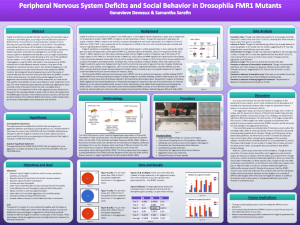
Fragile X syndrome is a genetic disorder caused by a trinucleotide repeat mutation in the FMR1 gene, occurring in one in 4,000 males and one in 8,000 females. The syndrome is characterized by a variety of social, learning, and cognitive deficits specific to each patient. The pathways surrounding the expression of the fragile X phenotype are largely unknown, and there is no current treatment for the disorder. Numerous studies have been conducted to investigate the role of the central nervous system in developmental disorders such as Fragile X Syndrome; however, there is a lack of studies focusing on the role of the peripheral nervous system. In our study, we developed a line of Drosophila melanogaster, using the GAL4-UAS system, that expresses the dFMR1 mutation only in the olfactory sensory neurons, a vital part of the Drosophila’s peripheral nervous system. We conducted aggression and courtship assays to test the social behavior of the peripheral dFMR1 mutants. We compared these behavioral results with the results of control wild-type flies and with Drosophila that have the dFMR1 mutation in their entire anatomy. Our preliminary results suggest that both aggression and courtship should be further researched, as it was found that specific characteristics of each social behavior were impaired in some way. The most noteworthy data that was collected was significantly lower courtship index in the experimental line and a complete lack of dominance of the experimental line in the aggression assay. Because the Drosophila that were genetically crossed using the GAL4-UAS system had the dFMR1 gene silenced in their olfactory sensory neurons, the flies had an abnormality in their ability to detect pheromones, which studies show are the basis of Drosophila social interaction and behavior. (more…)

Artifact of Learning: What Is Cancer?
By Gillian Yue, V Form
Artifact of Learning: What Is Cancer?
Editor’s Note: This video is from the following assignment in Advanced Biology—
Click Image for Video
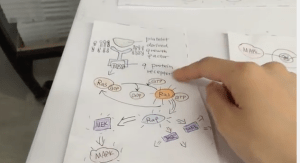
Charge: Create an Artifact of Learning* that will clearly explain to someone not in this class: What is Cancer? And How Does it Arise? Your artifact should synthesize the content from this unit (DNA Structure & Replication, The Cell Cycle, Mitosis & Cytokinesis, and Control of the Cell Cycle), as well as integrate new information that you have researched to better make sense of this disease. Your answer should not be a review of EVERYTHING examined; rather you should selectively integrate elements of each topic that help to explain what cancer is and how it arises. Note: This assignment does not ask – how do we treat cancer, detect cancer, prevent cancer, etc. Simply – What is Cancer?
Click here for video.
*Scroll to bottom for definition of an “Artifact of Learning” (more…)

Letter to the Editor: Native American Policy
By Mo Liu and Jamie Lance, V Form
Letter to the Editor: Native American Policy
Dear Editor Jackson,
It occurs to me that there is much attention raised among the general public regarding our government’s policy towards Indians, and therefore in writing to you, I, as a member of the Board of Indian Commissioners, want to clarify my position. Indians cannot be entirely excluded from our picture as a nation. However, the Indian society is not a cultivated society likes ours. One of my colleagues, who is experienced with Indian affairs and always provides us with elaborate information about the Indians, says their tribes are corrupted by “idleness, improvidence, and indebtedness”. The lack of private property or land and the underdevelopment of laws mark the Indian society as barbarous and inferior to ours. Because of this difference, since 1871 Indian tribes are no longer considered sovereign nations. Governments before us circumvented the Indian dilemma by relocating and establishing reservations west to the Mississippi River, yet now with a closed frontier and western migration, conflicts between settlers and the Indians are inevitable. The issue is pressing. (more…)

Math Modeling: Using Math for Flight Path Safety
By Kate Sotir, Cooper Sarafin, Anderson Fan, Shep Green, VI Form and Mo Liu, V Form
Math Modeling: Using Math for Flight Path Safety
Part 1:
The problem at hand is to create a model, a rating system, that would inform potential flyers of the safety of a particular flight. Our solution includes a mathematical equation that gives us a number between 1 and 100, depending on the inputs. Although the values themselves indicate the safety level of flights, we do not want to our audience to read into the numbers: a flight with a safety index of 63 should not be considered a more dangerous flight than a flight with a safety index of 67. Therefore, to make our model directly presentable to our audience, we classified the possible outcomes into ratings. A safety index ranges from 1 to 20 would have a rating of ★, from 20 to 40 would have ★★, 40 to 60 would be ★★★, 60 to 80 ★★★★, and finally, 80 to 100 would have the highest rating of ★★★★★, and flights that fall under this rating would be the safest choice based on our model. (more…)

Making a Change, Pint by Pint with a Blood Drive
By Jack Thalmann, V Form
Making a Change, Pint by Pint with a Blood Drive
Approximately every two seconds in the United States, someone needs a blood  transfusion, meaning that more than 36,000 donated pints of red blood cells are needed every day. This statistic surprised me last year when I was working on an assignment for Do The Right Thing, the sophomore core Saturday program. We had been assigned to create a mock advertisement about an organization that we believed was important. I chose to research blood drives, incorporating facts that I researched into an advertisement that I hoped would catch a viewer’s attention. The mere daily amount of blood needed was enough to shock me, because a person is only allowed to donate blood every two months. Therefore, to reach the amount needed daily amount, 13,140,000 donated pints are required every year. This comes out to be the equivalent of 2,190,000 citizens of the United States donating blood every time they are eligible: 6 times a year. (more…)

World War I Primary Sources Collection at the Library
By Marion Donovan, Assistant Librarian
World War I Primary Sources Collection at the Library
As a librarian at St. Mark’s this fall, I have begun to “weed” through our history collection and have taken a deep dive into time travel. In the past, I was a history teacher myself, so the primary sources that bring the past to life call out to me. A particular section in the library especially rich in those sources covers World War I. Both of my grandfathers fought in WWI on the Allied side, one as a doctor and the other as an engineer, so I grew up with stories and artifacts of “The Great War,” as it was first known. When I applied to graduate school for history at the University of Chicago, I discovered that La Verne Noyes, an American inventor and manufacturer of agricultural equipment, book holders, and windmills, had left the bulk of his fortune to scholarships for Allied veterans of WWI and their direct descendants. These scholarships have now expanded to include 48 colleges. April 6, 2017 will be the one-hundredth anniversary of the United States’ entry into WWI. The European side of the war began in 1914, so many newspaper and magazine articles have already examined new and old perspectives on those events. More will be coming with April 6 in view. We at St. Mark’s are lucky to have an extensive collection of first-hand material (diaries, letters, memoirs, news reports, propaganda, art, photographs) from marshals and generals to privates and civilians on wide-ranging aspects of this war. (more…)

Competing in the FIRST Robotics Challenge
By Kate Sotir, VI Form
Competing in the FIRST Robotics Challenge
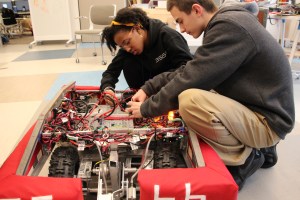
Working in the basement level of the STEM building, using lots of power tools, and occasionally throwing out words like “kickoff,” “drivetrain,” or “STEAMworks,” we are FIRST team 3566, also known as Gone Fishin’.
Gone Fishin’ competes in the FIRST Robotics Competition. FIRST stands for “For Inspiration and Recognition of Science and Technology.” The robotics competition, open to any high school student, was created in order to promote the STEM fields and offer a competitive yet collaborative atmosphere for robotics. In the FIRST Robotics Competition (FRC), teams are given a challenge, in the form of a game, and then have six weeks to build a 120 pound, $10,000 robot to meet this challenge. After those six weeks are up, teams compete in various regional events. The ultimate goal is to go to the world championship, held in St. Louis, where around 800 teams gather to play the game. (more…)

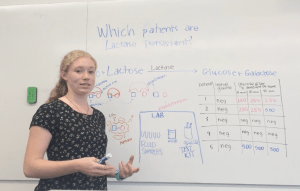
1-Take Video: Lactase Persistence
By Cordelia (Cricket) Dotson, V Form
Editor’s Note: The students were charged with designing an experiment to determine if five individuals were or were not lactose tolerant. After designing and completing the experiment they were given instructions on publishing the results in a 1-take video (instructions at bottom of the article).
Please click here or on the image below to see Cricket’s video on lactase persistence:


 LEO
LEO 