
Home » Posts tagged 'Chinese'
Tag Archives: Chinese
Faith and Negligence: Christian Perceptions and Interactions with Chinese Immigrants in 19th Century America
By Steven Zhang, VI Form
Faith and Negligence: Christian Perceptions and Interactions with Chinese Immigrants in 19th Century America
Editor’s Note: This paper was completed as a part of the History Research Fellowship, a one-semester course available to sixth form students.
Introduction
On one night in 1887 in San Jose, California, fires clawed at the sky. Smoke billowed from collapsing roofs of Chinatown apartments and stores, and winds sent trees into frenzies. Amidst this chaos, mothers, their clothes coated in ash, hustled their coughing children to safety. The origin of the fire, which uprooted the lives of approximately 1,400 Chinese residents, remained shrouded in mystery. However, clues to this destruction emerged in a solitary photograph that captured the aftermath of the devastation. In it, hundreds of white working men stood watching the destruction of one of San Jose’s Chinatowns (Figure 1).

Figure 1: The Burning of San Jose’s Chinatown
While the facts of this case are still obscure, the San Jose City Council a hundred years later would unanimously vote a resolution to apologize to Chinese immigrants and their descendants for the role the city played in “systemic and institutional racism, xenophobia, and discrimination.” Today such a terrifying act might be widely condemned, but at the time it was merely one of many incidents of anti-Chinese violence that went relatively unnoticed. In fact, the burning of San Jose Chinatown in history is often eclipsed by similar, anti-Chinese acts, such as the more devastating Santa Ana Chinatown fire. These incidents, lost in a history of anti-Chinese violence, marked the peak of hostility in the late 1800s.
(more…)Transpacific Scholars: A Journey Through the Boxer Indemnity
By: Daniel Guo, VI Form
Transpacific Scholars: A Journey Through the Boxer Indemnity
Editor’s Note: This paper was completed as part of a History Research Fellowship, a one-semester course available to sixth form students, where students write a historical research paper about their chosen topic.
Over the past two decades, the number of Chinese students in the United States has seen a remarkable surge, growing from a modest original number of around 20,000 students in 1991 to an enormous student body of more than 300,000 in 2021. Since 2009, Chinese students have consistently represented the highest portion of international students, making up nearly a third of all international students in American colleges and universities. These Chinese students choose to pursue a wide range of subjects and academic disciplines such as engineering, English, and law in the many different educational institutions that the United States offers, including prestigious universities such as Harvard and Yale. However, due to recent geopolitical tensions between China and the United States, the drive for Chinese students to study in the United States has diminished, with many turning to other prestigious schools in the United Kingdom and Europe instead.
This shift away from Chinese students in the United States is not just unique to the Chinese perspective: a Pew Research Center survey indicates that 55%, a majority of Americans surveyed, support limiting Chinese students studying in the United States. One in five Americans strongly supports limiting Chinese students in the United States. This situation is seemingly targeted specifically towards Chinese students, as the majority of Americans view international students favorably, with 80% of Americans expressing a positive opinion towards them.
(more…)
Examples of Experiences in Chinese Class
Examples of Experiences in Chinese Class
From Ms. Yuhong Xu: “My main pedagogical approach is teaching vocabulary, grammar, and speaking. I focus a lot on speaking, and my students are able to speak and communicate with a stronger confidence in and outside of class.”
On speaking by Caroline Sullivan (III Form): “Speaking is the most important part of learning Chinese. Although learning grammar and new vocab is essential to becoming fluent in Chinese, speaking and being able to communicate in the language is most important. If students only study Chinese grammar, they will never be able to make use of the language and communicate with their Chinese peers. By practicing speaking in class every day, I am making progress in mastering the language.”

Click on the image for a video of conversation in action.

Preservation of Metaphor in Translation: Analyzing the Chinese Poet Su Shi
By Yangfan Helynna Lin, VI Form
Preservation of Metaphor in Translation: Analyzing the Chinese Poet Su Shi
“Bad translations communicate too much” (1). In After Babel, George Steiner points out that a bad translation strips the original text of something important by unnecessarily applying new elements to the original text. In English translations of Chinese poems, one type of bad translation attempts at over-explaining the metaphors, or metaphorical objects, in the poem, which puts readers at the risk of accessing less information that the metaphor otherwise would have presented to the reader- – that is, a fuller image that the poem originally presents.
Let’s compare the following two translations of the same poem: Nian Nu Jiao: Chi Bi Huai Gu by Chinese poet Su Shi (2). *Literally translated into “Nian Nu Jiao: At Chi Bi Cherishing the Past”, with which Nian Nu Jiao is the tune that the poem rhymes.
念奴娇(赤壁怀古) 苏轼
大江东去,浪淘尽、千古风流人物。故垒西边,人道是、三国周郎赤壁。乱石穿空,惊涛拍岸,卷起千堆雪。江山如画,一时多少豪杰。
遥想公瑾当年,小乔初嫁了,雄姿英发。羽扇纶巾,谈笑间、樯虏灰飞烟灭。故国神游,多情应笑我,早生华发。人生如梦,一尊还酹江月。 (more…)

A Presentation and Role Play in Chinese Classes
By Helen Huang and Amy Kim, III Form [Chinese II] & Soo Bin (Josh) Lee and Shep Greene, VI Form [Chinese IV]
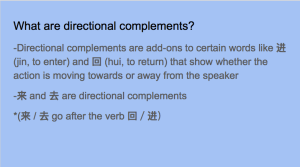
Editor’s Note: from Rubo Fu, St. Mark’s faculty member–“In Chinese class, presentations and role plays require students to use vocabulary and grammar rules they have learned to create their own stories or give opinions. This allows them to develop creativity and have a better experience using the language.”
Click on Image below for “Directional Complements” slide show in Chinese II
Click on Image below for a role play video of dialogue (transcript below) in Chinese IV


The Art of Calligraphy
By Sean Kim, VI Form
The Art of Calligraphy
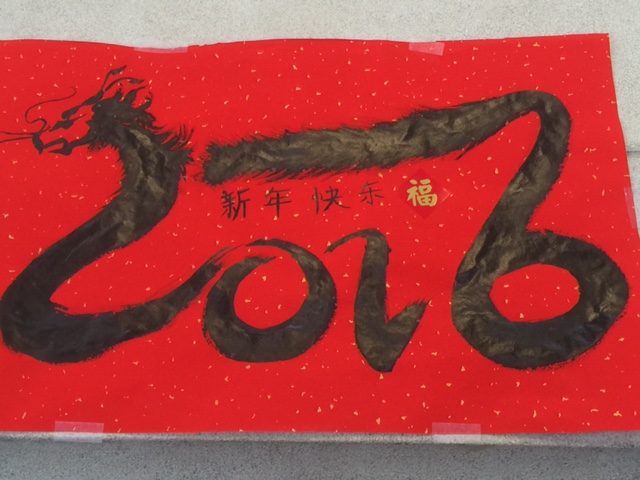 As the Western Hemisphere settles down from all the hubbub of the new year, many nations in East Asia and their diaspora communities recently celebrated their new year: the Lunar New Year. Even with all the “westernization,” celebrating holidays based on the lunar calendar and tradition that come with the holidays have stayed an integral part of communities throughout East Asia and beyond. One of the traditions of the holidays is calligraphy. Calligraphy, which began as a crude pictogram in Ancient China, has been considered a work of art for millennia. Just as art did, calligraphy in East Asia developed and evolved, spawning numerous styles of writing that came and went as centuries passed. (more…)


 LEO
LEO 