

Namaste from Karanjo
By Yusra Syed, V Form
Namaste from Karanjo
My trip to India this past summer was the best decision I have ever made in my teenage years. As a youth ambassador to several charities and organizations that are actively working in India, I heard about Ekal Vidyalaya and the wonderful work that they were doing in the rural tribal areas of India. Last summer, I visited urban areas of India with other organizations and traveled with my family; however, I had never seen remote areas of India and was curious about the work Ekal does for the people living there. Their presence in the the less targeted areas of India sparked my interest, as I understood some of the challenges that India faced as a country.
Some of the challenges that India faces include: 
- Lack of Education
- Urbanization
- Limited access to Healthcare
- Gender Roles
- Lack of Sanitation
- Water Scarcity
- Financial Transparency

Sea Acidification
By Jiawen (Angela) Li, IV Form
Sea Acidification
Editor’s Note: This is the assignment prompt for a unit on ecology–You will be given one week of class and homework time to investigate a topic of your choosing that relates to ecological or environmental sustainability. The goal will be to research the topic in depth and produce a final product that displays your understanding of the concept. You may choose to produce a video, Prezi, infographic, children’s book, or paper.
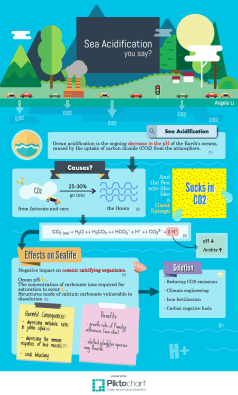 Angela’s pre-reflection: I chose the topic Sea Acidification because I was intrigued by the podcast about how oysters are affected by seawater acidification, and I wanted to know more about how it also affects other species, especially how it affects marine food chain/web. I hope to gain more knowledge on how seawater acidification generally affects marine life and expand my understanding from oysters to a larger variety of organisms. I wish to produce a piece of informative work including the introduction of seawater acidification, explanation of how it works, and details as to what the effects on the sea life are. This is related to these units because it expands on the “Science Friday” podcast on oysters and is connected with food webs, sustainability, and ecosystems. I’ll be working on my own, because I want to work on an infographic and working in pairs really slows the process down and complicates matters unnecessarily, and there could be an uneven distribution of work. My strategy would be to learn from my last experience with making an infographic, dividing my work into clear sections, maybe three to five, before doing research to be more efficient.
See the large infographic below! (more…)

Watching Whales
By U Jin Jo, IV Form
Watching Whales
Editor’s Note: This reflection is from a STEAM field trip (Studio I Art class + Exploratory Sciences: Land and Sea class) to the New England Aquarium.
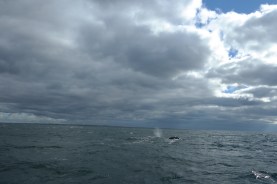
The cold air sprays into our visages as we step on board, the excitement barely hidden under our coats. Buildings are still in sight, and the engine seems to beat along with my heart. Airplanes fly high as we sit in silence. The boat slowly drifts against the water’s will, as if it is right where it is supposed to be. It flows with its own stream, with its own rhythm. The engine’s sound is different from its surroundings – more defined, as if to to

reassure its presence. The air is so strong that it seems like an uncontrollable storm. We bundle up as if the wind has instructed us to do so. The more we push against the water’s will, the more the wind pushes back. Trying to stay balanced, we stare at each other mischievously as if we are about to do something dangerous. Finally, the time that we have been waiting for arrives. After about 30 minutes of the bitter, cold boat ride, we see the first whale. (more…)

Yesterday, Today, and Tomorrow: Reflections on Miller’s The Crucible
By Carrick Zhu, V Form
Yesterday, Today, and Tomorrow: Reflections on Miller’s The Crucible
A lack of decency and empathy has caused many unnecessary deaths and trauma throughout history. As Joseph Welch once asked Senator McCarthy during the “Red Scare” hearings, “Have you left no decency?” [1] The Salem Witch Trials depicted by Arthur Miller in The Crucible took place more than three hundred years ago, yet Miller’s message has not lost its relevance in modern society. The hysteria surrounding the story still has the potential to reoccur in America. Arthur Miller portrays the evil side of humanity through the trials by depicting the selfishness, impressionability, and the atrocities committed because of fear. These characteristics portrayed in The Crucible remain poignant today because of the Chinese Cultural Revolution, the Red Scare of the 1920’s, and the Third Reich regiment. (more…)

Environmental Karma: Art on Environmental Crimes
By Ashley Lee, VI Form
Environmental Karma: Art on Environmental Crimes
Artist’s Note: In Advanced Studio, I began working on theme of “environmental crimes.” All of the pieces below, however, were produced outside of class.
“Environmental Karma”
 Environmental crime and excessive use of natural resources are excellent examples that show how grave this matter is. Gas, which is a key representative factor in this artwork, is one of the many nonrenewable natural resources. This means that once we use it all up, there is no more left for us. Although people do know that gas is a nonrenewable fuel, they still choose to continuously deplete it. (more…)

1-Take Video: Lactase Persistence
By Cordelia (Cricket) Dotson, V Form
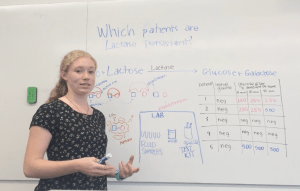
Editor’s Note: The students were charged with designing an experiment to determine if five individuals were or were not lactose tolerant. After designing and completing the experiment they were given instructions on publishing the results in a 1-take video (instructions at bottom of the article).
Please click here or on the image below to see Cricket’s video on lactase persistence:

Creating a Three-Minute Film
By Colin Capenito, IV Form
Creating a Three-Minute Film

Click Image for Film
This past fall season, I participated in the“Three-Minute Film Project” course that as part of St. Mark’s Saturday. The goal of the course appears basic: each group of five to six students were to produce a complete three-minute film by the end of the seven-week Saturday course. What was not basic, however, was making a good complete film. Three minutes may like a blip of time; in fact, some might even wonder how seven weeks could be spent working on mere three-minutes of film. It’s challenging. (more…)

Lindsay Nielsen Photography: Remarkable in the Unremarkable and Exceptional in the Unexceptional
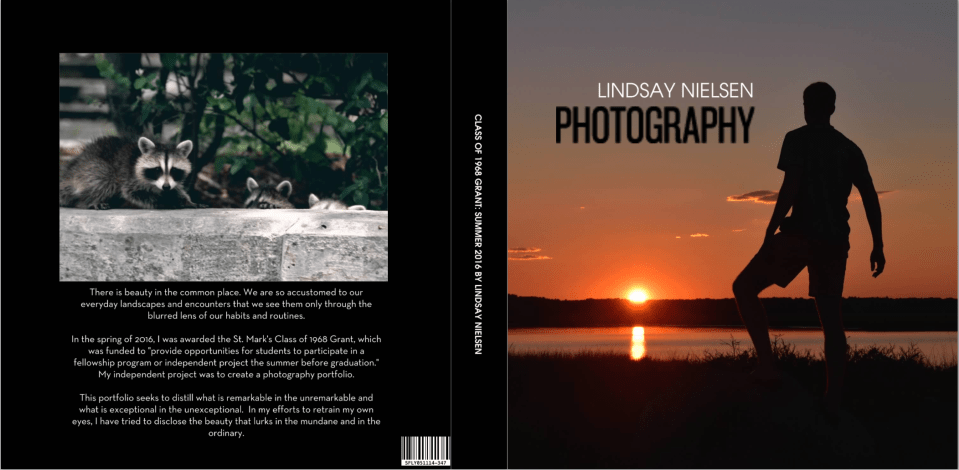 My first camera was a $200 Nikon Coolpix that I bought with all of my babysitting money the summer I turned 13. I had always loved photography and the idea of capturing moments we can’t get back. When I got older, I started watching Youtube videos and teaching myself how to take more advanced pictures. My mom was always asking me where her Canon DSLR was, because I would constantly borrow it to take photos of our two Vizslas. During sophomore year my godfather, Joseph Ratner, gave me his old Nikon D3100 and I was elated. It was my first serious camera, and I had every intention to make the most of it. Photography has always been a passion of mine and it was an amazing moment hearing that I was one of the recipients of the Class of 1968 Grant. I built this portfolio the summer after my junior year and I will continue to use my camera to capture everything around me.

 LEO
LEO 