
Home » Posts tagged 'Technology'
Tag Archives: Technology
Social Media & Privacy: Why Should We Care?
By Anika Sukthankar, VI Form
Social Media & Privacy: Why Should We Care?
Editor’s Note: This project was made possible with the support of the Thomas H. Kean ’53 Fellowship. At their 25th Reunion in 1987, the Class of 1962 established the Thomas H. Kean ’53 Fellowship Program to honor Tom Kean, their teacher, advisor, mentor, and friend. The purpose of this fellowship is to enable students to explore important public policy topics and to embark upon exemplary lives of public service in the spirit of Governor Kean.
Student-Submitted Note: As part of the Kean Fellowship, I took a college-level course called STS 1101: Science, Technology, and Politics. We studied several scientific controversies to further explore the relationship shared between technology and politics, and understood the societal implications. My deliverable was to write a LEO article on what I have found and researched.
“Behavioral advertising generates profits by turning users into products, their activity into assets, their communities into targets, and social media platforms into weapons of mass manipulation.”
-Rohit Chopra in his 2019 dissent against Facebook
As technology evolves and becomes an integral part of our society, the controversies surrounding its proper use and associated governmental policies have become increasingly complicated. We are building complex socio-technical systems that seem to guide our very behaviors and thinking. From the addictive nature of social media to privacy concerns, governmental policies seem to be lagging technological advancements. Events, such as the Capitol hearings, have made this topic of great interest.
Social media has become incredibly popular in recent years, with over 400 million new users joining these platforms annually. Despite this popularity, the majority of users are uncomfortable with the collection of personal data and believe that the government needs to do more to regulate the tech companies. Rebuilding trust between users and the social media companies will take a triumvirate of public awareness, self-regulation by the social media companies themselves, and government regulations.
(more…)Teens without Screens
By Ryan Krantz, VI Form
Teens without Screens
Editor’s Note: This project was made possible with the support of the Class of 1968 V Form Fellowship. At their 25th reunion, the Class of 1968 created a fund to provide grants to V Form students for independent study during the school year or, more commonly, during the summer between V and VI Forms. Their intent in establishing this fund was to reward independent thinking, ingenuity, and planning and to encourage the student exploring non-traditional fields of inquiry or using non-traditional methods of investigation.
Student-Submitted Note: I was awarded this grant to take a surfing road trip down the East Coast, without my phone.
In a world where humans are becoming increasingly dependent on electronic devices in all aspects of our lives, adolescents are particularly susceptible to screen addiction. The average American teenager spends over seven hours a day on screens, which accounts for about 40% of our conscious realities. My friends and I realized that we too, are victims of the “screenager” epidemic, and we wanted to know what our lives would be like if we didn’t have phones. In the winter of my junior year, I received a grant from the Class of 1968 V Form Fellowship at St. Marks to take a road trip along the east coast without my phone. My two best friends Conor Sullivan and Toby Zeidenberg agreed to come along on the road trip, and so on August 11, 2022, we left our phones, computers, and all other screens behind and hit the road.
(more…)
Quel rôle est-ce que la technologie joue dans la communication en 2017?
By Luc Cote, V Form
Quel rôle est-ce que la technologie joue dans la communication en 2017?
La technologie d’une génération définit comment chaque génération communique. Avant 1844 tout le monde communiquait en s’écrivant et en se parlant. En 1844, Samuel Morse a inventé le télégraphe. Pour la première fois, les gens pouvaient communiquer à tout le monde instantanément, le télégraphe a changé la façon dont les gens communiquaient. Tout le monde utilisait la nouvelle technologie de communication, c’était brilliant.
Mais, en 1876 Alexander Graham Belle a inventé le téléphone, et pour la première fois on pouvait écouter et parler en temps réel avec une personne loins de soi. Alors que la technologie facilitait la communication, la communication devenait moins officielle. (more…)

Unity Based Top-Down Shooter Game: Design and Development
By Gillian Yue, VI Form
Unity based Top-Down Shooter Game: Design and Development
I’ve always been interested in video games since I was a child. To me, playing games was never just entertainment; it was also a special artistic experience. While art can be presented in many forms, visually, auditorily or written down, video games are often a combination of different forms, as they need to contain graphics, sounds, and storylines.
This summer, through the Class of ’68 Grant, I worked on an independent game project for the iOS platform, a simple space-shooter-style game with a small variation: instead of simply shooting “bullets”, the player first collects the bullets by tapping on the randomly code-generated paintballs. I chose to work on this project because I’ve always enjoyed playing Space-Shooting games, and I wondered if I had the ability to create something similar. The bulk of the programming was facilitated by the game engine Unity3d, whereas the graphics and audio used in the game were created respectively in Photoshop and Garageband. So far, I’ve had the time to complete the basic structure and logic of the game, with a few characters, background and soundtracks, and I plan to add more artistic components as my project progresses. (more…)

Moral Obligation…in Hamlet & a Fetus
By Lulu Eastman, V Form
Moral Obligation…in Hamlet & a Fetus
Hamlet, a Shakespeare play, follows the tragic tale concerning a deeply troubled Danish prince of the same name. Hamlet is forced to confront his traitorous mother and uncle in order to avenge his murdered father, who, as a ghost, has requested Hamlet takes his uncle’s life in order to bring him justice. However, Hamlet is distressed by the thought of committing such a bloody deed. As he wavers through indecision regarding his proposed mission, he also struggles against the drowning weight of his depression, as the toxic environment of the palace causes him to lose faith in the goodness of people. In the novel, Nutshell, by Ian McEwan, the story of the fetus is based off of Hamlet. With the reflective fetus entangled in the plotting of his traitorous mother and uncle, he finds himself in a predicament similar to that of the Danish prince. Although he has yet to even experience life for his own, the fetus has already lost hope for the vitality and decency of humanity. Every moment of his being is spent listening to conversations that only reveal more and more of the villainous and duplicitous ways of his mother and uncle, Trudy and Claude. Both Hamlet and the fetus reach a point where they contemplate committing suicide, as it seems to be the only way to put an end to their pain. However, both decide to live instead. Though both Hamlet and the fetus have cynical views of the world, and both consider suicide, they continue living through their suffering because they have moral obligations, beliefs, and fears that bind them to life. (more…)

Optimism About the Power of the Book
By John Warren, Head of School
Optimism About the Power of the Book
Immediately after learning of our impending grandparenthood, our conversations with daughter-in-law and son, Caitlin and Ethan, turned to books—their recollections of favorite childhood books that had been read to them and that they had read to themselves, and our recollections of favorite books that we had read to Ethan and to our daughter, Amanda. From Ethan and Amanda’s infancy right up through much of elementary school, my wife and I had a nightly ritual of reading to them, and memories of those times are among our happiest. We have been pleased to learn that these memories are among Ethan and Amanda’s happiest, too. (more…)

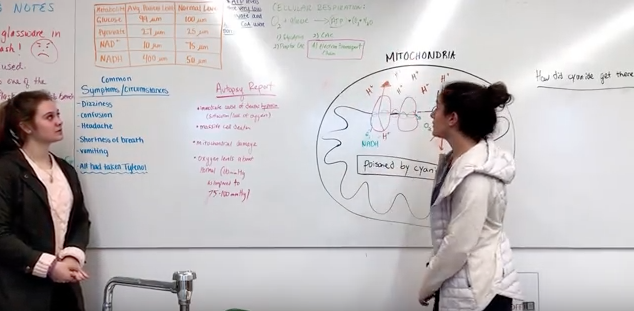
1-Take Video on Cyanide: The Mystery of the Seven Deaths
By Lindsey Dumond and Sada Nichols-Worley, V Form
1-Take Video on Cyanide: The Mystery of the Seven Deaths (click here)
Editor’s Note: After completing a deep examination of the process of Cellular Respiration, Advanced Biology students were randomly assigned to small groups (2-3) students and tasked with tackling a case study. The case of “The Mystery of the Seven Deaths” examined the true story of cyanide poisoning that occurred in the early 1980s. This case study required students to analyze data, make conclusions, and explain mechanisms of action. The students were then required to present the case to a lay person in 3 minutes through a 1-Take Video. A 1-Take Video is exactly what the name implies: a video shot in 1-take. This entire assignment was completed in an 80-minute block.
Click on the image below for the video!

Competing in the FIRST Robotics Challenge
By Kate Sotir, VI Form
Competing in the FIRST Robotics Challenge
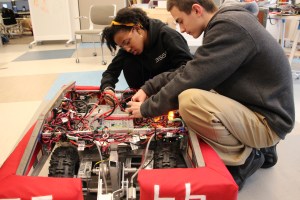
Working in the basement level of the STEM building, using lots of power tools, and occasionally throwing out words like “kickoff,” “drivetrain,” or “STEAMworks,” we are FIRST team 3566, also known as Gone Fishin’.
Gone Fishin’ competes in the FIRST Robotics Competition. FIRST stands for “For Inspiration and Recognition of Science and Technology.” The robotics competition, open to any high school student, was created in order to promote the STEM fields and offer a competitive yet collaborative atmosphere for robotics. In the FIRST Robotics Competition (FRC), teams are given a challenge, in the form of a game, and then have six weeks to build a 120 pound, $10,000 robot to meet this challenge. After those six weeks are up, teams compete in various regional events. The ultimate goal is to go to the world championship, held in St. Louis, where around 800 teams gather to play the game. (more…)


 LEO
LEO 