
Home » Posts tagged 'Teaching' (Page 3)
Tag Archives: Teaching

Letter to the Editor: Native American Policy
By Mo Liu and Jamie Lance, V Form
Letter to the Editor: Native American Policy
Dear Editor Jackson,
It occurs to me that there is much attention raised among the general public regarding our government’s policy towards Indians, and therefore in writing to you, I, as a member of the Board of Indian Commissioners, want to clarify my position. Indians cannot be entirely excluded from our picture as a nation. However, the Indian society is not a cultivated society likes ours. One of my colleagues, who is experienced with Indian affairs and always provides us with elaborate information about the Indians, says their tribes are corrupted by “idleness, improvidence, and indebtedness”. The lack of private property or land and the underdevelopment of laws mark the Indian society as barbarous and inferior to ours. Because of this difference, since 1871 Indian tribes are no longer considered sovereign nations. Governments before us circumvented the Indian dilemma by relocating and establishing reservations west to the Mississippi River, yet now with a closed frontier and western migration, conflicts between settlers and the Indians are inevitable. The issue is pressing. (more…)

Math Modeling: Using Math for Flight Path Safety
By Kate Sotir, Cooper Sarafin, Anderson Fan, Shep Green, VI Form and Mo Liu, V Form
Math Modeling: Using Math for Flight Path Safety
Part 1:
The problem at hand is to create a model, a rating system, that would inform potential flyers of the safety of a particular flight. Our solution includes a mathematical equation that gives us a number between 1 and 100, depending on the inputs. Although the values themselves indicate the safety level of flights, we do not want to our audience to read into the numbers: a flight with a safety index of 63 should not be considered a more dangerous flight than a flight with a safety index of 67. Therefore, to make our model directly presentable to our audience, we classified the possible outcomes into ratings. A safety index ranges from 1 to 20 would have a rating of ★, from 20 to 40 would have ★★, 40 to 60 would be ★★★, 60 to 80 ★★★★, and finally, 80 to 100 would have the highest rating of ★★★★★, and flights that fall under this rating would be the safest choice based on our model. (more…)

World War I Primary Sources Collection at the Library
By Marion Donovan, Assistant Librarian
World War I Primary Sources Collection at the Library
As a librarian at St. Mark’s this fall, I have begun to “weed” through our history collection and have taken a deep dive into time travel. In the past, I was a history teacher myself, so the primary sources that bring the past to life call out to me. A particular section in the library especially rich in those sources covers World War I. Both of my grandfathers fought in WWI on the Allied side, one as a doctor and the other as an engineer, so I grew up with stories and artifacts of “The Great War,” as it was first known. When I applied to graduate school for history at the University of Chicago, I discovered that La Verne Noyes, an American inventor and manufacturer of agricultural equipment, book holders, and windmills, had left the bulk of his fortune to scholarships for Allied veterans of WWI and their direct descendants. These scholarships have now expanded to include 48 colleges. April 6, 2017 will be the one-hundredth anniversary of the United States’ entry into WWI. The European side of the war began in 1914, so many newspaper and magazine articles have already examined new and old perspectives on those events. More will be coming with April 6 in view. We at St. Mark’s are lucky to have an extensive collection of first-hand material (diaries, letters, memoirs, news reports, propaganda, art, photographs) from marshals and generals to privates and civilians on wide-ranging aspects of this war. (more…)

Competing in the FIRST Robotics Challenge
By Kate Sotir, VI Form
Competing in the FIRST Robotics Challenge
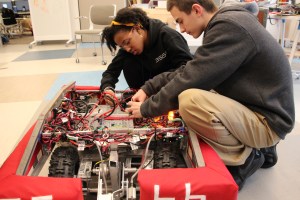
Working in the basement level of the STEM building, using lots of power tools, and occasionally throwing out words like “kickoff,” “drivetrain,” or “STEAMworks,” we are FIRST team 3566, also known as Gone Fishin’.
Gone Fishin’ competes in the FIRST Robotics Competition. FIRST stands for “For Inspiration and Recognition of Science and Technology.” The robotics competition, open to any high school student, was created in order to promote the STEM fields and offer a competitive yet collaborative atmosphere for robotics. In the FIRST Robotics Competition (FRC), teams are given a challenge, in the form of a game, and then have six weeks to build a 120 pound, $10,000 robot to meet this challenge. After those six weeks are up, teams compete in various regional events. The ultimate goal is to go to the world championship, held in St. Louis, where around 800 teams gather to play the game. (more…)

Empathy Through Education in China’s Xi Ma Yin Village
By Carrick Zhu, V Form
Empathy Through Education in China’s Xi Ma Yin Village
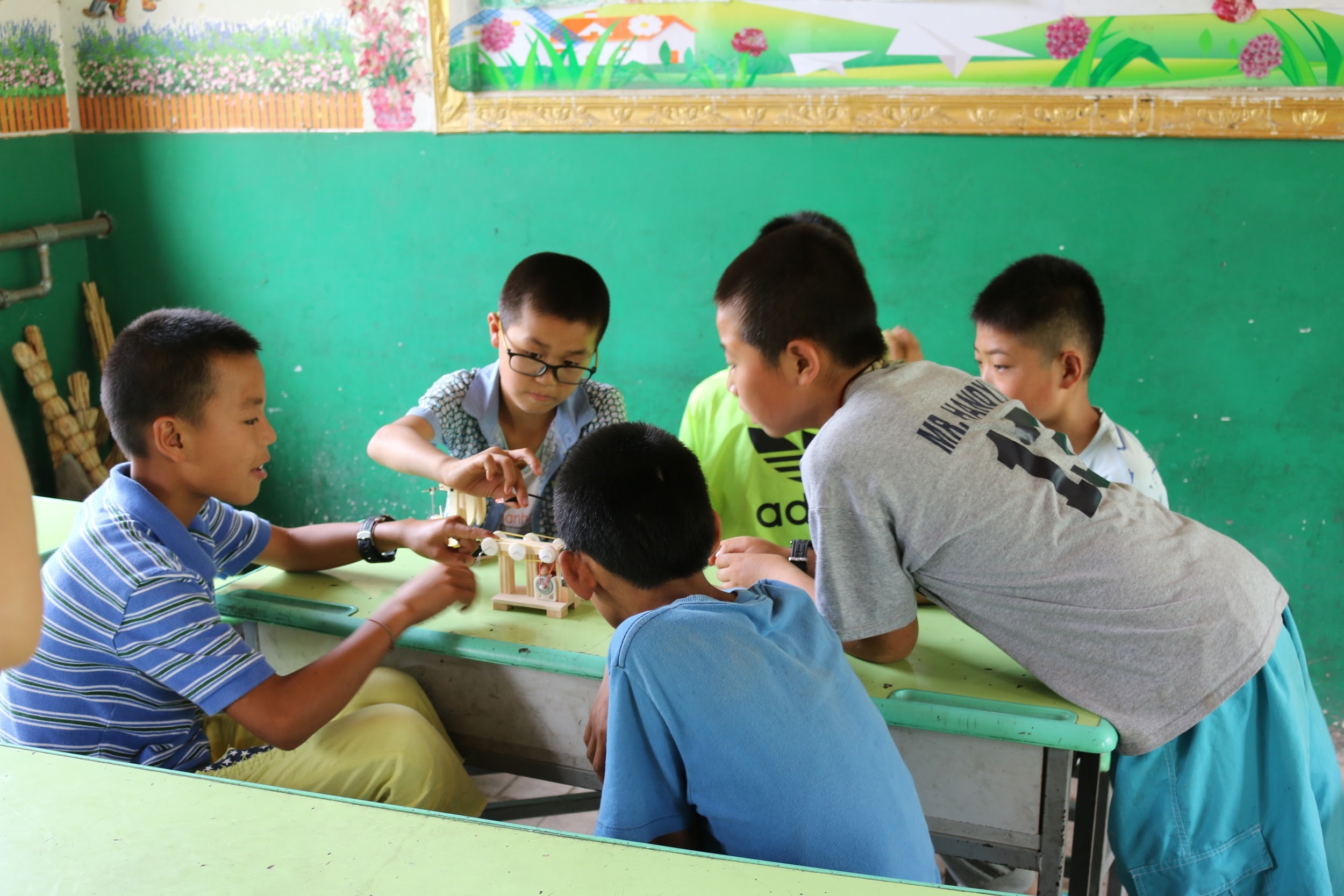 My mom and I began our volunteer teaching trip in 2014. With the help from the local Red Cross Organization in Ning Xia, China, we were able to find a local primary school situated in Xi Ma Yin village. Xi Ma Yin rests at the base of the Helan Mountain where the water supply is scarce. The villagers are mostly immigrants from the other side of the Helan Mountain. The elementary school where I worked is called Xi Ma Yin Immigrant Development Zone Elementary School. (more…)

Global Connections of Media and Skin
By June Seong, IV Form
Global Connections of Media and Skin
Amidst the chaos that is my life – including the future I must decide upon, the necessity to be “special,” and my attempt to make this post somewhat grammatically correct – I am struck by my simultaneous privilege and ignorance. This privilege and ignorance is exhibited through myriad ways at this very moment: 1) this dull MacBook Air that I am communicating through and that was probably configured by an underpaid or unpaid laborer; 2) the whizzing air conditioning that is breathing on my neck so that I might not die from heatstroke whilst the world scales up a few sweltering Centigrades; 3) the immensity of the world that is within computer click’s reach via Facebook. (more…)

Make Deep Work Your Superpower: Deep Work and School (Part 1)
By Dr. Colleen Worrell, Director of the Center for Innovation in Teaching and Learning
Make Deep Work Your Superpower: Deep Work and School (Part 1)
Want to learn complicated things quickly, be more productive, and generate higher quality work? Make Deep Work your superpower.
“Deep work” is a term coined by Georgetown University professor Cal Newport to refer to the ability to “focus without distraction on a cognitively demanding task” (“Cal Newport on Deep Work”). In his newest book, Deep Work: Rules for Focused Success in a Distracted World (NY: Grand Central Publishing, 2016), Professor Newport argues persuasively that the ability to do deep work is the superpower of the 21st century. By training your ability to focus and by actively carving out time “for real intense focused work,” Newport argues that we can train our brains and cultivate habits that build a (more…)

Engaging in 20% Time for Lifelong Learning
By Casey Pickett, English Faculty
Engaging in 20% Time for Lifelong Learning
From the time I was in kindergarten, I knew that I wanted to be a teacher. As a child, I spent 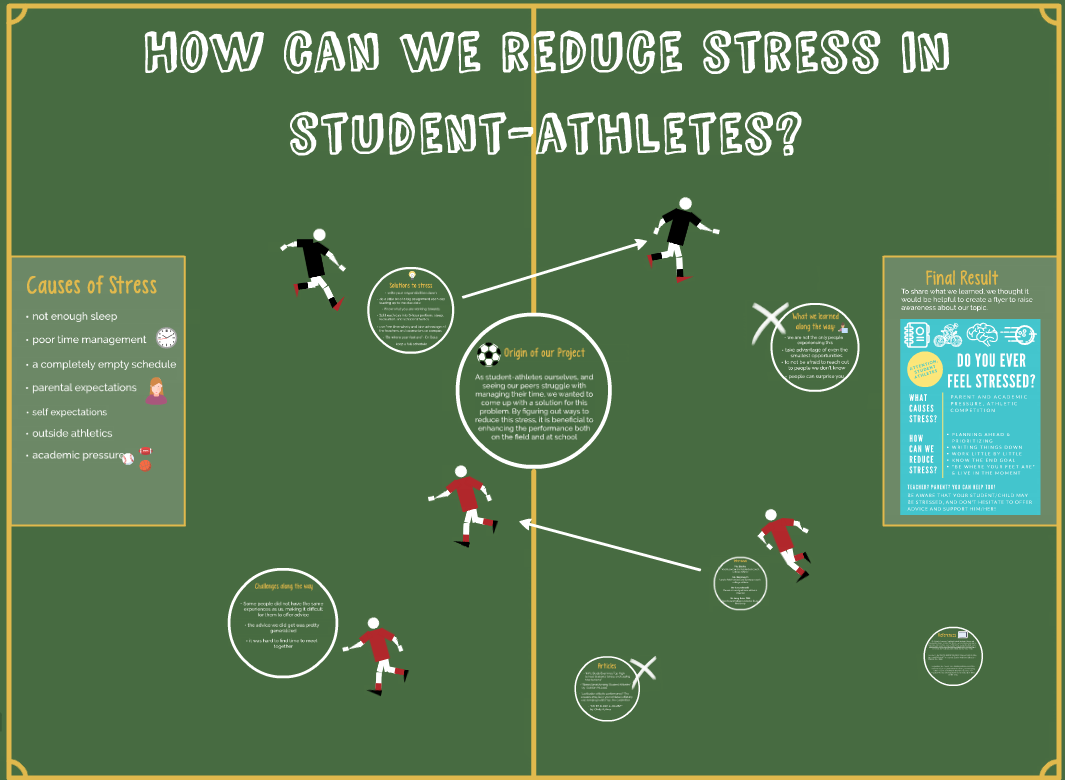 countless hours in my basement forcing my four siblings to be my students while I taught them whatever lessons my teachers had taught me earlier in the day. So, as I entered my Masters in the Arts of Teaching (MAT) program at Northeastern in the Fall of 2013, I couldn’t have been more excited to FINALLY learn my craft. I showed up to my first class ready to write down the formula for becoming a good teacher. I was expecting my professor to tell me EXACTLY what I needed to do in order to teach my students everything there was to know about reading, writing, and analyzing literature. Throughout my 18 months in the MAT program, I never did get that formula. What I did get, however, was a constant reminder that my job as a teacher was to prepare my students to become lifelong learners. So, with lifelong learning in mind, I decided to have my students engage in a 20% Time project (based off of Google’s 20% Time policy). (more…)


 LEO
LEO 