
Home » Posts tagged 'STEM' (Page 7)
Tag Archives: STEM

The West Nile Virus: The Minor Zoonotic Problem Without A Major Solution
By Anuoluwa Akibu, Jack Griffin, Sierra Petties, & Ben West, III Form; with mentors Ben Robb, V Form & Blaine Duffy, VI Form
The West Nile Virus: The Minor Zoonotic Problem Without A Major Solution
Abstract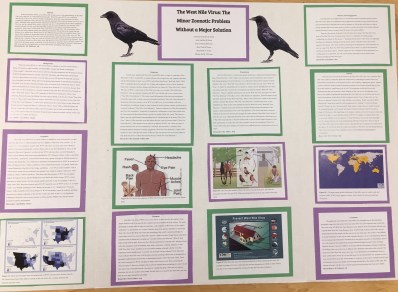
In the information below, you will be able to take away a full understanding on the West Nile virus, and how it is transmitted zoonotically. West Nile virus (WNV) is a pathogen, specifically a flavivirus, and it is found in arthropods. West Nile virus infections are most common in temperate areas, between late summer and early fall, when mosquito activity is at it’s peak. Although many people become infected with WNV most people do not show symptoms. The few who do, mostly have minor symptoms like fever and headache. One percent of the people infected with the virus develop lethal symptoms that require immediate medical assistance. Most cases of West Nile virus come from mosquito bites. The mosquitoes infect humans and other animals which are called dead end hosts. Dead-end hosts cannot pass the disease on to another host. Birds however are different because they are amplifier hosts. That means they continue to spread the disease to mosquitoes have not received the virus yet. The only known treatment to West Nile virus at the moment is pain killers because scientists are still figuring out a solution. There are cures for animals and some in development for humans. There isn’t a practical solution to West Nile virus, but there have been prevention methods created. The main focus for many groups worldwide is of the disease by managing the mosquito population and observing the bird population to restrict the further spreading of the disease. Researcher(s): All; Editor(s): All (more…)

STEM Fellow: Mitochondrial Disease in C. elegans
By Katherine Hartigan, VI Form
Mitochondrial Disease in C. elegans
Abstract
Mitochondrial disease refers to a class of hundreds of disorders related to the mitochondria that are caused by mutations in either mitochondrial DNA (mtDNA) or nuclear DNA
Please Click The Image To Download/See the Poster
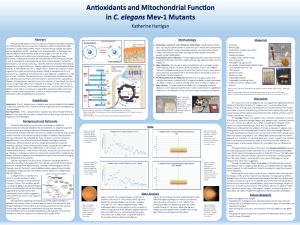
(nDNA). These mutations disrupt cellular respiration and the production of ATP, resulting in the overproduction of damaging free radicals. Mitochondrial diseases were once thought to be rare, but links between mitochondrial defects and many diseases of aging have been discovered, making these diseases far more prevalent than previously thought. A cure is nonexistent, and treatments are often individualized or ineffective. Antioxidants, such as Coenzyme Q10, have the ability to neutralize free radicals, making them a logical choice as a dietary supplement for mitochondrial disease patients. In this experiment, the C. elegans mev-1 mutant was used as a model organism for human mitochondrial disease. MitoQ, a reengineered form of Coenzyme Q10 targeted to the mitochondria, was added as a supplement to the diet of mev-1 mutants. The groups of mev-1 mutants were observed and data was collected every 12 hours until their death to determine their approximate lifespan. Following experimentation and data collection, it was found that there was not a significant difference in between the lifespans of the control mev-1 mutants without MitoQ, and the experimental mev-1 mutants with the MitoQ added to their diet. It is necessary to repeat this experiment while collecting data in shorter time intervals than 12 hours in order to draw more accurate conclusions when completing future research. (more…)

Carbon Dioxide vs. The Ocean
By Laura Drepanos, IV Form
Carbon Dioxide vs. The Ocean: What I learned at the High School Marine Science Symposium
Are the ocean’s problems really my problems?
This was the only question going through my head as I pulled up to front circle two days before March break at 6:50 in the morning.
The short answer: yes.
When Ms. Lohwater announced at school meeting that there was an opportunity to go to the High School Marine Science Symposium (HSMSS) at Northeastern University, I immediately took it. I have always loved learning about the ocean and visiting the Wood’s Hole Oceanographic Institution since I was young. Missing a day of classes for this at the end of the academic window required an overwhelming amount of planning ahead: I had to take tests on my own time and finish all of my assignments. However, I left the HSMSS with many takeaways that made it all worth it.
My first takeaway: Sea Acidification is very real. (more…)

Fake News & Google: A Vessel in the Sea of Verity and Deceit
By Lulu Eastman, V Form
Fake News & Google: A Vessel in the Sea of Verity and Deceit
In our Digital Age, Google has become a vital tool to the global population, with over a billion people worldwide relying on the search engine as their guide to the human library known as the internet. Google not only nurtures the insatiable curiosity and hunger for knowledge innate to mankind, but also easily provides the masses with unreliable and false information, resulting in an age where anyone can easily be deceived online. (more…)

STEM Fellows: Fragile X Syndrome in Fruit Flies
By Jenny Deveaux and Samantha Sarafin, VI Form
Peripheral Nervous System Deficits and Social Behavior in Drosophila FMR1 Mutants
1.1 Abstract
Click here to view full size of poster
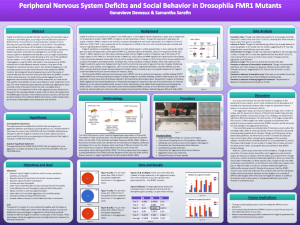
Fragile X syndrome is a genetic disorder caused by a trinucleotide repeat mutation in the FMR1 gene, occurring in one in 4,000 males and one in 8,000 females. The syndrome is characterized by a variety of social, learning, and cognitive deficits specific to each patient. The pathways surrounding the expression of the fragile X phenotype are largely unknown, and there is no current treatment for the disorder. Numerous studies have been conducted to investigate the role of the central nervous system in developmental disorders such as Fragile X Syndrome; however, there is a lack of studies focusing on the role of the peripheral nervous system. In our study, we developed a line of Drosophila melanogaster, using the GAL4-UAS system, that expresses the dFMR1 mutation only in the olfactory sensory neurons, a vital part of the Drosophila’s peripheral nervous system. We conducted aggression and courtship assays to test the social behavior of the peripheral dFMR1 mutants. We compared these behavioral results with the results of control wild-type flies and with Drosophila that have the dFMR1 mutation in their entire anatomy. Our preliminary results suggest that both aggression and courtship should be further researched, as it was found that specific characteristics of each social behavior were impaired in some way. The most noteworthy data that was collected was significantly lower courtship index in the experimental line and a complete lack of dominance of the experimental line in the aggression assay. Because the Drosophila that were genetically crossed using the GAL4-UAS system had the dFMR1 gene silenced in their olfactory sensory neurons, the flies had an abnormality in their ability to detect pheromones, which studies show are the basis of Drosophila social interaction and behavior. (more…)

Artifact of Learning: What Is Cancer?
By Gillian Yue, V Form
Artifact of Learning: What Is Cancer?
Editor’s Note: This video is from the following assignment in Advanced Biology—
Click Image for Video
Charge: Create an Artifact of Learning* that will clearly explain to someone not in this class: What is Cancer? And How Does it Arise? Your artifact should synthesize the content from this unit (DNA Structure & Replication, The Cell Cycle, Mitosis & Cytokinesis, and Control of the Cell Cycle), as well as integrate new information that you have researched to better make sense of this disease. Your answer should not be a review of EVERYTHING examined; rather you should selectively integrate elements of each topic that help to explain what cancer is and how it arises. Note: This assignment does not ask – how do we treat cancer, detect cancer, prevent cancer, etc. Simply – What is Cancer?
Click here for video.
*Scroll to bottom for definition of an “Artifact of Learning” (more…)

Non-Euclidean Geometry
By Gabriel Xu, VI Form
Non-Euclidean Geometry
What if math students no longer had to study similar triangles because they simply don’t exist?
What if you could draw as many lines parallel as you want to a given line from only one point?
What if angle-angle-angle was enough to prove congruence of triangles?
Would these changes to our known geometric system finally make it easier, or would they further contribute to its fascinatingly intricate nature?
Studying Non-Euclidean Geometry aims to answer these questions. (more…)

Math Modeling: Using Math for Flight Path Safety
By Kate Sotir, Cooper Sarafin, Anderson Fan, Shep Green, VI Form and Mo Liu, V Form
Math Modeling: Using Math for Flight Path Safety
Part 1:
The problem at hand is to create a model, a rating system, that would inform potential flyers of the safety of a particular flight. Our solution includes a mathematical equation that gives us a number between 1 and 100, depending on the inputs. Although the values themselves indicate the safety level of flights, we do not want to our audience to read into the numbers: a flight with a safety index of 63 should not be considered a more dangerous flight than a flight with a safety index of 67. Therefore, to make our model directly presentable to our audience, we classified the possible outcomes into ratings. A safety index ranges from 1 to 20 would have a rating of ★, from 20 to 40 would have ★★, 40 to 60 would be ★★★, 60 to 80 ★★★★, and finally, 80 to 100 would have the highest rating of ★★★★★, and flights that fall under this rating would be the safest choice based on our model. (more…)


 LEO
LEO 