
Home » Posts tagged 'Religion' (Page 3)
Tag Archives: Religion

World War I Primary Sources Collection at the Library
By Marion Donovan, Assistant Librarian
World War I Primary Sources Collection at the Library
As a librarian at St. Mark’s this fall, I have begun to “weed” through our history collection and have taken a deep dive into time travel. In the past, I was a history teacher myself, so the primary sources that bring the past to life call out to me. A particular section in the library especially rich in those sources covers World War I. Both of my grandfathers fought in WWI on the Allied side, one as a doctor and the other as an engineer, so I grew up with stories and artifacts of “The Great War,” as it was first known. When I applied to graduate school for history at the University of Chicago, I discovered that La Verne Noyes, an American inventor and manufacturer of agricultural equipment, book holders, and windmills, had left the bulk of his fortune to scholarships for Allied veterans of WWI and their direct descendants. These scholarships have now expanded to include 48 colleges. April 6, 2017 will be the one-hundredth anniversary of the United States’ entry into WWI. The European side of the war began in 1914, so many newspaper and magazine articles have already examined new and old perspectives on those events. More will be coming with April 6 in view. We at St. Mark’s are lucky to have an extensive collection of first-hand material (diaries, letters, memoirs, news reports, propaganda, art, photographs) from marshals and generals to privates and civilians on wide-ranging aspects of this war. (more…)

The Individual’s Perception & “Knowing” God
By Lucy Cao, VI Form
The Individual’s Perception & “Knowing” God
The controversies over the existence of God or the validity of religious beliefs derive from a lack of tangible proof. Religious doctrines, unlike mathematical equations or scientific formulas, are usually proposed without a sequence of logical inferences backed up by repeated and consistent observations. Therefore, the question lingers whether a consensus is attainable among us regarding a universally accepted proof of a deity. My answer is no. Nevertheless, we can still know God. Religious and spiritual experiences rely on the self. The uniqueness of each individual’s perception of God makes it impossible to establish a defined path to the objective knowledge of God. However, we can know God through a subjective point of view, and the validity of the knowledge of God should not be diminished by its subjective nature. (more…)

On Knowledge and Knowing God
By Natalie Novak, VI Form
On Knowledge and Knowing God
At the heart of any civilization lies a fundamental core centered on religion. Many great empires have risen and fallen, while maintaining their devotion to some kind of transcendent being or reality. Ethics, morality, governing laws, and codes of conduct all stem from some kind of religious or higher rule. However, the being that has created these ideals always comes into question when one is deciding whether to follow these “rules.” This brings about the discussion of God’s existence. Is it possible to know God? Can we prove his validity? Is this knowledge truly sound? What even is it “to know?” The question of God is a complex one, furthered by the complexity of the phrase to know. To fully grasp the notion of knowing god, it is essential to comprehend the notion of knowing. (more…)

Seventh Day Adventists: FAQ for You
By Abby Moses, VI Form
Seventh Day Adventists: FAQ for You
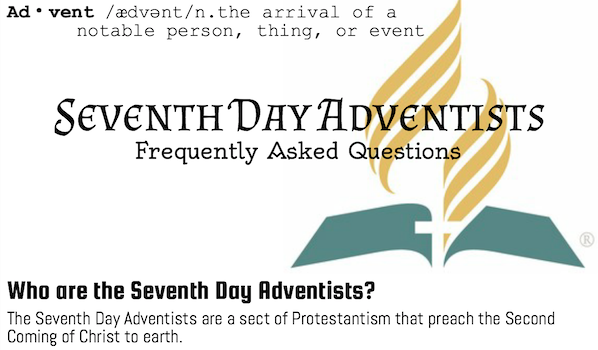
Click here for the full-size version of the Piktochart! Or scroll down.

Unitarianism in New England
By Payton Nugent, VI Form
Unitarianism in New England
Rising liberal ideologies in the early nineteenth century caused a split of the more liberal beliefs of Unitarians from the conservative, orthodox beliefs of the Congregationalists. This separation occurred slowly, but gradually, throughout New England. When the majority of a church congregation preferred Unitarian beliefs to those of the Congregationalists, the parish converted to Unitarianism.[1] The most influential driving force of this split was William Ellery Channing’s book, Unitarian Christianity, which has become known as the “Unitarian Manifesto.”[2] Unitarian Christianity proclaimed many of the beliefs that caused the Unitarian sect to break from the Congregationalists. While the Congregationalists believed in the idea that Jesus, God, and the Holy Spirit were all the same entity, the Unitarians believed that Jesus was not God.[3] Unitarians also rejected predestination, which asserts that God determines a person’s salvation before birth.[4] His book was a result of many movements and rising liberal ideologies of the time such as the Enlightenment, Scientific Revolution, and Great Awakening. One church that this separation greatly influenced was the Pilgrim Church in Southborough, Massachusetts. (more…)

Knowing God
By Adriana Roman, VI Form
Knowing God
The majority of people do not believe in the existence of anything if it cannot be seen, felt, smelled, or touched. This notion has to do partly with the time period we live in—the era of technological advances, where almost anything in the world can be proven through tangible proofs and reasons. As a result, everything we experience externally, through the world, can be “known”, or believed in, because there is irrefutable evidence that will produce the same result every time a specific situation occurs or a question is brought up. For example, gravity’s existence can be “known” because we have experienced countless times that a dropped pencil will fall to the ground due to the pulling force of gravity. Experience (more…)

The Dalai Lama: A Spiritual Leader Above a Political One
By Lucy Cao, V Form
The Dalai Lama: A Spiritual Leader Above a Political One
China and Tibet have a long history of relations. Beginning with the Manchu rule of Tibet, conflicts and disputes between the Chinese and Tibetans have persisted. Unwilling to compromise with a centralized ruler, Tibet seized the opportunity to claim itself as an independent state after the overthrow of the Qing Dynasty. However, following the establishment of the People’s Republic of China in 1949, Tibet became an integral part of China. From then on, numerous riots and uprisings for Tibetan independence and the preservation of Tibetan traditional culture and religion have taken place (Goldstein 84-86).
One aspect of the complex relationship between China and Tibet has some connection with the Dalai Lama selection process. As a tradition of Tibetan Buddhism, Finding the reincarnation of the Dalai (more…)

Optimism About Positive Psychology
By Sarah Eslick, Associate Director of The Center for Innovation in Teaching & Learning
Optimism About Positive Psychology
 What allows humans to thrive? What conditions, actions, or qualities contribute to well being? How do we help kids become resilient?
Historically, the field of psychology has focused on mental illness. Depression, schizophrenia, and other disorders of the mind carried far more intellectual gravitas than the psycho-emotional characteristics that lead to happiness. Certainly these illnesses are less subtle, easier to categorize, label, and examine. In striking contrast, the field of positive psychology studies how people do well: how we cultivate positive emotions and optimism and how we develop grit and self-regulation. It explores how we benefit from resilience and gratitude while recognizing our (more…)


 LEO
LEO 