
Home » Posts tagged 'Independent Projects' (Page 5)
Tag Archives: Independent Projects

On a Life as an Asian-American & Embracing That with Open Arms
By Lindsay Nielsen, VI Form
On a Life as an Asian-American & Embracing That with Open Arms
The worst activity of my freshman summer was taking six-hour classes of drivers’ ed for five days straight. The only thing that made it bearable was that our teacher let us watch the world cup instead of parallel parking videos, and we were let out early on the last day because my teacher’s daughter suddenly went into labor. Before she got the call, my teacher passed out our graded permit tests. “So..” she said, “it looks like Peggy Chen got a perfect score. Please raise your hand and grab your test” Pause. Let me tell you three things. 1. I knew no one in this class. 2. I did not earn a perfect score and 3. When she told the class Peggy Chen scored a 100, every single person, including the teacher, looked at me expecting me to raise my hand. After trying to tell them my last name was actually Nielsen, a shy, Asian, Peggy Chen out-stretched her hand from the corner of the room to claim her test.
Believe it or not, this is a usual occurrence for me. And definitely not as weird at the week before when a middle-aged woman walked up to me in Best Buy asking how the definition of a 4k tv differed from a curved model. “I’m sorry,” I said. “I don’t work here.” A few awkward stares were exchanged. “Oh…” she said. She looked at me puzzled as if all Asians roaming electronic stores were automatically employees. She then walked away.
Race wasn’t always a prevalent component of my life, but once I knew others were attentive to my race, it started an onslaught of experiences relating to being Asian in what was to me: a largely Caucasian world. In my personal experience, I will explain how I went from of state of oblivion, to self-hate, to self love all in a short period of 18 years. (more…)

An Analysis of Alienation: The Natural Estrangement of the Individual
By Cooper Sarafin, VI Form
An Analysis of Alienation: The Natural Estrangement of the Individual
Total Estrangement
Alienation is a natural state of human beings. We are set in an environment that leaves us with a sense of inadequacy and ineptitude and no matter what extent to which we alter our facades and wear a mask of falsity; we will never be able to cross the glass ceiling that is our expectations. From the very moment we are conceived, we are being classified and divided among throngs of opinions, preferences, and expectations. We are expected to live up to this normality of society, the ever prevalent quest to “fit in”. To be amidst the general populace and succeed in a manner relative to the ideas of said society and government that preside over our specific demographic. We are expected to succeed in the realm of capitalism and to move further up this hierarchy and supersede the ranks of the proletariat in turn for the bourgeoisie. We are expected to develop social relationships with everyone we meet and to be liked by them. We are expected to achieve great things and to do what has never been done before. In the aftermath of all this expectation, what is left for us to expect for ourselves other than that which has been told to us? In that we are governed by these (more…)

20% Time (Genius Hour) With Freshmen: Civic Action
By Ms. Casey Pickett’s III Formers
20% Time (Genius Hour) With Freshmen: Civic Action
Editor’s Note: In Ms. Casey Pickett’s III Form English classes, her students pursue 20% Time (or “Genius Hour”) projects. Below are Ms. Pickett’s instructions, a student’s reflection, and several artifacts from the experience. Please keep scrolling!
Purpose:
The purpose of the project is to give you time to pursue something that you are passionate about, interested in, or something you’ve always wanted to do. It is a time for you to be creative and to take ownership of your learning AND your education. If it is important to you, it has value.
Essential Questions:
What does it mean to be a citizen (global, local, digital)?
What are civics? Why is it important that we are civically engaged?
How can I be a voice for and/or create social change?
Please click here for the full assignment explanation.
A Reflection by Paige LaMalva
As a student, I feel as though there isn’t enough time after academics and athletics to pursue something a student is interested in. At a school like St. Mark’s, for example, we are in class from 8:30am-3:00 pm and then at sports from 3:30-5:00 pm, which is followed by a short period of time to relax before study hall at 7:30 pm. With the 20% Time project, my fellow classmates and I were permitted to explore a topic of our interest. For me, I chose to research pancreatic cancer. Without the 45-minute block per week working on this, I wouldn’t have learned why pancreatic cancer is called “The Silent Cancer.” (more…)

Trump’s Reform on Immigration Policies, Pros and Cons
By Jenny Shan, IV Form
Trump’s Reform on Immigration Policies, Pros and Cons
Editor’s Note: For this module in Social Justice class, students worked individually and/or collaboratively on a specific topic related to immigration policy or the refugee crisis. A Final Artifact of Learning (FAoL) should demonstrate understanding of the topic and “answer” the driving question in a comprehensive way. It should synthesize learning by organizing and applying understanding on the topic/question.

Click Image To Play Video

Gun Control in America: A Nonpartisan Investigation
By Sam Lauten, VI Form
Gun Control in America: A Nonpartisan Investigation
 For the entirety of my life, I have been taught that there are good politicians and evil politicians. I have been taught that there is only Democrat and Republican. I grew up in a firmly liberal household, in a liberal state, and attended liberal private schools from kindergarten to my senior year of high school. This is not a criticism of my family, nor is it a criticism of liberal education, rather a recognition of the fact that I have been exposed to very few people that are significantly different than I am. However, this year as I began to look onward to studying political science at college in the fall, there was something that I found deeply troubling about experiencing eighteen years of life without having my own political views truly challenged. Even so, I have always had firm opinions about nearly every issue, even those which I have not necessarily experienced the effects of first hand. An example of one of these issues is gun regulation. (more…)

STEM Fellow: Mitochondrial Disease in C. elegans
By Katherine Hartigan, VI Form
Mitochondrial Disease in C. elegans
Abstract
Mitochondrial disease refers to a class of hundreds of disorders related to the mitochondria that are caused by mutations in either mitochondrial DNA (mtDNA) or nuclear DNA
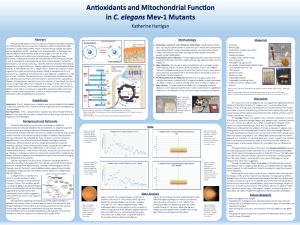
Please Click The Image To Download/See the Poster
(nDNA). These mutations disrupt cellular respiration and the production of ATP, resulting in the overproduction of damaging free radicals. Mitochondrial diseases were once thought to be rare, but links between mitochondrial defects and many diseases of aging have been discovered, making these diseases far more prevalent than previously thought. A cure is nonexistent, and treatments are often individualized or ineffective. Antioxidants, such as Coenzyme Q10, have the ability to neutralize free radicals, making them a logical choice as a dietary supplement for mitochondrial disease patients. In this experiment, the C. elegans mev-1 mutant was used as a model organism for human mitochondrial disease. MitoQ, a reengineered form of Coenzyme Q10 targeted to the mitochondria, was added as a supplement to the diet of mev-1 mutants. The groups of mev-1 mutants were observed and data was collected every 12 hours until their death to determine their approximate lifespan. Following experimentation and data collection, it was found that there was not a significant difference in between the lifespans of the control mev-1 mutants without MitoQ, and the experimental mev-1 mutants with the MitoQ added to their diet. It is necessary to repeat this experiment while collecting data in shorter time intervals than 12 hours in order to draw more accurate conclusions when completing future research. (more…)
Something Less Depressing –– A 10-Minute Play
By Cooper Sarafin, VI Form
Something Less Depressing –– A 10-Minute Play
Editor’s Note: In the VI Form elective “Writing for Actors,” the assignment called for students to write a stageable one act play, beginning with a dramatic problem. Cooper workshopped his play several times in class, culminating in a staged reading at the end of the third window. He then took it upon himself to revise it once more before sending it out to a national forum, “Trade a Play Tuesday” , where another writer read his play and provided feedback.
SOMETHING LESS DEPRESSING
By Cooper Sarafin
Cast of Characters
James: Individual who prefers the company of himself as opposed to that of others. Doesn’t care what others think of him.
Lily: A friendly girl who likes to get to know many people.
Amy: Stereotypical popular student, superficial and self-obsessed.
Opens with a Lone Figure sitting at a lunch table in thought. In the corner is a vending machine.
Scene 1
James begins talking into a tape recorder
James:
Such a stigma around this, sitting alone. Why must it be regarded as entirely wrong? As something to be undesired? I see them all sitting together, absorbed in mindless conversation, unstimulating, quite boring in fact. Not to say I haven’t been counted part of them, for that’d be inaccurate. Such times as I have attempted to interact with them I joined only to have been left feeling more alone than I do now. It’s my opinion that sitting here alone, my mind to roam free, is much less lonely than to be trapped in your own head with nothing to say. Isn’t it rather lonely to be the only person who doesn’t seem to care? To be an irrelevant bystander, in close proximity, yet so far removed. For me, to exculpate myself is not a decision, but the only reasonable course of action. For alone by choice is far better than alone by force. (more…)

Original Songwriting and Recording
By Simon Zlystra, Reed Andary, Shep Greene, John Hart, Nick Harrison, and George Littlefield, VI Form
Original Songwriting and Recording
Editor’s Note: These reflections and recordings come from the winter St. Mark’s Saturdays course, “Songwriting and Recording.” The course, taught by Mr. Jason Eslick, covers songwriting and composition in electronic and acoustic mediums while getting students started with the art of recording and production. Students worked to come up with a recorded, mixed, and mastered final project.
Simon Zylstra:
Reed Andary:
Shep Greene:
John Hart:
Nick Harrison:
George Littlefield: (more…)


 LEO
LEO 