
Home » Posts tagged 'identity' (Page 5)
Tag Archives: identity

Make Peace With the Day to Enjoy the Evening: Remains of the Day
By Gabriel Xu, V Form
Make Peace With the Day to Enjoy the Evening: Remains of the Day
There’s an old Chinese idiom that roughly translates to, “The person on the spot is baffled, the onlooker sees clearly”. Surely, this applies to the case of Mr. Stevens. As the aged butler in Remains of the Day travels farther away from the house he has been in service of for decades, he starts to see the truth of his former employer more clearly — a truth so dark and ugly that Stevens has tried very hard to escape. Although Mr. Stevens is forced to learn the tragic truth about his former lord and consequently his own small, yet undeniable contribution as butler to the evildoing his master was conducting, the meeting with Ms. Kenton, a former housekeeper, allows him to see value in his decades of service, to make peace with his past, and eventually to move forward into a hopeful future. (more…)

Modern Day Martins
By Jenny Deveaux, V Form
Modern Day Martins
Much like hip hop music, modern day United States culture is based upon movements for change and the spread of continental ideas.
Hip hop was born in the seventies, and first originated in New York City. The genre was developed largely by African-Americans, but evolved to incorporate nuances from other minority groups such as Latin-Americans. Today, hip hop is a multi-billion dollar franchise that has become a symbol of United States culture because it exemplifies a diverse and influential community that seeks to spread tendentious ideas. Artists like Common, Nelly, Macklemore, and LL Cool J use their prominence in the hip hop genre to address today’s issues. Macklemore did this recently in his song “Same Love,” advocating for marriage equality while producing a track that made the top charts in America. (more…)

The Great Gatsby: Chapter 10
By Eric Zhang, V Form
The Great Gatsby: Chapter 10
(Editors’ Note: In Ms. Matthews’ American Literature class, this assignment prompted students to create a 10th chapter of Fitzgerald’s The Great Gatsby, utilizing Nick Caraway’s melancholic tone and including some type of closure for the characters)
It had been five years since the funeral, and I finally returned to this city that I once thought was haunted. Everything was so depressing. There were no sounds of the orchestra playing or shimmering sights of the girls wearing fancy dresses with decorations on their shoes. The city of New York had changed since that October in 1929, what was later called Black October. I wandered the streets of New York, and ultimately, I was pulled back to the Eggs and Gatsby’s mansion. What was once a (more…)

U.S. Historical “I am” Poems
By Samantha Sarafin, John Hart, George Littlefield, and Ginny Walsh, V Form
U.S. Historical “I am” Poems
Each of our United States History courses revolves around eight major themes prevalent throughout history. One of those themes is the question of “Who is an American” at any given time in the nation’s history. In keeping with our work and also trying to connect what we do inside our classroom to the broader St. Mark’s community and world at large, each class took their Community and Equity Day “I am” poems and looked at them from a historical angle. Each student was asked to look at an “I am” poem from the perspective of a figure from history. Some students were asked to be someone as specific as Alexander Hamilton, while others were (more…)

Northern Pacific Seastar Asterias amurensis & My Zone as an Artist
By Mei-Mei Arms, III Form
Northern Pacific Seastar Asterias amurensis & My Zone as an Artist
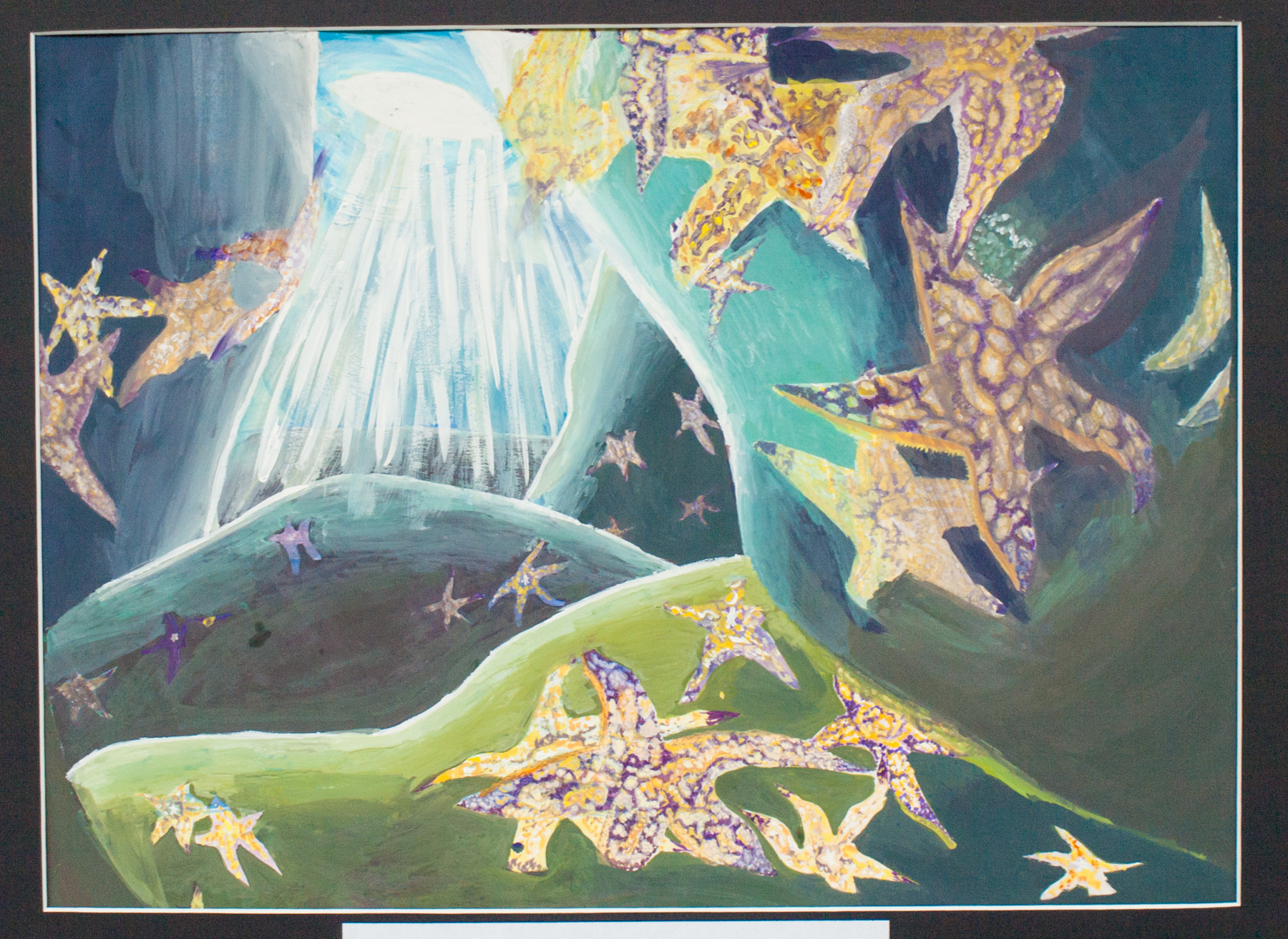
(See larger image below)
This seastar originated in Japan, Korea, China and Russia, about 20-40 metres deep off the coasts of these countries. It was introduced by the ballast waters of cargo ships as they returned from these countries and used ocean water to replace the weight of cargo. They can reproduce without the aid of another sea star and can multiply in the thousands. Due their rough exterior, the Northern Pacific Seastar does not have many natural enemies. Their larvae are so small that we cannot find a way to capture them and nothing appears to eat them at that stage in their life cycle. The Sea stars eat crustaceans and due to their numerous population, when they enter a new area, their numbers can wipe out the whole population of crustaceans. They can break off limbs and these limbs can grow in to new Sea Stars, but this process does take years. (more…)

La Realidad de la “Democracia Racial” entre Brasil (En Español and English)
By Theo Bartlett, V Form
La Realidad de la “Democracia Racial” entre Brasil (En Español and English)
Our core objective in our Spanish IV class is to study Latin American history in order to understand how and why Latin America has been shaped into the region that it is today. Within our curriculum, we accomplish this task by doing case studies on many different countries in Latin America, in which we study the national history of the country and then connect it to recent publications regarding its modern day situation. Within these case studies, we explore the demographics, economics, politics, and social scene of a country by immersing ourselves in Latin American literature, political debates, documentaries, and movies, and we reflect on what we have learned in both classroom discussions and written responses throughout the studies. Most recently, at the end of our case study on Brazil, we were asked to take the information that we learned in the PBS documentary “Black in Brazil”, which talks (more…)

“Just” An American
By Veera Korhonen, VI Form
“Just” An American
Some students have a background, identity, interest, or talent that is so meaningful they believe their application would be incomplete without it. If this sounds like you, then please share your story.
I’m just an American. Or so I thought. Growing up overseas, I was always associated with other multi-cultural kids who had a parent working for the American Embassy. As a result, I was an American and only an American. This was despite the fact I had spent more of my life out of the States than in it and I had a bi-racial background of being Finnish and Indian. When I decided to attend a small boarding school in Massachusetts, I figured I would have no problem adjusting to a new community in America. Since I was moving from Saudi Arabia, a country with a demanding set of religious laws to live by, I thought I could adapt to fit even the most extreme conditions. I had no idea that moving back to a country that I considered my own would be the hardest transition of my life. (more…)

Changing Society and the Lives of Black Men
By Jammil Telfort, VI Form
Changing Society and the Lives of Black Men
Fifty-eight.
That is the percentage of incarcerated American youth who are black.
Fourteen.
That is the percentage of the United States population who are black.
According to the aforementioned trends, most black men are destined to lives of crime, preventing them from becoming upstanding citizens of the United States. As I transition into adulthood, I am haunted by these ominous statistics that tell me that by next fall, I should be in a prison cell and not in a college dorm. Despite having the odds stacked against me, I have challenged this idea through my very existence. (more…)


 LEO
LEO 