
Home » Posts tagged 'Collaboration' (Page 6)
Tag Archives: Collaboration

Video Oral Arguments: Literature on Trial
Students on Film (in order of appearance): Charlotte Wood, Jenny Deveaux, Joey Smith, Amanda Christie, Josh Loveridge, Gabe Brower, Janelle Carmichael, VI Form
Video Oral Arguments: Literature on Trial
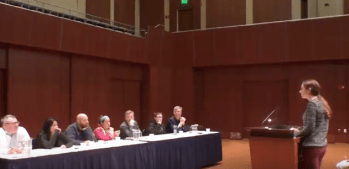
Editor’s Note: This is a highlight reel from Ms. Matthews’ Literature on Trial class (2016 VI Form fall semester English). The course is divided into two sections. In the first half, the focus is on trials, plaintiffs, prosecutors and defendants, reading works of literature and brainstorming criminal or civil wrongs committed by characters in the text. Students work in trial groups to gather evidence, prepare witnesses, and put on their best case. The second half consists of appellate work where students focus on the after effects of a trial, reviewing lower court records for Constitutional issues, drafting briefs for appeal and preparing for a final oral argument.
Please click here or on the images for the “student attorneys” in action! 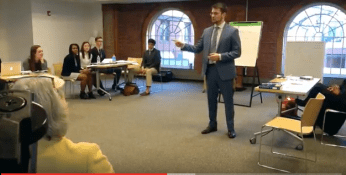
 (more…)

Letter to the Editor: Native American Policy
By Mo Liu and Jamie Lance, V Form
Letter to the Editor: Native American Policy
Dear Editor Jackson,
It occurs to me that there is much attention raised among the general public regarding our government’s policy towards Indians, and therefore in writing to you, I, as a member of the Board of Indian Commissioners, want to clarify my position. Indians cannot be entirely excluded from our picture as a nation. However, the Indian society is not a cultivated society likes ours. One of my colleagues, who is experienced with Indian affairs and always provides us with elaborate information about the Indians, says their tribes are corrupted by “idleness, improvidence, and indebtedness”. The lack of private property or land and the underdevelopment of laws mark the Indian society as barbarous and inferior to ours. Because of this difference, since 1871 Indian tribes are no longer considered sovereign nations. Governments before us circumvented the Indian dilemma by relocating and establishing reservations west to the Mississippi River, yet now with a closed frontier and western migration, conflicts between settlers and the Indians are inevitable. The issue is pressing. (more…)

(In)Visible: The TV Pitch Project Winner
By Katie Hartigan, Nick Hadlock, and Anderson Fan, VI Form
(In)Visible: The TV Pitch Project Winner
 Logline:
Unified in isolation, six strangers’ morality is put to the test when taking a pill makes them invisible to everyone but each other, but what they don’t know is that they are part of a social experiment and are constantly being watched.
Elevator Pitch:
(In)Visible is a two-season television show falling under the category of sci/fi, drama, and thriller. It is about six main characters that participate in a seemingly risk-free drug trial by Osiris Pharmaceutical that leaves them invisible to everyone except each other. They must cooperate in order to overcome the challenges presented to them and the mystery of what happened to them. Little do they know, they are being watched by six “monitors” behind the operation who are observing the behavior of people who think nobody is watching. Themes of cooperation, isolation, and leadership emerge as the characters find modes of survival and uncover the mystery. Season One ends with the six participants transitioning into monitors, and thus inheriting the responsibilities of monitors. New participants are introduced as the six monitors give them different moral tasks as part of the social study. Season Two ends with the new participants discovering how to escape the cycle: do the right thing.

Math Modeling: Using Math for Flight Path Safety
By Kate Sotir, Cooper Sarafin, Anderson Fan, Shep Green, VI Form and Mo Liu, V Form
Math Modeling: Using Math for Flight Path Safety
Part 1:
The problem at hand is to create a model, a rating system, that would inform potential flyers of the safety of a particular flight. Our solution includes a mathematical equation that gives us a number between 1 and 100, depending on the inputs. Although the values themselves indicate the safety level of flights, we do not want to our audience to read into the numbers: a flight with a safety index of 63 should not be considered a more dangerous flight than a flight with a safety index of 67. Therefore, to make our model directly presentable to our audience, we classified the possible outcomes into ratings. A safety index ranges from 1 to 20 would have a rating of ★, from 20 to 40 would have ★★, 40 to 60 would be ★★★, 60 to 80 ★★★★, and finally, 80 to 100 would have the highest rating of ★★★★★, and flights that fall under this rating would be the safest choice based on our model. (more…)
SURREAL: The TV Pitch Project Winner
By Teagan Ladner, Tracy LeBlanc, and Riley Lochhead, VI Form
SURREAL: The TV Pitch Project Winner
Logline:
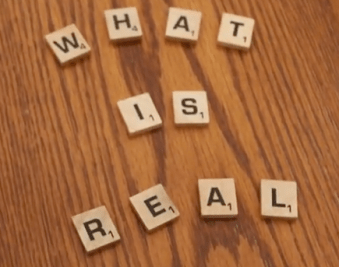
Click Image for Trailer of Surreal
What is real?
Elevator Pitch:
Five adolescents embark on individual journeys to determine what is real, a question that they have been struggling with since early childhood. Surreal will take the viewer through the lives of these characters, bouncing from the “present” to the “future”. All having the connection of a summer camp, the characters experience what seems like an earthquake during their time at camp that leaves them questioning its significance and legitimacy. As they get older, the characters have more visions that are continually perplexing, and for the majority of the show the characters are trying to find meaning with what they see in the visions. These visions are meant to lead them to the ultimate question “What is real?” and causing them to think about some of the common threads of humanity along the way including emotions, beliefs, connections, personal truths, and more. (more…)

World War I Primary Sources Collection at the Library
By Marion Donovan, Assistant Librarian
World War I Primary Sources Collection at the Library
As a librarian at St. Mark’s this fall, I have begun to “weed” through our history collection and have taken a deep dive into time travel. In the past, I was a history teacher myself, so the primary sources that bring the past to life call out to me. A particular section in the library especially rich in those sources covers World War I. Both of my grandfathers fought in WWI on the Allied side, one as a doctor and the other as an engineer, so I grew up with stories and artifacts of “The Great War,” as it was first known. When I applied to graduate school for history at the University of Chicago, I discovered that La Verne Noyes, an American inventor and manufacturer of agricultural equipment, book holders, and windmills, had left the bulk of his fortune to scholarships for Allied veterans of WWI and their direct descendants. These scholarships have now expanded to include 48 colleges. April 6, 2017 will be the one-hundredth anniversary of the United States’ entry into WWI. The European side of the war began in 1914, so many newspaper and magazine articles have already examined new and old perspectives on those events. More will be coming with April 6 in view. We at St. Mark’s are lucky to have an extensive collection of first-hand material (diaries, letters, memoirs, news reports, propaganda, art, photographs) from marshals and generals to privates and civilians on wide-ranging aspects of this war. (more…)

Competing in the FIRST Robotics Challenge
By Kate Sotir, VI Form
Competing in the FIRST Robotics Challenge
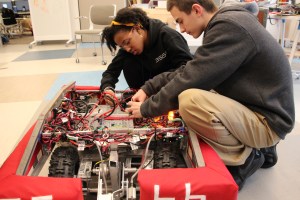
Working in the basement level of the STEM building, using lots of power tools, and occasionally throwing out words like “kickoff,” “drivetrain,” or “STEAMworks,” we are FIRST team 3566, also known as Gone Fishin’.
Gone Fishin’ competes in the FIRST Robotics Competition. FIRST stands for “For Inspiration and Recognition of Science and Technology.” The robotics competition, open to any high school student, was created in order to promote the STEM fields and offer a competitive yet collaborative atmosphere for robotics. In the FIRST Robotics Competition (FRC), teams are given a challenge, in the form of a game, and then have six weeks to build a 120 pound, $10,000 robot to meet this challenge. After those six weeks are up, teams compete in various regional events. The ultimate goal is to go to the world championship, held in St. Louis, where around 800 teams gather to play the game. (more…)

Creating a Three-Minute Film
By Colin Capenito, IV Form
Creating a Three-Minute Film
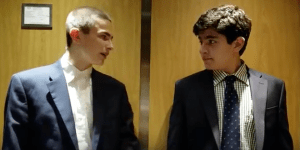
Click Image for Film
This past fall season, I participated in the“Three-Minute Film Project” course that as part of St. Mark’s Saturday. The goal of the course appears basic: each group of five to six students were to produce a complete three-minute film by the end of the seven-week Saturday course. What was not basic, however, was making a good complete film. Three minutes may like a blip of time; in fact, some might even wonder how seven weeks could be spent working on mere three-minutes of film. It’s challenging. (more…)


 LEO
LEO 