
Home » Season 4 (Page 5)
Category Archives: Season 4

Baseball: A Diplomatic Tool Between the U.S. and Cuba
By Matt Walsh, IV Form
Baseball: A Diplomatic Tool Between the U.S. and Cuba
When Mr. Calagione, our varsity baseball coach, first mentioned the prospect of visiting Cuba in the spring of 2017, I was dubious. Although President Obama had shown signs of improving diplomatic relations with Cuba in 2014, I had believed that American travel to Cuba would have to wait several years. The opportunity to immerse myself in the culture of Cuba, a country impoverished by many regimes of cruel dictators and gripped by the historical intervention of the United States and the Soviet Union, intrigued me. I never considered Mr. Calagione’s idea to visit Cuba as a realistic proposal. It was not until he gathered all members of the baseball team in October that the prospect of visiting Cuba became legitimate. The appearance of the word “Cuba” on that piece of paper immediately enlivened me. While I looked forward to playing baseball, enjoying the warm weather, and interacting with locals using my Spanish, the learning aspect of the trip was what excited me the most. The historical context of Cuba from colonialism to the revolution created a unique social, cultural, and political landscape that I was excited to learn about. My eagerness to learn about the livelihoods of those with different social and cultural backgrounds often drove me to engage in what I call “research frenzies”: the hectic act of researching a topic of interest by delving into articles, videos, and photos on the internet using more than thirty tabs. This was often a time consuming (and battery consuming) endeavor that acted in place of actual traveling, and it fulfilled my desire to learn about other cultures. I would always choose travel over feverishly scouring the internet, so the opportunity to visit Cuba for a week energized me. (more…)

Artifact of Learning: What Is Cancer?
By Gillian Yue, V Form
Artifact of Learning: What Is Cancer?
Editor’s Note: This video is from the following assignment in Advanced Biology—
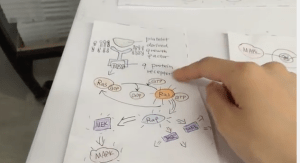
Click Image for Video
Charge: Create an Artifact of Learning* that will clearly explain to someone not in this class: What is Cancer? And How Does it Arise? Your artifact should synthesize the content from this unit (DNA Structure & Replication, The Cell Cycle, Mitosis & Cytokinesis, and Control of the Cell Cycle), as well as integrate new information that you have researched to better make sense of this disease. Your answer should not be a review of EVERYTHING examined; rather you should selectively integrate elements of each topic that help to explain what cancer is and how it arises. Note: This assignment does not ask – how do we treat cancer, detect cancer, prevent cancer, etc. Simply – What is Cancer?
Click here for video.
*Scroll to bottom for definition of an “Artifact of Learning” (more…)
Painting the Underwater Protected “Ocean Park”
By Nicola Hartmann, U Jin Jo, Filip Kierzenka, Ivy Li, and Lucy Martinson, IV Form & Sean Farrell, Paula Hornbostel, Helen Huang, Paige LaMalva, Aidana Maitekova, Isabelle O’Toole, Illia Rebechar, and Sophie Student, III Form
Painting the Underwater Protected “Ocean Park”
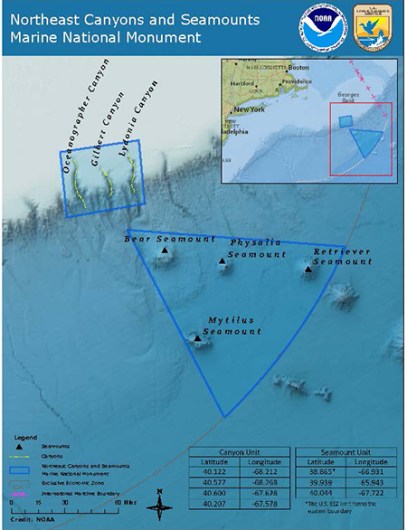
Map of National Monument. 150 miles SouthEast of Cape Cod: 4, 913 square miles.
On September 15, 2016, President Obama designated the Northeast Canyons and Seamounts Marine National Monument (map right) to be the Atlantic Ocean’s first underwater protected area. Open to recreational fishing and phasing out commercial fishing will make this area, the size of Connecticut, a valuable research area and refuge for marine life. Dr. Scott Krauss, senior advisor and scientist at the New England Aquarium, was instrumental in securing this area of crucial habitats with 1,000-year-old deep sea corals, unique characteristics of three canyons — deeper than the Grand Canyon — and four deepwater seamounts — 13,000 feet from the ocean floor. Protected from oil, gas exploration, and overfishing, scientists will be able to observe and understand changes. The marked area will help preserve rare and endangered corals, fish, invertebrates, turtles, and three species of whale.
Students in Studio I made this new protected space their area of investigation. (more…)

Moral Obligation…in Hamlet & a Fetus
By Lulu Eastman, V Form
Moral Obligation…in Hamlet & a Fetus
Hamlet, a Shakespeare play, follows the tragic tale concerning a deeply troubled Danish prince of the same name. Hamlet is forced to confront his traitorous mother and uncle in order to avenge his murdered father, who, as a ghost, has requested Hamlet takes his uncle’s life in order to bring him justice. However, Hamlet is distressed by the thought of committing such a bloody deed. As he wavers through indecision regarding his proposed mission, he also struggles against the drowning weight of his depression, as the toxic environment of the palace causes him to lose faith in the goodness of people. In the novel, Nutshell, by Ian McEwan, the story of the fetus is based off of Hamlet. With the reflective fetus entangled in the plotting of his traitorous mother and uncle, he finds himself in a predicament similar to that of the Danish prince. Although he has yet to even experience life for his own, the fetus has already lost hope for the vitality and decency of humanity. Every moment of his being is spent listening to conversations that only reveal more and more of the villainous and duplicitous ways of his mother and uncle, Trudy and Claude. Both Hamlet and the fetus reach a point where they contemplate committing suicide, as it seems to be the only way to put an end to their pain. However, both decide to live instead. Though both Hamlet and the fetus have cynical views of the world, and both consider suicide, they continue living through their suffering because they have moral obligations, beliefs, and fears that bind them to life. (more…)

Video–How to Sell the Story: St. Mark’s Beyond the Classroom
By Drew D’Orsi, V Form
Video–How to Sell the Story: St. Mark’s Beyond the Classroom
Click on Image for the Video
In my fall St. Mark’s Saturdays course, “How to Sell the Story,” the Admission Office assigned the class a project to create a short admission video. Throughout this experience, we learned how a school sells its product of education and how it engages prospective students and families in order to “sell the story.” My group approached this project by thinking about what sets St. Mark’s apart from other prep schools. What immediately came to mind was the people of St. Mark’s and the opportunities that we have outside of the academic curriculum. Therefore, we came up with the idea of “St. Mark’s: Beyond the Classroom.” My group members (Lizzie Provost, LaQuan Mckever, Kaela Dunne, Jeff Koo) and I were pleasantly surprised that just within our small, five-person group were were able to discover such diversity and to have each member articulate a different aspect of our school community.
Into the Mystic with Thunderhorse: a Q & A
By Shep Greene, Steven Landry, George Littlefield, and Cole Schmitz, VI Form
Into the Mystic with Thunderhorse: a Q & A
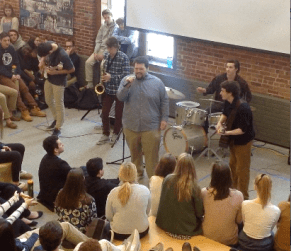
LEO: How did you form the band and who are the members and their roles?
Thunderhorse: Our band consists of four members: Steven Landry, George Littlefield, Cole
Click for “Into the Mystic” live
Schmitz, and Shep Greene. Steven is on the vocals and has been singing since his middle school acting career. He is a member of the Marksmen and choir. George is the drummer, and he has also been playing since middle school. Cole plays the tenor saxophone and has been for seven years. A very talented musician (he is the only person to win the Massachusetts Association for Jazz Education’s “Most Valuable Player” two years in a row), he has been integral to the Jazz Band and now serves as its vice president. Finally, Shep plays the guitar. He has been playing since eighth grade, but started getting serious about it sophomore year. (more…)

“I Simply Speak Best in Metaphors”–Creative Writing at SM
By Alex Colon, VI Form
“I Simply Speak Best in Metaphors”–Creative Writing at SM
Editor’s Note: The Rise of the Short Story and News That Stays News are VI Form elective courses that constitute a key part of St. Mark’s creative writing program. In the fall, students examine the integral parts of a successful short story in order to craft their own. In the spring, students explore poetry, both originally in English and in translation. In News That Stays News, students attempt to define poetry, experiment with form, and establish a personal voice.
Alex Colon’s short story, “Completely Undone,” was composed while using the second person pronoun (you) perspective as the driving force of the story. This is a particularly difficult task, as one risks alienating the reader. For Alex’s second piece here, a poem entitled “The Morning Inconspicuous,” the assignment was simply one of form: write a sestina. However, a sestina is a very complex form of obsession, where the six words at the ends of the lines in the first stanza are repeatedly woven, in a given order, throughout the poem.
Completely Undone
Your heart beats slow- abnormally slow. You are healthy and lean, but your heart is beating along like you are on your deathbed. You must have been in love at some point because there is no other reason why your heart should beat so slow. Your feet struggle to pick themselves up. With every step you are putting yourself in danger. (more…)

I and Other: Thought to Address, with Nods to Kant and Sisyphus
By June Seong, IV Form
I and Other: Thought to Address, with Nods to Kant and Sisyphus
It is of ever more pertinence to address the striated homogeneity, be it through race, sex, or socioeconomic background, that divides the boarding school community. Upon closer observance, it would not be a stretch to conclude that such phenomena in schools is directly representative of the striations that exist in American society today. Andreas Wimmer directly hits at this in his study, “Beyond and Below Racial Homophily: ERG Models of a Friendship Network Documented on Facebook.” He states that such homogeneity, or better phrased, homophily, a principle that states that “birds of a feather flock together,” “might be produced by micro mechanisms other than the psychological preference for same-race alters, including and most importantly the segregation of everyday lives into different domains, which reduces opportunities to meet individuals” (Wimmer 3). (more…)


 LEO
LEO 