
Home » Season 2 (Page 8)
Category Archives: Season 2

Video: Expressing Specific Details and Overall Picture in History
By Jane Watts, V Form
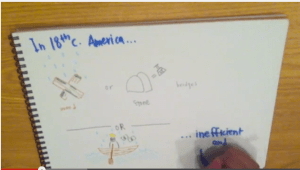 This year is my first year taking any history at St. Mark’s. Taking two histories my junior year, it’s been hard for me to keep up with so much material that we’re given to understand each class. I feel that using art to visualize and work with the material we learn provides me with a more comprehensive understanding of the general picture. In Advanced US History, I’ve recently done two assignments utilizing art. The first assignment was for the Technology project, (more…)
The Pillars of Herakles: At the Bridge Between Europe and Africa
By Stephen Hebert, Religion Faculty
For his tenth labor, the lion-skin-wearing, club-wielding, Greek hero Herakles fetches a bunch of cattle belonging to Geryon, a monster living on an island beyond the far western end of the Mediterranean. Geryon is a fearsome creature, so fearsome that centuries later, Dante Alighieri will depict him in the Inferno as a flying manticore who embodies fraud. In order to reach this great mythical beast, Herakles must go beyond the edge of the known world, past where “Europe meets Libya,” in the words of Apollodorus. To get there, Herakles splits a mountain in two, creating a strait between Europe and Africa now known as the Strait of (more…)
Oh….Chem: The Power of a Narrative in an Advanced Science Course
By Michael Wirtz, Assistant Head of School/Science Faculty
“Negative finds the positive.” I use this phrase often. If you did not know me, you might think I was a pessimist. In fact, I am quite the opposite: I am a teacher and I believe that optimism lies at the core of any good teacher. I share this phrase, “negative finds the positive,” in my attempt to distill the complexities of organic chemistry[1] into something sticky for my students. While most chemistry students experience limited amounts of organic chemistry in high school, it is a discipline featured prominently in my Advanced Chemistry course at St. Mark’s. In fact, organic chemistry is critical to (more…)

TASP Aims To Solve A St. Mark’s Energy Problem
By Liam Monheim V Form, Erica Christensen VI Form, Sarah Robertson V Form, and Jazzy Randle VI Form
 In Advanced Environmental Science, we have stopped doing modules and problem sets and instead are beginning a project that will take us until the end of February. Our class is split into groups of three and four. The project is to create an Essential Question and a Challenge that we will then address and attempt to solve.
The only specification for our Challenge is that it must relate to energy. In order to help generate ideas for Challenge, we wrote down observations on the campus of St. Mark’s relating to energy. We asked administrators, teachers, and students about their thoughts (more…)

Intersecting Struggles
By Brittany Bing, VI Form
Feminism: a word so heavy it often feels like an elephant in the room when mentioned amongst a group of people.
Feminism pisses people off. Feminists are supposed to be man haters and bra-burning idealists who think that women are superior to men. As ridiculous as the stereotype sounds, the true modern feminist doesn’t believe that women are inherently better than men. Unlike misogyny, feminism simply refers to one’s belief in the equality of the sexes. Of course, feminist ideals are exponentially more complex than just wanting equality. Over the summer, I explored these concepts in depth at the Independent School Gender Project held at the Hotchkiss School.
As a veteran conference attendee, I knew what to expect. ISGP is a small, all-women’s conference (more…)

Want to Be More Creative? Get Immersed in Nature!
By Hans Zhou, V Form
Today’s children only spend around 20 minutes outside per day. The number of visits in both national parks and nature-based recreation has steadily declined since the 1980s. Social media and technology are taking away opportunities to go out and explore nature. The modernized life we are living now is much better than the one our ancestors had in terms of medical care and living standards, but are we missing out on the benefits and beauty nature might hold for us? A study by Strayer and University of Kansas psychologists Ruth Ann Atchley and Paul Atchley has shown that immersion in natural settings could improve creativity. The study involved 56 people: 30 men and 26 women at an average age of 28. These subjects were divided into eight different groups to participate in hiking trips without any technology from four to six days (more…)

Modeling H1N1’s Impact on the United States’ Population
By Lucy Cao, IV Form
 The infectious disease, H1N1, that I have modeled, includes six compartments: susceptible 1 (S1), susceptible 2 (S2), pre-infectious, infectious (I), diagnosed and recovered (R).
Susceptible 1 and susceptible 2 refer to the two groups in the susceptible population: S1 is children and the elderly, while S2 is the rest of the population. Children and the elderly are excluded from the total population and placed in a separate compartment because they are more vulnerable to the H1N1 virus and have a greater chance of getting infected. Thus, the rate from S1 to infectious is bigger than the rate from S2 to infectious. I calculated my rates from the susceptible compartments to the infectious compartment with the formula β*S*I/N, in which β is the rate of transmission, S is the population of susceptible, I is the population of infectious and N is the total (more…)

“It’s Complicated”: Relationships in “Interpreter of Maladies”
By Marcus Permatteo, IV Form
In the short story “Interpreter of Maladies” by Jhumpa Lahiri, both Mrs. Das and Mr. Kapasi have complicated relationships with their families. Each has a spouse and several children, yet show unfaithful qualities toward their families. Due to these unfaithful traits, their love for their families is questionable. As the characters reveal their feelings in the story, however, it is clear that Mr. Kapasi loves his family more than Mrs. Das because he makes continuous attempts to save his marriage, he is faithful to his wife, and he continues to love his children. Mrs. Das does none of these things. Mr. Kapasi tried to save his relationship with his wife, while Mrs. Das did not. Neither Mr. Kapasi nor Mrs. Das have loving relationships with their spouses. However, it is clear that Mr. Kapasi tried for a long time to make things work (more…)


 LEO
LEO 