
Home » 6th Season (Page 11)
Category Archives: 6th Season

Vonegut’s Cat’s Cradle: Thoughts on Science, Ethics, and Being Human
By Jiwon Choi, VI Form
Vonnegut’s Cat’s Cradle: Thoughts on Science, Ethics, and Being Human
I am drawn to science. I always loved history and literature, too, but science made sense to me, scratched my itch in a way other subjects never did. As I did chemistry experiments or drew molecular diagrams, I felt part of a never-ending search for truth, an heir to the great, inexhaustible spirit of inquiry.
And every year I saw more evidence for the validity and even nobility of that spirit. Whether it was the laser cutter that lets me instantly carve out trophies for the little kids who come for free robotics classes on Saturdays or a news item about advancements in self-driving cars, science met my expectations time and time again, sparking my imagination and literally making my heart beat faster.
Of course, I’m not ignorant of the repercussions that come along with new discoveries. I’ve read plenty of pieces about the threats AI will pose to the workforce, and I worry about accidents involving autonomous cars. But still, when I did my mental cost-benefit analysis, science was unequivocally a net good. And besides, isn’t it science itself that will find solutions to these problems? Surprisingly to me, it was in a literature class that my attitude about science was shaken forever. Almost immediately upon beginning Kurt Vonnegut’s Cat’s Cradle, my heart sank, filling me with an uncomfortable feeling I couldn’t resolve. (more…)

Examples of Experiences in Chinese Class
Examples of Experiences in Chinese Class
From Ms. Yuhong Xu: “My main pedagogical approach is teaching vocabulary, grammar, and speaking. I focus a lot on speaking, and my students are able to speak and communicate with a stronger confidence in and outside of class.”
On speaking by Caroline Sullivan (III Form): “Speaking is the most important part of learning Chinese. Although learning grammar and new vocab is essential to becoming fluent in Chinese, speaking and being able to communicate in the language is most important. If students only study Chinese grammar, they will never be able to make use of the language and communicate with their Chinese peers. By practicing speaking in class every day, I am making progress in mastering the language.”
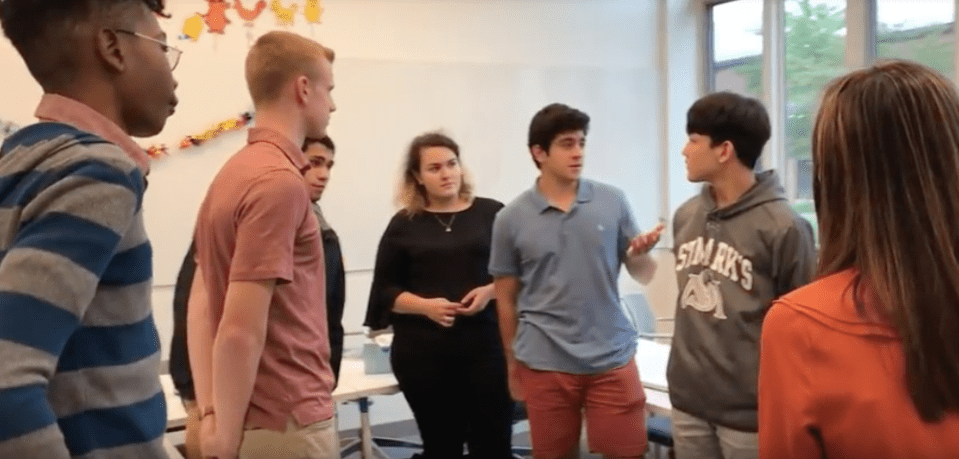
Click on the image for a video of conversation in action.

Treating AAA (Abdominal Aortic Aneurysms)
By Megan Christy, VI Form
Treating AAA (Abdominal Aortic Aneurysms)
I am captivated by one particularly compelling question: how can we manipulate the body so it fixes itself? Could a combination of biology, chemistry, physics, and engineering be the answer?
I began exploring this question in the summer of 2017 while participating in a biomedical engineering program at Boston Leadership Institute. There, I applied this question to the way in which we treat aneurysms. Abdominal aortic aneurysms (AAA) are a “silent killer.” They form when the walls of a blood vessel weaken and are difficult to diagnose due to the lack of symptoms prior to rupture.[1] Once ruptured, AAAs have a mortality rate of 90%.[2] When an unruptured AAA is diagnosed, it is vitally important to treat it in a minimally invasive and lasting manner. (more…)

My Mind’s I(sland)
By Justin Zhang, VI Form
My Mind’s I(sland)
Editors’ Note–The assignment in the VI Form elective, Getting LOST: TASK–Create a visual display in the form of an island: your Mind’s I(sland). The island will be a visual representation of what constitutes your identity (“Mind’s I”) as an individual through five regions: Family; Friends; Home; Body; Your Character.

Size: 4 ft. x 3 ft.

A Brand New Self Through Debate
By Carl Guo, III Form
A Brand New Self Through Debate
“I think I should give some thank-yous. First, I’d like to thank this kid, Rajesh, who gave me one hundred dollars to be in the thank-you speech…” This is how the champion of the US National Speech & Debate Association (NSDA) Nationals began his thank-you speech. I was there, watching the finals, imagining that one day, I could stand there on the stage and give a speech like that in the finals. This dream came true quickly after two months. I won the championship of the Chinese debate nationals last summer. It felt amazing and unbelievable, and in retrospect, my debate journey is a miracle that truly shaped the person I am now.
It was coincident that I found out about debate three years ago when I accidentally saw a poster in front of my extracurricular classroom. I thought it might be an excellent opportunity to practice English since I was not a native speaker, so I signed up for it. This turned out to be the most important decision I have ever made in my life. (more…)

Boys to Businessmen: A Blog About Industrial Real Estate
By Nick Karlsson, Filip Kierzenka, and Nick Bechard, VI Form
Boys to Businessmen: A Blog About Industrial Real Estate

Jed Raymond ’95, Nick B., Nick K., Fil, Howard Hodgson ’74
This past summer, we traveled to the United Kingdom and Poland to experience international business and commercial real estate. The previous summer, we were fortunate to intern at Cabot Properties, an industrial real estate firm in Boston. That summer, we compiled data on the Polish industrial real estate market and economy. This information proved to be beneficial during our 11-day trip when we visited the UK branch of Cabot and met with various other firms and market experts. Our adventures are organized into one website. This trip was an unforgettable learning experience that was made possible by the A.A. Jones Grant. (more…)

Computer Vision: Mapping Poverty in Uganda
By Cathy Zhou, IV Form
Computer Vision: Mapping Poverty in Uganda
This summer, I attended an all-girls program called Ai-4-ALL, formerly known as SAILORS (Stanford Artificial Intelligence Laboratory’s Outreach Summer Program). Inspired by the camp’s model “AI will change the world. Who will change AI?” I believe that people, instead of perceiving artificial intelligence (AI) as threats, should use it as a tool for impact. During this camp, I, along with seven other AI-enthusiasts, created a model for mapping poverty using satellite images. (more…)

Fitzgerald Deviates from Manichaean Plots with Gatsby
By Aditya Mynampaty, V Form
Fitzgerald Deviates from Manichaean Plots with Gatsby
Editors’ Note: In Mr. Eslick’s American Literature class, the students write paragraphs of 300 words or less at the end of each week. The aim is to work toward a thesis for a full essay.
The Great Gatsby lacks a protagonist and an antagonist: an unusual trait for a book. F. Scott Fitzgerald deviates from the standard, Manichaean plots found in most novels to demonstrate the absence of any pure good or evil people in America. The closest character The Great Gatsby has to a protagonist is the narrator, Nick, but no character in the novel is villainized or pitted against him. Fitzgerald creates characters like Gatsby, who collaborates with gamblers and match-fixers, Tom, who cheats on his wife, and Daisy, who runs over and kills a woman. Nick, however, never speaks ill of these flawed people. His unbiased narration style makes it hard to form strong feelings for characters and difficult to root for or against anyone. Even though Gatsby is the epitome of the American Dream, having worked his way to wealth from nothing, Nick never praises him. By preventing his audience from forming opinions about the characters, Fitzgerald communicates the large gray area in American personalities. There are not any virtuous or immoral people; there are Americans. (more…)


 LEO
LEO 