
When “Critical Friends” Are Actually Appreciated
by Samantha Wilson, English Faculty
Who would ever want “critical friends”? Why would you willingly put your work out there when everyone could tear it apart? How could you listen as others discussed your lesson plan or assessment as if you weren’t even there?
These are just a few of the questions that might race through a teacher’s mind when faced with what are known as Critical Friends Groups, which bring anywhere from six to ten teachers together to critique and improve each other’s work on a regular basis using protocols. CFGs have been around since the mid-1990s and were first promoted by the (more…)
The “Toy” World of St. Mark’s: Tilt-Shifting Effect
by The New Media Class of Mr. Christopher Roche, Computer Science and Physics Faculty
The New Media class (a computer science elective) at St. Mark’s explores digital design and desktop publishing 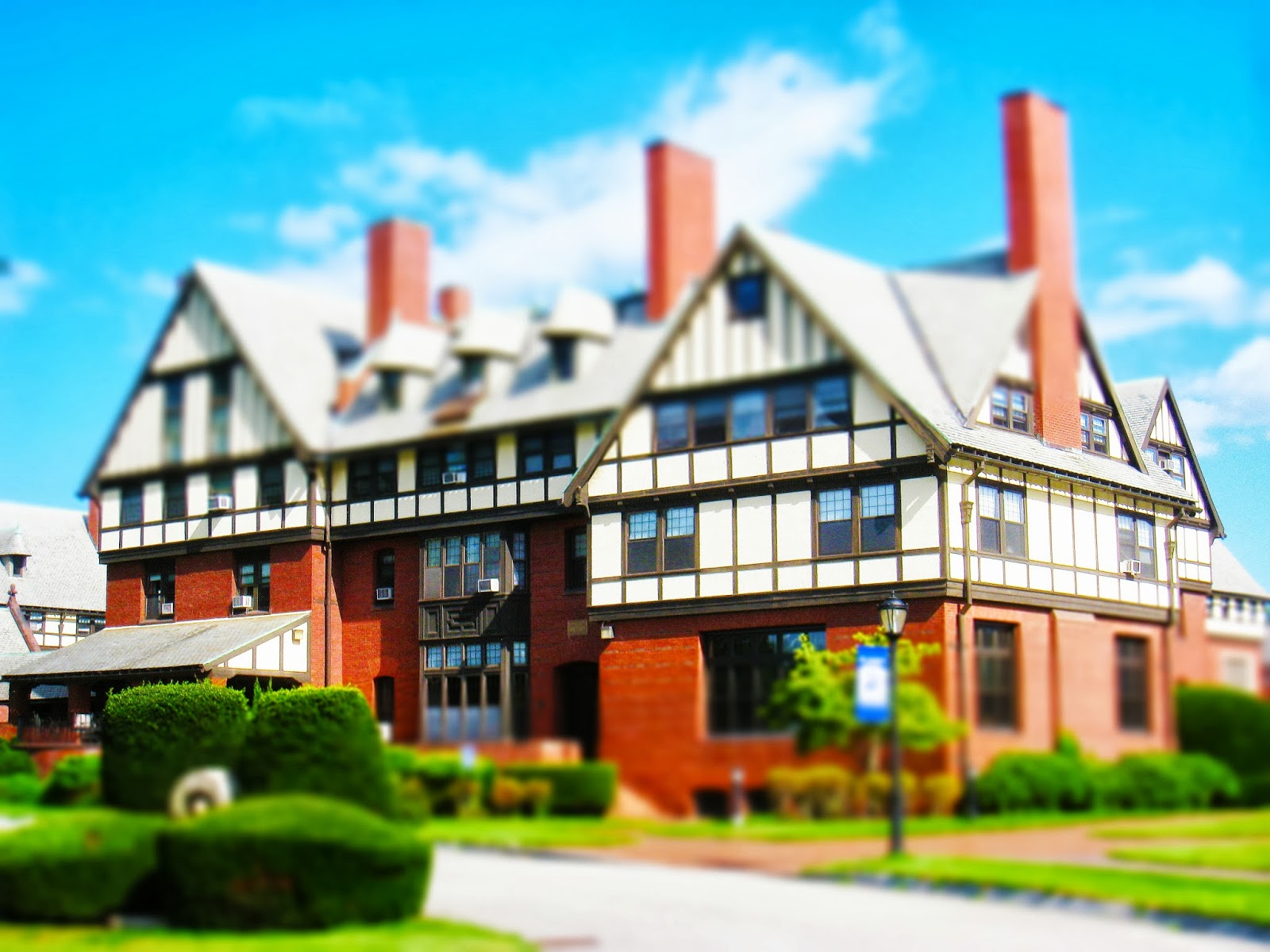 ideas, using 2D and 3D tools like Photoshop, Illustrator, and CAD software. The class seeks to show students the myriad possibilities of design in the digital world. Gabriel Xu, III Form, came to the second class this fall with an amazing image he found that showed the “tilt-shifting” effect (it was his response to a “favorite photo” assignment). When we saw the image, we were so excited to investigate tilt-shifting so we could learn how it works and practice it ourselves. (more…)
22 Hours Across the World
by Mame Kane, V Form
 Last summer, I participated in a new exchange program between St. Mark’s and St. Hilda’s School in Queensland, Australia. Dr. Warren, the head of the Global Citizenship Initiative, introduced me to the program. Dr. Warren taught my Third Form Seminar class in 2011-12, and she ignited my intrigue about the different parts of the world that we studied in that course. I expressed my interest to her about becoming more globally aware and competent, and she emailed me last September. I was asked if I wanted to (more…)
Learning How To Read, Again
by Finnegan Schick, VI Form
Can you remember what it was like to be illiterate? That was an individual dark age, sometime before your fifth or sixth birthday, which was filled with strange symbols: black and white icons sprawled across book pages, on shop windows, and on the sides of trucks. The world of words was the world of your parents, mysterious, silent…and agonizingly boring. Young Alice Liddell, just before her famous journey to Wonderland, asks herself, “What is the use of a book without pictures or conversations?” The answer, for young children, is simple. Such lackluster books, full of meaningless words and dry chapter-headings, are useless. (more…)
Math and Physics as Play
by Jacob Backon, Mathematics and Science Faculty
When I tell people that I teach physics and geometry they usually respond with a grimace or a sound usually reserved for the taste of something rotten. This is almost always followed up with some sort of admission of defeat at the hands of either or both of these subjects. Occasionally, someone will tell me they loved geometry but hated algebra as if the two were competing vacation locales. In many ways, this is like admitting that you love words but hate reading. It seems to me that many people’s opinions of math and physics are negative. (more…)
Sharing About Teaching and Learning
by Lynette Sumpter, Dean of Academics and Director of The Center
This year I’m teaching a religion elective called “Psychology and Religion.” The focus of the course is to examine religion through the lens of psychology, prompting deep thinking about religious phenomena and experiences. My primary work in graduate school was exploring the relationship between psychology and religion, and I found my graduate years of study extremely rewarding. What was most powerful was finishing graduate school with even more questions necessitating a life-long learner approach to engaging these questions! (more…)
Controlling the Handedness of Pesticides: STEM Fellowship Project
by Julie Geng, V Form
Synthesis of R-Furalaxyl Using D-Alanine Methyl Ester via Buchwald-Hartwig Cross Coupling Reaction Followed by Nucleophilic Acyl Substitution
Fundamentals of Chirality
This summer, I was enrolled in an intensive organic chemistry program at Stanford University. This program exposed me to the concept of stereochemistry.
Stereochemistry involves the study of the relative spatial arrangement of atoms that form the structure of (more…)
Experimenting with Hydrogen Through a Rotary Engine
by Alex Padron, VI Form
Last year, Pete Hopkinson and I discovered a shared interest in engineering. We heard about the Class of 1968 Fellowship Grant and decided to do a project, albeit not having any specific idea in mind. Over the weeks after hearing about the grant, we bandied about many different ideas. These projects included everything from working with holograms to generating electricity with tidal power. We came across the idea of a rotary engine in the end because Pete’s dad was working on a rotary engine project for the Navy, and we thought the technology (more…)


 LEO
LEO 