
Home » 2019 (Page 10)
Yearly Archives: 2019

Women’s Movement into the Medical Field in Late 19th Century America: Uncovering the Story of Elizabeth Blackwell
By Rosanna Zhao, VI Form
Women’s Movement into the Medical Field in Late 19th Century America: Uncovering the Story of Elizabeth Blackwell
Section I. Introduction
“Medicine is so broad a field, so closely interwoven with general interests, dealing as it does with all ages, sexes and classes, and yet of so personal a character in its individual appreciations, that it must be regarded as one of those great departments of work in which the cooperation of men and women is needed to fulfill all its requirements.”
Elizabeth Blackwell, 1849
During the nineteenth century, most middle class women did not have a voice or place in the workforce outside the home. Instead, they served as housewives, taking care of the family by doing domestic chores, gardening, or nurturing their husbands and children. However, as the women’s rights movement took root with the Seneca Falls Convention in 1848, women began to fight for a role in the workplace and rebelled against the cult of domesticity. Although they faced obstacles along the way and gender equality in the workplace is still imperfect, there were many successes over the following 150 years.
Throughout the past several decades, the number of employed women increased drastically. Women in the labor force rose by an astonishing 257%.[1] In the medical field, for example, there were no accredited female doctors in the first half of the nineteenth century, but women now make up over a third of doctors in the United States. This remarkable change had roots going back to the mid-nineteenth century, when more women strove to join professional fields, especially the medical field. For centuries, women such as abortionists and midwives had practiced forms of medicine, but the general public did not consider them to be legitimate physicians. Therefore, not only were more women trying to become integrated into the medical field as professional physicians, but they were also striving to attend medical school in order to prove that their knowledge and ability as physicians were equal to those of men. In the early nineteenth century, no medical schools admitted women. In this biased environment, many trailblazers paved the way to allow more women to attend medical schools and become physicians. One of the most notable trail blazers during the mid-nineteenth century was Elizabeth Blackwell, the first woman to earn a medical degree in the United States. Throughout her journey, Blackwell faced many obstacles. However, she was able to become a physician because she was able to persevere through the many challenges in her away. (more…)

A Looming, Dreary Cloud to a Calamitous Crash: Roosevelt, Keynes, and Their Responses to the World’s Greatest Economic Catastrophe
By Matthew Gates, VI Form
A Looming, Dreary Cloud to a Calamitous Crash: Roosevelt, Keynes, and Their Responses to the World’s Greatest Economic Catastrophe
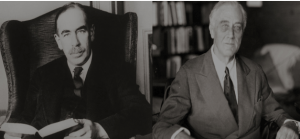
During the “Roaring Twenties,” the United States’ economy boomed; by 1923, the U.S. unemployment rate dropped to an unprecedented 2.4%.[1] In fact, at the end of the decade, the U.S. boasted the largest economy in the world.[2] The laissez-faire economic policies of Republican Presidents Warren G. Harding, Calvin Coolidge, and Herbert Hoover were extremely popular among business owners and Americans during the 1920s, as lowering taxes granted businesses more money to grow and put more money in the pockets of ordinary American citizens.[3] Additionally, Harding’s signing of the Fordney-McCumber Tariff Act, which imposed a tax on foreign goods, caused imported products to be far more expensive than domestic goods. As a result, the tariff incentivized citizens to buy American goods, increasing the profits of American businesses and resulting in an overwhelming expansion in production and jobs.[4] These Republican Presidents believed that government intervention not only hindered personal economic freedom, but they also believed it was wrong and a danger to freedom.[5]

Minnie Vautrin and John Rabe: The Beacons of Humanity during the Nanking Massacre
By Amy Wang, VI Form
Minnie Vautrin and John Rabe: The Beacons of Humanity during the Nanking Massacre
Introduction
On a cold winter morning, about thirty soldiers came to a house. As soon as the landlord answered the door, the soldiers shot him with a revolver. When the landlord’s wife knelt down, asking why they killed her husband, they shot her as well. Upon entering the house, the soldiers dragged a female tenant Mrs. Hsia out from under a table, where she tried to hide with her one-year-old baby. After stripping and raping her, the soldiers bayoneted Hsia in the chest. They then stabbed the baby to death. Meanwhile, some soldiers went to the next room, where Mrs. Hsia’s parents and her two daughters, aged sixteen and fourteen, were hiding. They shot the grandmother when she tried to protect the girls. As the grandfather grasped the body of his wife, they killed him, too. Five to six soldiers raped the two girls and bayoneted both, along with their younger sister, who was also in that room. Before they left, the soldiers murdered the two children of the landlord, the elder bayoneted and the younger split down through the head with a sword.[1]
This was not a horror movie made for the sake of violence and gore. It was one of the countless cases of unspeakable atrocities that took place during the Nanking Massacre in the winter of 1937. (more…)

Red Guards During the Great Proletarian Cultural Revolution
By Justin Zhang, VI Form
Red Guards During the Great Proletarian Cultural Revolution
Introduction
Following Japanese surrender in 1945, China emerged as the victor of the Second Sino-Japanese War after decades of Japanese occupation and eight years of total war. A new series of military struggle for control of China between the Nationalist forces under Chiang Kai-Shek and the Communists under Mao Zedong, who were reluctant co-belligerents allied during the Second Sino-Japanese War. After four years of military conflict, the Chinese Civil War concluded with the triumph of the Communists in 1949 with almost all of mainland China falling under communist control and the remainder of Nationalists escaping to the island of Taiwan.[1] After the proclamation of the People’s Republic of China (PRC), Mao initiated extensive cooperation with the Soviet Union under Stalin’s lead to transform China’s war-ravaged economy into a planned economy closely following the Soviet model.
As Nikita Khrushchev came into power after Stalin’s death in 1953, however, relations between the PRC and the Soviet Union worsened. Khrushchev began engaging in a process of de-Stalinization, criticizing many aspects of Stalin’s leadership, in particular, the confrontation of the West and his cult of personality.[2] Mao, who emulated Stalin’s style of leadership as he developed his own cult of personality, denounced de-Stalinization as Marxist revisionism, a pejorative term used to describe an abandonment of Marxist principles such as the worldwide struggle for communism as the Soviet Union sought peaceful coexistence with the West.[3] The term was later widely used during the Great Proletarian Cultural Revolution as a justification for the persecution of “counter-revolutionaries.” (more…)

Smartphone Chemistry Bonding : Tin (Sn)
By Jason Park, V Form
Smartphone Chemistry Bonding : Tin (Sn)
CLICK HERE for Jason’s slides for his presentation.
Abstract
 There are a total of 83 elements on the periodic table that are stable, or nonradioactive. Of the 83 elements, nearly 70 of the elements (84%) can be found inside of a smartphone. Amongst these seventy, numerous rare-earths contribute to a smartphone’s function. Each element is carefully researched and requires specific chemical processes. However, parts of the world that produce and supply these raw materials often face shortages and cause environmental damages. Although consumers may find a new iPhone exciting to purchase, the materials that constitute the device should be considered. (more…)

Nepos: What Was No Spartan Woman Too Proud To Do?
By Tommy Flathers, IV Form
Nepos: What Was No Spartan Woman Too Proud To Do?
When Ms. Cook and I were going over what I had read over the week sometime early in Window 1, we came across this phrase. I flagged it down as a potential essay topic and have looked forward to exploring it in more detail. I am looking forward to researching the morality of the Greeks and Romans, or how the Romans viewed the morality of the Greeks. Currently, I have almost no knowledge of the subject. All that I know I learned from reading Nepos. I think that it might be “ad scaenam” because in line 5 he also mentions the stage.
Research question:
What could Nepos have written on line 4 of his Prologue? What was no Spartan woman too proud to do? Judging by contextual clues, which option makes the most sense? What evidence from the Latin text supports your claim? (more…)

Project Based Learning in The Global Seminar: The Zamibia Presentation
By Sarah Bechard, Michael Ferlisi, and Sydni Williams, III Form
Project Based Learning in The Global Seminar: The Zamibia Presentation
Editor’s Note: All III Formers took part in The Global Seminar’s project to create a proposal to improve the state of the fictitious country Zamibia. The students collaborated in groups as United Nations Development Programme Sustainable Development Teams. The two artifacts below include the slide presentation that the students delivered to their classmates, teachers, and visitors as well as the video of the presentation.

Click here for Sarah, Michael, and Syndi’s Presentation for Zamibia (more…)

Fundamentals of Photography: A St. Mark’s Saturdays Course
By Waverly Shi, Celine Ma, Hudson Ramirez, Alex Chen, Emma Simon, JB Clarance, Tommy Flathers, Duncan McCarthy, Holden Leblanc, Elon Stefan, Trevor Neff, Peter Nelson
To view slideshow of student images and skill employed, CLICK HERE!!
Fundamentals of Photography: Syllabus
A. Making Great Pictures
- what makes a great picture
- understanding your camera
- selecting the right lens for your photo
- using shutter speed purposefully
- photo shoot – front circle: take a series of photos of something that’s moving and show how different shutter speeds produce different results
B. Aperture and Depth of Field
- understand the inverse relationship between aperture and depth of field
- sharing and critique of photos from previous week
- photo shoot – cemetery: use aperture to create depth of field
C. Lighting
- found or ambient light
- introduced light and flash
- the color of light
- sharing and critique of photos from previous week
- photoshoot – reservoir trail:use lighting creatively


 LEO
LEO 