
Home » 2016 (Page 7)
Yearly Archives: 2016

The Importance of Classics in the 21st Century
By Riley Lochhead, V Form
The Importance of Classics in the 21st Century
Editor’s Note: In Latin III Honors, the students wrote essays to submit to the Eidolon Essay Contest. The prompt called for an explanation and argument for why studying Classics is important in the 21st century.
Studying Classics has helped me with many things such as SAT vocabulary, gaining a better understanding of the foundation of the English language, and having a better grasp on the history of ancient Rome. Although all of these skills are valid examples of the importance of studying the Classics, they are not what makes studying Classics most valuable in the 21st century. It is crucial to continue to educate students in the area of Classics is because Latin and Greek create opportunities for students to be independent critical thinkers who are able to produce their own ideas and to ask questions that provoke them to question their previous assumptions about the topics being discussed. This skill can be applied to many other disciplines and is crucial to development of a growth mindset. (more…)

Math Modeling: Improved System for Ranking Colleges
By Steven Li & Gabriel Xu, V Form and Finn Reams & Thee Ngamsangrat, VI Form
Math Modeling: Improved System for Ranking Colleges
Summary
Our task was to rank undergraduate colleges based on major elements that were most important to us. To solve the problem at hand, we first came up with six general elements of a college that held significance and found specific variables that would quantify each element. After putting all the variables into a ranking function, we adjusted the weights put on each category in correspondence with the importance we believed they contributed. We applied our model to both normal and extreme cases for testing, and we drew a 3D graph that showed the relationship between the final result with two of the variables as well. (more…)

Seventh Day Adventists: FAQ for You
By Abby Moses, VI Form
Seventh Day Adventists: FAQ for You

Click here for the full-size version of the Piktochart! Or scroll down.

Unexpected Life Lessons in Haiti–Lock Picking Skill Learned from a Priest!
By Riya Shankar, IV Form
Unexpected Life Lessons in Haiti–Lock Picking Skill Learned from a Priest!
Desi and I stood outside the bedroom, laughing hysterically as we banged on the door. We had just been locked out of the room for the second time for a reason I could not remember, most likely Natalie and Amanda ganging up on us. Nothing was funnier to us than being stuck on the other side of the door, the four in the room giggling as they listened to us struggle. After about five minutes of the insanity, the priest, Père Reginald, walked out of his room and stared at our red, smiling faces. As he watched the scene carry on, we suddenly stopped, afraid that we had disturbed him. He signaled for us to carry on, smiling at how hard we were trying to get them to open the door. This time, instead of his usual wave or quiet “hello”, he approached Desi and me with the biggest grin on his face. He joined our pounding, this time adding his deep voice saying, “This is the priest. Open the door!” We laughed even harder as he continued trying to talk to them, knowing they wouldn’t listen. He joined our laughing, his jolly laugh filling the room. (more…)

Anarchism 101
By Claudia Chung, VI Form
Anarchism 101
First and foremost, I feel the need to clarify the definition and etymology of the word Anarchism. Etymology traces the word back to its Greek roots of an (without) and arkhos (leader, chief). From the two parts, comes the words anarkhia and anarkhos and, eventually, anarchy and anarchism. All the words have one identical meaning: without rulers. It is due to the common misuse of the word in literature and entertainment media that anarchy has now become synonymous with anomie. Anomie, despite also having its roots in Greek, comes from the word anomia and carries the definition of “lawless.” Now that we have differentiated between anarchy and anomie, we can move on to the true meaning of anarchism. (more…)

GoPro Video Tour of Belize
By Mary Hoffman, IV Form
GoPro Video Tour of Belize

Click here for Video! (Only 2:02!)
I traveled to Belize during the first week of Spring Break with Mrs. Lohwater and 10 other of my peers (Jammil Telfort ’16, Katie Hartigan ’17, Blaine Duffy ’17, Jessica Adams ’17, Grace Barron ’17, Jenny Deveaux ’17, Caroline Bailey ’17, Amanda Christy ’17, Claire O’Brien ’18, and Frank Hua ’19). Our first destination was Blue Creek, which is located in the Toledo area of Belize. In Blue Creek we zip-lined, swam in the creek, went iguana seeking, swam through a cave, went to the Mayan ruins, learned about the culture, and talked with the children who lived there. In this part of Belize, the Mayan culture is still very prominent. For the next part of our trip, we traveled to South Water Caye, which was a 45 minute boat ride (more…)

Modern Day Martins
By Jenny Deveaux, V Form
Modern Day Martins
Much like hip hop music, modern day United States culture is based upon movements for change and the spread of continental ideas.
Hip hop was born in the seventies, and first originated in New York City. The genre was developed largely by African-Americans, but evolved to incorporate nuances from other minority groups such as Latin-Americans. Today, hip hop is a multi-billion dollar franchise that has become a symbol of United States culture because it exemplifies a diverse and influential community that seeks to spread tendentious ideas. Artists like Common, Nelly, Macklemore, and LL Cool J use their prominence in the hip hop genre to address today’s issues. Macklemore did this recently in his song “Same Love,” advocating for marriage equality while producing a track that made the top charts in America. (more…)

Open C Tuning Improvisation with the Guitar (Video)
By Liam Monheim, VI Form
Open C Tuning Improvisation with the Guitar (Video)
During the winter season, I was granted an ACE (Athletic Commitment Exemption, or a season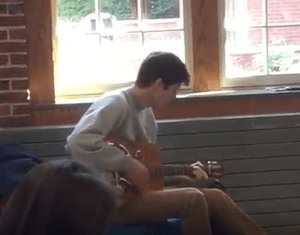 without afternoon sports) in order for me to focus on practicing the guitar. I used this time not only to improve my improvisation skills, but to teach myself a completely new way of approaching the instrument. I learned how to play in an alternative tuning called open C tuning. Standard guitar tuning from lowest string to highest uses pitches EADGBE. In order to make a chord, you must finger the strings with your left hand. However, when you strum the strings in open C tuning without doing any fingering with the left hand, it creates a C Major chord. This means learning new chord fingerings, but it also opens up a sonic richness in the instrument. (Click on picture to play video)
My solo performance (Click here for video) is a structured improvisation using open C tuning. By structured improvisation I mean that I follow a similar structure each time I play it but I decide in the moment what, how, and why I play a certain part.


 LEO
LEO 