
Home » Posts tagged 'Teaching' (Page 6)
Tag Archives: Teaching
Schooling, Inquiry, and the Promise of the “St. Mark’s Saturdays” Program
By Nat Waters, Associate Dean of Academics
Schooling, Inquiry, and the Promise of the “St. Mark’s Saturdays” Program
One of the more transformative developments in my teaching practice in recent years has been the addition in each of my courses of essential questions — formulations that, in the words of Understanding by Design author Grant Wiggins, inspire, “deep thought, lively discussion, sustained inquiry, and new understanding as well as more questions.”
In that same spirit, I’d like to offer an essential question for this LEO piece on the exciting new developments in the St. Mark’s Saturdays program. Begin by thinking of your own high school experience, whether that is as immediate as May 2015, or farther removed than you would care to admit, even in close company:
“Which of the many academic lessons that comprise your high school experience are most memorable, most enduring, and most valuable to life and work in the ‘real world’?” (more…)

Chalk Talk: My RANT on “Old” and “New” Pedagogy
By Adam Jewell, History Faculty
Chalk Talk: My RANT on “Old” and “New” Pedagogy
Ahhhh the smell of those white board markers, I love them, I just love them. If they do anything, they, at the very least, keep us from getting chalk all over us and having students ingest chalk dust like some sort of appetizer. It is my nostalgia for chalk that leads me to ponder something that keeps coming back to me like some sort of bad meal at every restaurant my wife and I ever go to. It is the practice of “chalk and talk” instruction. As the name entails, it is a practice as old as chalk, and well slate; I will confess I have no clue which came into use first. To be more exact, it is also as old as whenever one human sat and talked to another about something one of them was either curious about or “knew” more about. In essence, “chalk and talk” is a representation of the “old style” of teaching. (more…)
The Pillars of Herakles: At the Bridge Between Europe and Africa
By Stephen Hebert, Religion Faculty
For his tenth labor, the lion-skin-wearing, club-wielding, Greek hero Herakles fetches a bunch of cattle belonging to Geryon, a monster living on an island beyond the far western end of the Mediterranean. Geryon is a fearsome creature, so fearsome that centuries later, Dante Alighieri will depict him in the Inferno as a flying manticore who embodies fraud. In order to reach this great mythical beast, Herakles must go beyond the edge of the known world, past where “Europe meets Libya,” in the words of Apollodorus. To get there, Herakles splits a mountain in two, creating a strait between Europe and Africa now known as the Strait of (more…)
Oh….Chem: The Power of a Narrative in an Advanced Science Course
By Michael Wirtz, Assistant Head of School/Science Faculty
“Negative finds the positive.” I use this phrase often. If you did not know me, you might think I was a pessimist. In fact, I am quite the opposite: I am a teacher and I believe that optimism lies at the core of any good teacher. I share this phrase, “negative finds the positive,” in my attempt to distill the complexities of organic chemistry[1] into something sticky for my students. While most chemistry students experience limited amounts of organic chemistry in high school, it is a discipline featured prominently in my Advanced Chemistry course at St. Mark’s. In fact, organic chemistry is critical to (more…)

The Top Of My Head Was Taken Off: At The Dodge Poetry Festival
By Sarah McCann, English Faculty
Poet Ezra Pound called poetry “news that stays news.” I subscribe to that. William Carlos Williams admonished:
It is difficult
to get the news from poems
but men and women die every day
for lack
of what is found there.
And Emily Dickinson, one of my favorites, wrote, “If I feel as if the top of my head were taken off, I know that is poetry.” (more…)

Ebola Coverage: In the News, In Our Classroom
By Kimberly Berndt, Science Department Head
Do we have the time? It is the first, last, and interminable question educators ask when considering whether they should divert from their intended plans. This question came to mind immediately when Lindsey Lohwater and I considered pausing midway through our current Advanced Biology unit in order to focus entirely on the Ebola epidemic – not for one day, but for more than one week. But, to this (somewhat) rhetorical question, my mind, or perhaps my gut, immediately responded. No, we don’t have the time– but we can’t NOT do this.
There exists a palpable tension between meeting the expectations of an Advanced curriculum and providing students with unique, relevant, and dynamic learning opportunities. The expectation that our students will be prepared to perform well on pre-designed exams, such as many AP exams, that are devoid of current events often limits the opportunities that we (more…)

Three Weeks in English Teacher Heaven — Shakespeare’s Globe Theatre
By Jeniene Matthews, English Faculty
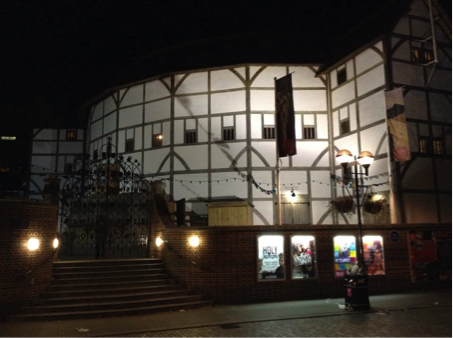 What happens when you bring together 25 passionate, talented, and eager teachers of English and Drama? What happens when that diverse group of people works nonstop in and around The Globe Theatre — one of the most significant performance spaces on the planet? You get magic.
The magic comes from the building itself. Conceived, built, rebuilt, and rebuilt again, the Globe Theatre was the vessel that brought Shakespeare’s genius to the people. Learning its history — and living it and becoming a small part of it — has a way of changing us.

Rome Cannot Be Built In a Day, But It Can Be in a Double Period
By Claire Seidler, VI Form
This past semester I began as a Teaching Assistant for Dr. Harwood’s Latin II Class. I am interested in both Classics and teaching, so this independent study seemed perfect for me. As this semester has gone by, however, I have found that this independent study is more challenging than I had thought.
Teachers are under constant criticism from their students. It was easy when I was the critic, but I have found a deeper appreciation for teachers having gone through it myself. Since I am only a few years (more…)


 LEO
LEO 