
Home » Posts tagged 'STEM' (Page 6)
Tag Archives: STEM
Constructing a Flowchart in Biology
By Amy Wang, V Form
Constructing a Flowchart in Biology
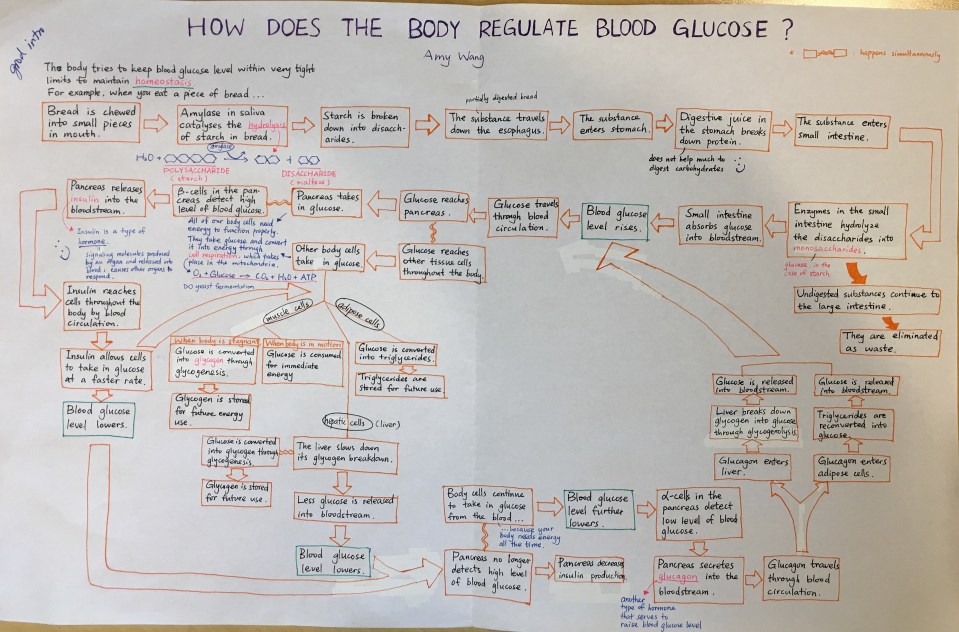
Editor’s Note: The following description of the assignment provided by Ms. Kimberly Berndt, STEM Faculty–
It can be challenging to understand the complex physiological mechanisms and pathways we explore in Biology. One effective strategy to synthesize, organize, and review information is through visual thinking. We employ visual thinking in a number of ways. In this assignment, students were charged with constructing a flowchart to illustrate their current understanding of how carbohydrates are metabolized.
An effective flowchart takes a complex process and simplifies it in a manner that makes the information more accessible. Flowcharts can be found in many Biology textbooks for this reason. However, the process of constructing a flowchart can be an even more effective tool for learning. Constructing a flowchart requires multiple intellectual tasks. (more…)

Unity Based Top-Down Shooter Game: Design and Development
By Gillian Yue, VI Form
Unity based Top-Down Shooter Game: Design and Development
I’ve always been interested in video games since I was a child. To me, playing games was never just entertainment; it was also a special artistic experience. While art can be presented in many forms, visually, auditorily or written down, video games are often a combination of different forms, as they need to contain graphics, sounds, and storylines.
This summer, through the Class of ’68 Grant, I worked on an independent game project for the iOS platform, a simple space-shooter-style game with a small variation: instead of simply shooting “bullets”, the player first collects the bullets by tapping on the randomly code-generated paintballs. I chose to work on this project because I’ve always enjoyed playing Space-Shooting games, and I wondered if I had the ability to create something similar. The bulk of the programming was facilitated by the game engine Unity3d, whereas the graphics and audio used in the game were created respectively in Photoshop and Garageband. So far, I’ve had the time to complete the basic structure and logic of the game, with a few characters, background and soundtracks, and I plan to add more artistic components as my project progresses. (more…)

Penny the Penguin: Parents’ Best Helper!
By Izzy Kim, VI Form
Penny the Penguin: Parents’ Best Helper!
This summer, I attended a tech + business program at MIT called LaunchX, formerly
TO ORDER PENNY:
Please visit www.ami4kidz.com to adopt your own Penny! There you can learn more about Penny and the “Penny” Initative!
You don’t even have to be a parent to adopt a Penny–If you have ANYONE in your family who will love Penny, let them know that Penny is the PERFECT gift for Christmas or New Year’s!
We believe that every kid, no matter who they are, should experience the best childhood. So, for every five Pennies sold, we are donating one to a child fighting autism and order disorders.
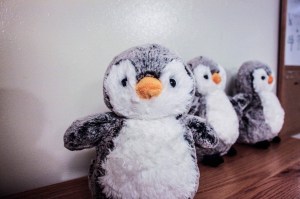
known as MIT Launch. I was admitted as a “hacker,” with my specialities in app development and virtual reality. The ultimate goal of the camp was to create a start-up and pitch the business idea in four weeks. I worked with three other students and together we co-founded Ami. Ami has an ambitious vision of “keeping kids happy and healthy,” and we are taking a first shot at our vision with our pilot product Penny the Penguin. On the outside, Penny might seem like any other penguin plush. Yet, Penny is a kid’s best buddy and the parent’s best helper: Penny can speak parent-crafted messages through a phone-connected bluetooth speaker. Through these messages, children will adopt healthy habits, and parents will find parenting less of a difficulty and more of a joy. Busy parents who accidentally forget to remind kids to “brush their teeth” or “wash their hands” can simply set up a reminder on our accompanying app to have a message played specific times. We tested our products on families living in the greater Boston (more…)

Productivity, Neuroscience, and Deliberate Practice: Deep Work and School (Part 2)
By Dr. Colleen Worrell, Director of the Center for Innovation in Teaching and Learning
Productivity, Neuroscience, and Deliberate Practice: Deep Work and School (Part 2)
With the school year off to a frenetic start, I am returning to the topic of deep work, which I wrote about in LEO last September. My article, “Make Deep Work Your Super Power,” was supposed to be the first in a series of posts that would connect Georgetown Professor Cal Newport’s book Deep Work: Rules for Focused Success in a Distracted World to school and learning. “Deep work” is the ability to focus deeply on a challenging task for a specific period of time, blocking out all distractions in order to get stuff done efficiently and well. The fact that I’m writing part 2 of the “series” one year later proves that I have yet to master this skill. Indeed, my failure to build deep work into my own practice is, in part, what motivates this post. (more…)

A New Reality for Cancer Patients
By Sophie Haugen, VI Form
A New Reality for Cancer Patients
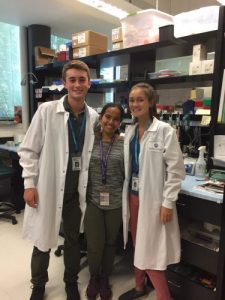 “No radiation. No Chemo. No Cancer.” These are the words on the sign hanging from the window of the Ben Towne Center for Childhood Cancer Research at the Seattle Children’s Research Institute. Partway through my fifth form year in Advanced Biology, Jack Thalmann and I were fortunate enough to be selected for internship positions at a cutting-edge research lab for one month of the coming summer.
This past August, we traveled to Seattle and lived in Magnolia, an urban-residential neighborhood located a few miles north of downtown Seattle, with Max (‘72) and Marcia Witter. Each day we commuted to the Ben Towne Center and worked in the Jensen Lab, which focuses on immunotherapy as a treatment for pediatric cancer. Dr. Michael Jensen (‘82), the director of the Center, has made remarkable strides and has achieved some incredible success. Dr. Jensen and the staff at the Jensen Lab take an innovative approach to fighting cancer: they collect blood samples from pediatric cancer patients, genetically engineer the patient’s own T-cells to recognize cancer cells, and infuse the treatment back into the patient’s body. (more…)
Dreaming Big: Robotics and Circuits Class
By Chris Roche, STEM Faculty
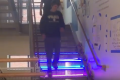
The Circuit Engineering Stair Master
The students in my spring “Robotics and Circuits Engineering with Physical Computing” class did it. They pulled it off!! We now have the “Stair Master” currently installed and running in the stairwell off the first floor of the St. Mark’s STEM building. Students and faculty like the installation, and we are looking forward to a phase two expansion that has music!
The “Stair Master” is an installation that allows a flight of stairs to be interactive with the people walking on them. Here are videos showing the Stair Master in action:
Video 1: Click Here
Video 2: Click Here
Video 3: Click Here
When you step on one of the steps in the “Stair Master”, LED light strips light on the stair you are on. The system uses sensors to know which stair you are on, triggering the appropriate lights. There are versions of interactive stairs already existing, such as the musical staircase at the Museum of Science in Boston. However, the “Stair Master” at St. Mark’s was designed and prototyped exclusively by the “Robots and Circuits” class, using class-built knowhow and our prototyping process. (more…)

Encapsulating Antitumor Nanodrugs
By Michelle Hung, VI Form et al
Encapsulating Antitumor Nanodrugs
Nano-particulate drugs hold great promise in improving drug efficacy because of their enhanced solubility, prolonged retention time, and higher bioavailability with tissues or cells. Generally, these nanoparticles are encapsulated to keep them well dispersed according to specific particle sizes in the manufacturing process. The additional advantage of encapsulation is that a rationally selected coating agent may tailor the pharmacokinetics and control the release of therapeutic nanoparticles in the targeted tissue, simultaneously reducing the toxicity and side effects of drugs. (more…)

STEM Fellow: Probing the Semantic Representations of Emotional and Social Concepts in Autism
By Lucy Cao, VI Form
Probing the Semantic Representations of Emotional and Social Concepts in Autism
Abstract
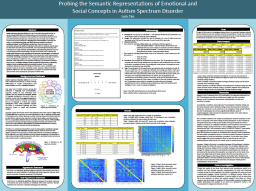
Please Click The Image To Download/See the Poster
Autism Spectrum Disorders (ASD) are a set of neurodevelopmental disorders as shown through difficulties in social interaction and communication as well as repetitive behaviors. Symptoms of ASD manifest at an early age and become most prominent between the ages two to three years old. One major area of defect common among ASD individuals is language and communication, especially the ability to comprehend language and make inferences based on social and emotional context. Recent linguistics studies have shown that there is an association between the ability of individuals with autism to attribute mental states (to themselves and others) and verbal skills. It is found that high-functioning ASD individuals have a less coherent representation of emotional experiences and tend to avoid using emotional terminology. The goal of this study was to examine the relationship between social competence and semantic representation of social and emotional concepts. Knowing that lexical co-occurrences are useful measurements of semantic knowledge, participants of this study were asked to rate pairs of verbs in terms of similarity on a scale from 1 to 5, 1 being very similar and 5 being very dissimilar. Data collected from the typically developing (TD) participants indicates that there is a correlation between social competence and accuracy of similarity ratings of verbs containing social and emotional content. The less socially competent, the less accurate the ratings are. Moreover, such a correlation is not present in verbs of no social or emotional content. However, the investigator failed to identify a significant difference in the ASD population’s perception of emotional and social verbs and the control participants’ perception of these verbs due to reasons of methodology.


 LEO
LEO 