
Home » Posts tagged 'STEM' (Page 11)
Tag Archives: STEM
The Horrific Nazi Experiments During World War II
By Lucy Holland, VI Form
The Horrific Nazi Experiments During World War II
Presently, informed consent is a widely used and understood term – the process of receiving consent from patients before administering a medical intervention on them. But before a court case in 1957[1], only 58 years ago, informed consent was not required in medical practices, which meant that medical practitioners could do almost anything to their patients without them knowing or realizing that it was ethically wrong. In The Immortal Life of Henrietta Lacks, Henrietta’s cells were taken for a culture when she went into Johns Hopkins because of what the doctors eventually discovered was (more…)

The Power of Grants in Student Development
By Camille Banson, VI Form and Ryan Lee, VI Form
Editor’s Note: The Matthews Educational Fund provides grants to students of any form who are good citizens and solid students. Grants are made for special needs such as tutoring assistance, special instruction, seminars, academic experiences of a national or international nature, and personal growth and advancement opportunities. Awards are based on merit and need as determined by a faculty committee. Last year, Camille Banson and Ryan Lee received the Matthews Fund Award to pursue their educational endeavor. Here is an overview of their experience.
Camille Banson:
Over the summer, I participated in a Boston University Summer Program. It ran for two weeks (more…)

Biology Research Paper: Tuskegee Syphilis Study
By Conor Brockway, V Form and Damion Nsiah, V Form
Biology Research Paper: Tuskegee Syphilis Study
The first half of the 20th century was plagued by actions that are deemed unethical and frightening in today’s society. These actions included the spreading of the Jim Crow Laws, the rising of the KKK, and the speculation of the stock market, resulting in the Great Depression. Many Americans now know of these actions and condemn them. However, poor medical practices during this time period were often overlooked. Many doctors, without advanced equipment or proper safety guidelines, would perform procedures on living bodies to see what happened to them. These experiments were often completed without informed consent. One of the most unethical studies that came from the 1900’s was the Tuskegee Syphilis Study. (more…)

The Reality of Health Care (or Lack of It) for America’s Poorest
By Brittany Bing, VI Form
The Reality of Health Care (or Lack of It) for America’s Poorest
The reality of health care in America is rather grim. Compared to our foreign counterparts and prior to the Affordable Care Act, America was one of the few developed countries that lacked a form of universal health care. In Advanced Biology this year, we read Rebecca Skloot’s The Immortal Life of Henrietta Lacks, which showed the complexities between biomedical ethics, race, and access to health care. Henrietta Lacks was a black woman who developed advanced cervical cancer and died in 1951. What followed was one of the biggest injustices in medical (more…)

A Vegan’s Manifesto
By Henry Hirschfeld, IV Form
A Vegan’s Manifesto
“Are you sure you’re getting enough protein?” and “Humans were designed to be omnivores” are common reactions when I tell people I eat vegan. A vegan diet is where one must abstain from all animal products, including meat, dairy products, eggs, and even honey. I became a vegan after working at an organic farm for the first time in the Northeast Kingdom of Vermont. Working in the soil and taking care of the vegetables every day showed me the tremendous amount of work it takes to feed people. At farmer’s markets on the weekends, I was fortunate enough to interact with my customers, and I witnessed first-hand how much they appreciate fresh produce. Mary, my mentor on the farm, helped me realize that 75% of today’s farms are polluted with harmful chemicals which affect the soil quality as well as the (more…)

The Global Seminar Infectious Disease Project: Cervical Cancer
By Ben Hunnewell, Justin Langway, Helynna Lin, and Oliva White, III Form
Editor’s Note: The Global Seminar teaching team worked with all III Formers on an infectious disease project. This is a complex project that involves group work with other members of the III Form and with V Form biology mentors. The final result was exhibited in a poster session, allowing for visitors to do a conference walk and have questions answered by the poster’s creators.
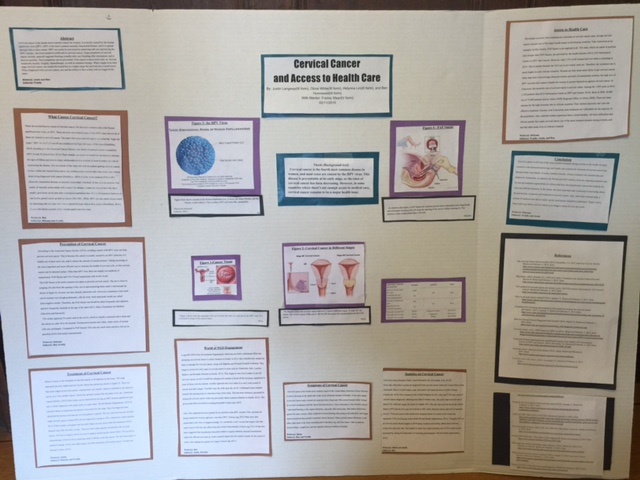 Abstract: Cervical cancer is the fourth most common cancer for women. It is mostly caused by the human papilloma virus (HPV.) HPV is the most common sexually transmitted disease, and it is spread through skin to skin contact. HPV can easily be prevented by practicing safe sex and having the HPV vaccine, but if not treated it could lead to cervical cancer. Some symptoms of cervical cancer include unusual vaginal bleeding (usually after sex), bleeding after menopause, or bleeding between periods. These symptoms can be prevented, if the cancer is discovered early on. (more…)

The S-Word: Meaningful Implementation of Sustainability as a Theme in Curricula
By Lindsey Lohwater, Science Faculty
The S-Word: Meaningful Implementation of Sustainability as a Theme in Curricula
For some, sustainability is a buzzword – a current trend in both popular and educational culture. However, viewing this topic as just the next trend does it a disservice. We are all familiar with those trends that promise to elevate our teaching and help us churn out those elusive well-rounded, critical-thinkers that will change the future of our nation and world. Most of those trends inevitably fizzle out. We cannot allow sustainability to do the same. Inherent in the concept of sustainability (defined as able to last or continue for a long time[1]) is the understanding that it deserves to be methodically infused into our curricula with the (more…)

III Form Physics: First Engineering Design Challenge
By Lindsey Dumond, III Form
III Form Physics: First Engineering Design Challenge
Units 1, 2, and 3 all focused on the same design challenge, which was to create an object with the highest average velocity over two meters. The object also had to be self-propelled and could not leave contact with the track at any time, or it would be disqualified. At the end of unit one, we chose several materials that we thought would be most useful in creating an object that could complete the challenge. We created a first design based on what we knew about physics at that point. In unit two, we built a model of our first design and tried to make it self-propelled. After facing challenges during this step we redesigned and rebuilt. As we redesigned, we were also learning more about physics and concepts that (more…)


 LEO
LEO 