
Home » Posts tagged 'STEM' (Page 10)
Tag Archives: STEM

Outcomes in Team Based Learning in Algebra II
By Mr. Scott Dolesh, Mathematics Faculty
Outcomes in Team Based Learning in Algebra II
My project compares the outcomes of students in Team Based Learning (TBL) Algebra II courses versus students in traditional teacher directed Algebra II courses. I had one Algebra II course that I used the TBL approach, and I had one Algebra II course that I used a traditional teacher directed approach. I also had a colleague who had two Algebra II courses that she taught using the TBL approach, and another colleague who had one Algebra II course that she taught using a traditional teacher directed approach. I compared the outcomes on our two common assessments that we give in Algebra 2: the first being the midterm exam and the second being the final exam. (more…)

A Swift Introduction to Programming with Swift
By Colin Capenito, III Form
A Swift Introduction to Programming with Swift

Apple announcing Swift
A few months ago, the Computer Science 1 class began to learn and work with a programming language called “Swift”. Swift is a programming language, used to create apps for iOS and OS X, the operating systems that run devices such as iPhones, iPads, and Macs. Swift is a relatively new language, only announced by Apple around 19 months ago. When it was announced, many were surprised: new programming languages are not created all that often. Developers were desperate to get their hands on Apple’s new language, curious to see what it could and couldn’t do. Since Swift was released, it has grown into a popular language for anyone looking to create apps for the App Store. (more…)

The European Green Crab
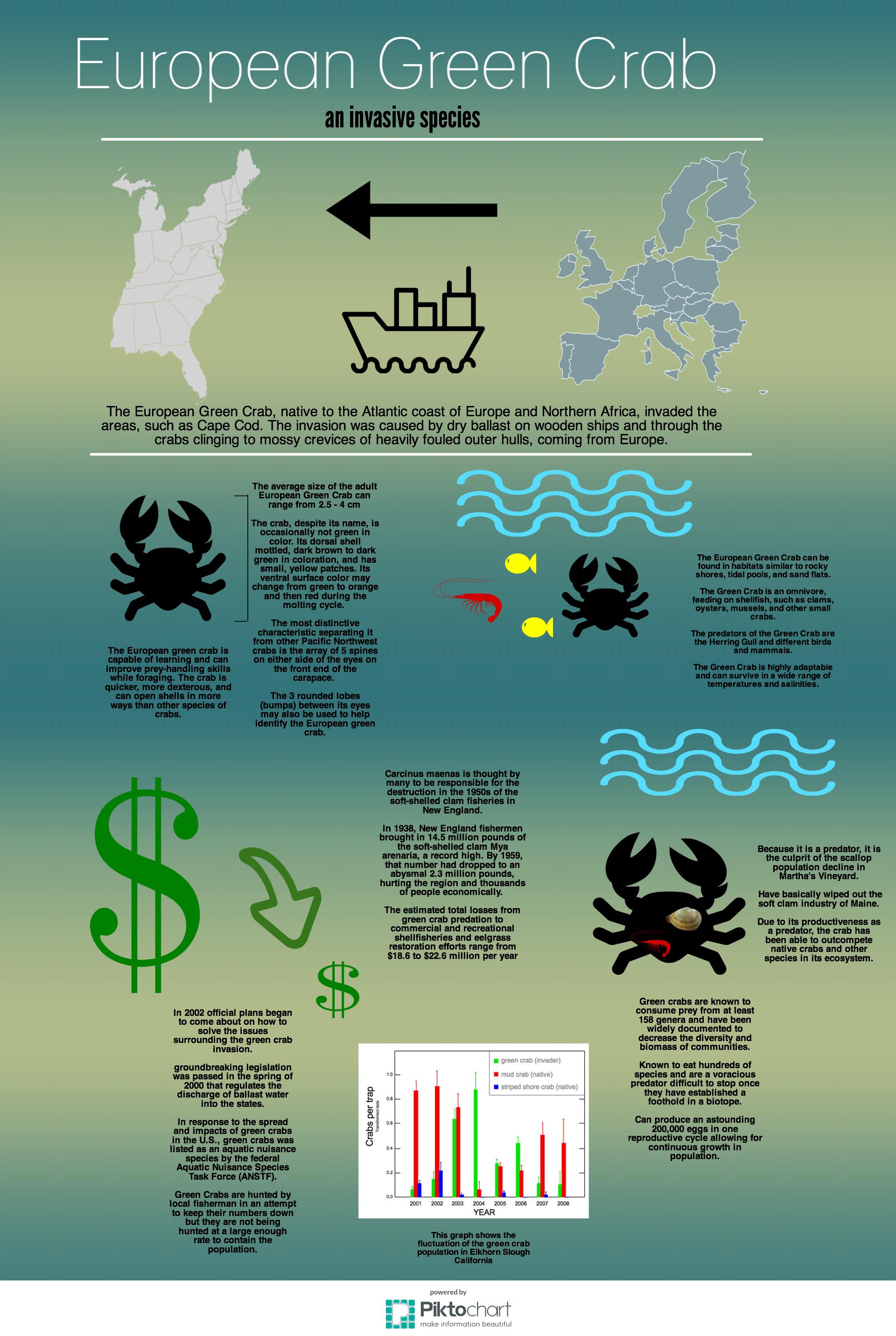
A note from the creators, Ellie Hedison (V Form) and Marcus Permatteo (V Form):
While creating our infographic, we wanted to strike a balance between being informative and visually appealing. The European Green Crab, an invasive species, has transformed ecosystems and communities along the eastern coast of the United States. We hoped to address the main aspects of the Green Crab as an invasive species and how it puts ecosystems in danger through visuals and graphs instead of simply just writing a paper. The European Green Crab was an appealing topic for us because it has a local effect, infiltrating the coasts of Maine and Cape Cod. (more…)

Environmental Blog: Can We Blame Cows for Climate Change?
By Emma Plumb, VI Form
Environmental Blog: Can We Blame Cows for Climate Change?
Editors’ Note: The following piece is one of many blog posts written by Advanced Environmental students; check out the blog here–https://2015enviroblog.wordpress.com/
We all know that burning fossil fuels releases greenhouse gasses into the atmosphere. We can, and should, buy hybrid cars, ride our bikes and put up solar panels to help solve the problem of climate change. But did you know coming home to a steak dinner also contributes to greenhouse gas emissions? Livestock is responsible for 27% of greenhouse gas emissions in the U.S., and 18% of emissions worldwide through enteric (microbial) fermentation and manure management, not even taking into account transportation. (more…)

The Circadian Clock and The Adverse Effects of Elevated CAT Level
By David Baek, VI Form
The Circadian Clock and The Adverse Effects of Elevated CAT Level
Introduction: This project probes into the molecular mechanism of the circadian clock of Drosophila Melanogaster. The circadian clock exists in all living things and regulates the daily rhythm of organisms’ metabolism, behavior, and other outputs that affect the organisms’ development (CH Ko, 2006). The circadian clock is a field that researchers and scientists have yet to fully understand due to the ambiguity of how circadian clock affect invertebrates and vertebrates. To uncover one small aspect of this obscurity, this study seeks to find the effect of sleep deprivation on antioxidant defense in fruit flies. If there were to be a link, the investigation would be significant as the effect will explain how sleep deprivation in humans can lead to the weakening of their antioxidant defense, leading to multiple cardiovascular diseases and pathological conditions such as plaque formation in vessels (Takeda, 2011) (Dominguez-Rodriguez et al, 2009). (more…)

Drunk Worms: My Internship and Research on Alcoholism
By Marissa Huggins, VI Form
Drunk Worms: My Internship and Research on Alcoholism
Alcoholism is a serious disease that affects 7.2 % of the United States adult population.¹ This illness is often influenced by genetics; more people are predisposed to develop alcoholism, or alcohol addiction, based on their DNA. While significant discoveries have been made, there is room for growth in the scientific research field surrounding the genetic factors that contribute to the development of alcoholism.This past summer, I engaged in an eight-week long internship at Rosalind Franklin University under the mentorship of Dr. Hongkyun Kim. Dr. Kim’s work focuses on researching muscular dystrophy, ion channel localization, and alcohol and excitability using Caenorhabditis elegans (C. elegans) as a model organism. (more…)

Alternative Assessment and the Art of Exploring
By Brady Loomer, Science Faculty
Alternative Assessment and the Art of Exploring
Exploring can be described as the simple act of discovery. In a literature course, a student may explore meanings, interpretations, and characters’ lives. In an art course, a student may explore depth, shadow, and space. In a science course, a student may explore the structure of the atom, cellular structure, or action vs. reaction. All these are important aspects of a student’s education, however there is something still missing in that definition of exploring and discovery. Exploratory Sciences tries to delve into a distinctly human condition, the desire to explore new places. If human beings were not inherently curious about what lies over the next hill we would not be one of the most well adapted and expansive species on the (more…)

Babies Are Babies: Multiple Viewpoints on IVF
By Faith White, VI Form
Babies Are Babies: Multiple Viewpoints on IVF
My older siblings are twins, scientifically made in a lab, test tube babies. Scientists wearing white coats created them, in a Petri dish. Just like 4 million other children, they would not be here without science and medicine. Despite its many success stories, however, IVF has brought about many ideological controversies involving religion, ethics, and socioeconomics. But had it not been for my IVF siblings and my mother’s reproductive system resetting, I am not sure that I would ever be born. The question remains, however, should a couple that is struggling to conceive for one reason or another, but is able to pay to use IVF to have the baby that they have always wanted, benefit while (more…)


 LEO
LEO 