
Home » Posts tagged 'Research' (Page 6)
Tag Archives: Research

Competing in the FIRST Robotics Challenge
By Kate Sotir, VI Form
Competing in the FIRST Robotics Challenge
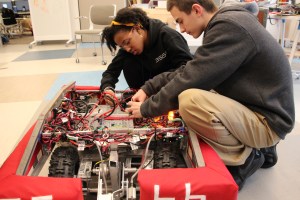
Working in the basement level of the STEM building, using lots of power tools, and occasionally throwing out words like “kickoff,” “drivetrain,” or “STEAMworks,” we are FIRST team 3566, also known as Gone Fishin’.
Gone Fishin’ competes in the FIRST Robotics Competition. FIRST stands for “For Inspiration and Recognition of Science and Technology.” The robotics competition, open to any high school student, was created in order to promote the STEM fields and offer a competitive yet collaborative atmosphere for robotics. In the FIRST Robotics Competition (FRC), teams are given a challenge, in the form of a game, and then have six weeks to build a 120 pound, $10,000 robot to meet this challenge. After those six weeks are up, teams compete in various regional events. The ultimate goal is to go to the world championship, held in St. Louis, where around 800 teams gather to play the game. (more…)

Striving for a Cure at the Ben Towne Center for Childhood Cancer Research
By Katie Hartigan, VI Form
Striving for a Cure at the Ben Towne Center for Childhood Cancer Research

As my eyes scanned the people seated at the conference table around me, I admired each one of them immensely. To know that I was sitting in a lab meeting with the faces behind the statistic “93% remission rate for children with acute lymphoblastic leukemia” was astonishing to me. I stared up at the projector screen taking in the jargon that I partially understood, trying to decipher each scientific discovery and hoping that one day my name too would follow some great breakthrough displayed on a similar projector screen.
In the spring of my junior year, I was selected to travel to Seattle that upcoming August to work at the Ben Towne Center for Childhood Cancer Research at the Seattle Children’s Research Institute. (more…)

Voice in Guitar and in Literature…and in Me
By Shep Greene, VI Form
Voice in Guitar and in Literature…and in Me
The guitar is an integral part of who I am. As my skill has progressed, I’ve seen my appreciation and understanding of music progress as well. Over this past year, I began to delve into a more abstract form of music in improvisation. Within this form of my guitar playing, I began to find striking similarities between music and literature. Imagine every note as a letter and every note coming together to form a riff, with all of the respective letters coming together as one word. By the end of a piece, just as by the end of a novel, you’ll have a powerful message to send out to your listeners and readers. (more…)

Global Connections of Media and Skin
By June Seong, IV Form
Global Connections of Media and Skin
Amidst the chaos that is my life – including the future I must decide upon, the necessity to be “special,” and my attempt to make this post somewhat grammatically correct – I am struck by my simultaneous privilege and ignorance. This privilege and ignorance is exhibited through myriad ways at this very moment: 1) this dull MacBook Air that I am communicating through and that was probably configured by an underpaid or unpaid laborer; 2) the whizzing air conditioning that is breathing on my neck so that I might not die from heatstroke whilst the world scales up a few sweltering Centigrades; 3) the immensity of the world that is within computer click’s reach via Facebook. (more…)

Tuskegee Syphilis Study
By Hans Zhou, VI Form
Tuskegee Syphilis Study
The Tuskegee Syphilis Study symbolizes the oppression towards African Americans in the medical field. This inhumane study conducted by the U.S. Public Health Services (USPHS) lasted for 40 years until an Associated Press story revealed it.

A Novel of Reaction: Larsen’s Passing
By Charlotte Wood, V Form
A Novel of Reaction: Larsen’t Passing
W.E.B. Dubois wrote that “all Art is propaganda and ever must be…” He thought that artists and writers should try to make the world a better place through their work. Nella Larsen, the author of Passing, would not agree. Her novel centers on two light-skinned black women, Clare Kendry and Irene Redfield, and their respective decisions to pass as white or not. I believe she wrote this novel not to persuade the reader of something or to convince them to enact change, but rather to reflect the world how she sees it. The book is a reaction to society, not something for society to react to. Passing itself is portrayed as something that simply is, not wholly good or wholly bad. Both characters participate in it, and so the reader is not meant to side with one over the other. The relative passivity of its message is reflected in the passivity of its main character, Irene. Because she is not active, the intention of the novel is not active. Lastly, the ambiguity of the ending leaves the reader, like Irene, with more questions than answers. (more…)

The Quest to Improve the Teaching of Electricity in the St. Mark’s Introductory Physics Course
By Jacob Backon, STEM Faculty
The Quest to Improve the Teaching of Electricity in the St. Mark’s Introductory Physics Course
Abstract
In response to research indicating significant conceptual misunderstandings of basic electrical concepts, the physics teachers at St. Mark’s incorporated the CASTLE curriculum into the introductory physics course. Over the past few years this curriculum has met with two significant challenges: delivering efficient feedback in response to student model building, and the time it takes to move through the curriculum. Canvas modules were used to address these challenges, and a concept test was administered before and after instruction to gather data on the effectiveness of these techniques. Preliminary data with a very small sample size indicates the CASTLE curriculum and Canvas modules did result in higher scores on the concept test than data reported from a more traditional style of instruction. (more…)

Make Peace With the Day to Enjoy the Evening: Remains of the Day
By Gabriel Xu, V Form
Make Peace With the Day to Enjoy the Evening: Remains of the Day
There’s an old Chinese idiom that roughly translates to, “The person on the spot is baffled, the onlooker sees clearly”. Surely, this applies to the case of Mr. Stevens. As the aged butler in Remains of the Day travels farther away from the house he has been in service of for decades, he starts to see the truth of his former employer more clearly — a truth so dark and ugly that Stevens has tried very hard to escape. Although Mr. Stevens is forced to learn the tragic truth about his former lord and consequently his own small, yet undeniable contribution as butler to the evildoing his master was conducting, the meeting with Ms. Kenton, a former housekeeper, allows him to see value in his decades of service, to make peace with his past, and eventually to move forward into a hopeful future. (more…)


 LEO
LEO 