
Home » Posts tagged 'Literature' (Page 5)
Tag Archives: Literature

World War I Primary Sources Collection at the Library
By Marion Donovan, Assistant Librarian
World War I Primary Sources Collection at the Library
As a librarian at St. Mark’s this fall, I have begun to “weed” through our history collection and have taken a deep dive into time travel. In the past, I was a history teacher myself, so the primary sources that bring the past to life call out to me. A particular section in the library especially rich in those sources covers World War I. Both of my grandfathers fought in WWI on the Allied side, one as a doctor and the other as an engineer, so I grew up with stories and artifacts of “The Great War,” as it was first known. When I applied to graduate school for history at the University of Chicago, I discovered that La Verne Noyes, an American inventor and manufacturer of agricultural equipment, book holders, and windmills, had left the bulk of his fortune to scholarships for Allied veterans of WWI and their direct descendants. These scholarships have now expanded to include 48 colleges. April 6, 2017 will be the one-hundredth anniversary of the United States’ entry into WWI. The European side of the war began in 1914, so many newspaper and magazine articles have already examined new and old perspectives on those events. More will be coming with April 6 in view. We at St. Mark’s are lucky to have an extensive collection of first-hand material (diaries, letters, memoirs, news reports, propaganda, art, photographs) from marshals and generals to privates and civilians on wide-ranging aspects of this war. (more…)

America: A Country of Apple-Eaters (Salinger’s “Teddy”)
By Minjae (Izzy) Kim, V Form
America: A Country of Apple Eaters (Salinger’s “Teddy”)
A seven-year-old child is in a math class learning simple addition and subtraction of single digit numbers. To logically approach this mathematical concept, the instructor employs the analogy of cookies; she asks, “If your mom left four cookies on the table, but your sister took two of the cookies, how many cookies can you eat?” A smart and logical child raises his hand and says, “I can eat two cookies!” and the teacher rewards him with a lollipop for correctly answering the question. However, according to Salinger, that child does not deserve a lollipop because he only answered the question logically, not spiritually. Although logic is the primary approach people take to solve most problems, in “Teddy” from Nine Stories, Salinger highlights the conflict between spirituality and logic and uses this dichotomy to guide the readers in interpreting the enigmatic epigraph. To accomplish this, Salinger kills Teddy at the end of the story to verify Teddy’s esoteric wisdom of spirituality, condemn the American view on spirituality, and usher the readers to interpret things spiritually rather than logically. (more…)

Maturity and Youth: Connection in “For Esme, with Love and Squalor”
By: Helynna Lin, V Form
Maturity and Youth: Connection in “For Esme, with Love and Squalor”
In J.D.Salinger’s novel, The Catcher in the Rye, the rebellious teenage protagonist, Holden Caulfield, leaves school and wanders in New York City, trying to resolve his hatred towards the ingenuine, superficial adult world and his nostalgia of youthful innocence. The theme, conflict between youth and maturity, is continued in Salinger’s short story, “For Esme, with Love and Squalor.” The story takes place in an English town where American soldier Sergeant X prepares himself for battle and meets Esme, a 13-year-old girl who has recently lost her parents in war. They have a good conversation, at the end of which they promise each other to exchange letters. After D-Day, Sergeant X experiences a mental breakdown and loses the courage to live, but the arrival of Esme’s letter brings him strength to continue living. In this story, the wartime and battlefield are representative of the dark sides of society, and the two characters are symbols of adults and adolescents. By describing the connection between Esme and Sergeant X, Salinger proposes that youth and maturity can resolve one another’s struggles and fight against the downsides of society. (more…)

Voice in Guitar and in Literature…and in Me
By Shep Greene, VI Form
Voice in Guitar and in Literature…and in Me
The guitar is an integral part of who I am. As my skill has progressed, I’ve seen my appreciation and understanding of music progress as well. Over this past year, I began to delve into a more abstract form of music in improvisation. Within this form of my guitar playing, I began to find striking similarities between music and literature. Imagine every note as a letter and every note coming together to form a riff, with all of the respective letters coming together as one word. By the end of a piece, just as by the end of a novel, you’ll have a powerful message to send out to your listeners and readers. (more…)

Rebel Without a Cause and Juvenile Delinquency Hysteria
By Harry Kuperstein, VI Form
Rebel Without a Cause and Juvenile Delinquency Hysteria
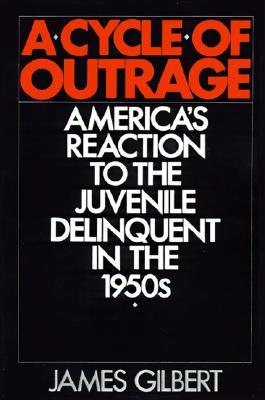 Rebel Without a Cause, starring James Dean, was released in 1955, which was around the peak of the hysteria surrounding juvenile delinquency. Chapter 4 of Gilbert’s A Cycle of Outrage states that from 1953 to 1958, there was a spike in articles about delinquency. The Senate also heard cases of delinquency in 1953, some of which lasted over a decade. And, it soon became evident that movies about teenagers turning towards delinquency, likely propped up by famous icons like James Dean, became wildly popular. Over sixty films centered on the idea of juvenile delinquency were released in the 1950s (Gilbert 85). (more…)

Race in Hurston’s Their Eyes Were Watching God: an Infographic
By Haley Dion, IV Form
Race in Hurston’s Their Eyes Were Watching God: an Infographic
We were given a project that instructed us to create an infographic on a key theme from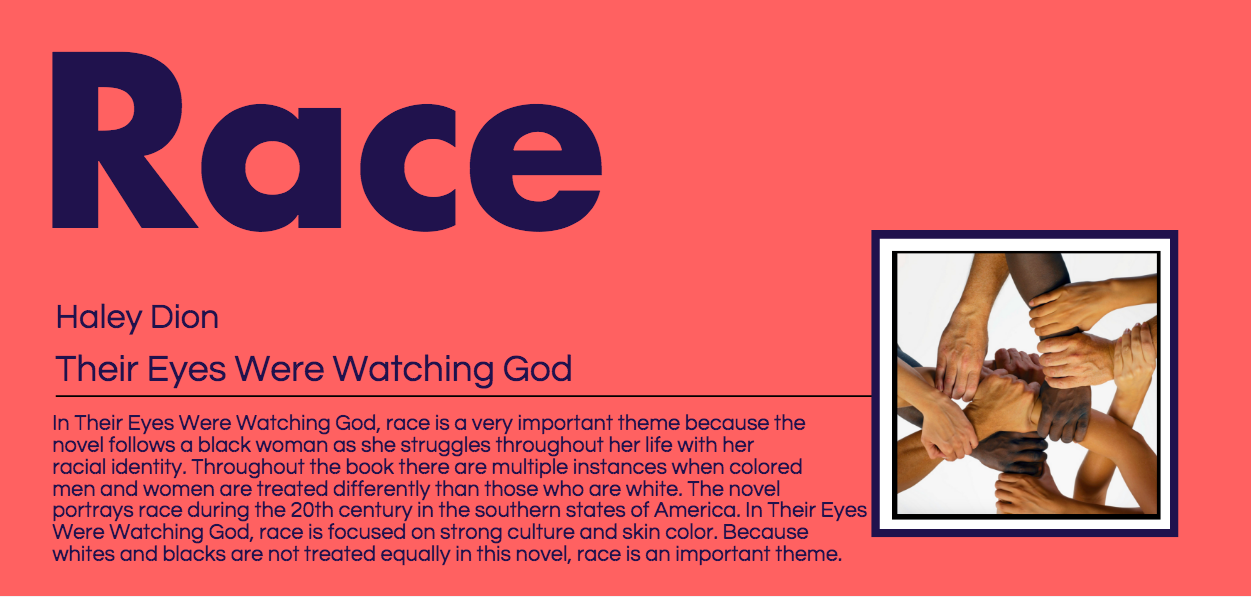 Their Eyes Were Watching God. My infographic focuses on the theme of race in the novel. It discusses the characters’ connections to race, the relationship between race with other themes in the book, and the presence of race throughout the chapters. I enjoyed creating this infographic because I got to look at the importance of a modern day issue in the 1920s/1930s time setting of the novel. The elements of the infographic are below or you can access the full infographic by clicking here. (more…)

Global Connections of Media and Skin
By June Seong, IV Form
Global Connections of Media and Skin

Amidst the chaos that is my life – including the future I must decide upon, the necessity to be “special,” and my attempt to make this post somewhat grammatically correct – I am struck by my simultaneous privilege and ignorance. This privilege and ignorance is exhibited through myriad ways at this very moment: 1) this dull MacBook Air that I am communicating through and that was probably configured by an underpaid or unpaid laborer; 2) the whizzing air conditioning that is breathing on my neck so that I might not die from heatstroke whilst the world scales up a few sweltering Centigrades; 3) the immensity of the world that is within computer click’s reach via Facebook. (more…)

The Early Twentieth Century Irish Boy: A Paradox in Joyce’s “Araby”
By Isabelle Titcomb, IV Form
The Early Twentieth Century Irish Boy: A Paradox in Joyce’s “Araby”
Upon being asked “who is the greatest in the kingdom of heaven?” Jesus replied, “truly I tell you, unless you change and become like little children, you will never enter the kingdom of heaven” (Matthew 18:1-3). Therefore, when a devout child becomes a young adult, he may find that he is no longer welcomed into the kingdom. Such a realization brings confusion and agonizing repression. “Araby” by James Joyce draws upon this notion through the telling of the coming-of-age story of a sheltered Irish Catholic schoolboy harrowed by newfound desire. (more…)


 LEO
LEO 