
Home » Posts tagged 'Interdisciplinary' (Page 6)
Tag Archives: Interdisciplinary

Read the Pilot Episode: GASLIGHT–a Sci-Fi T.V. Series
By Sarah Robertson, Chloe Ene, Jasmine Williams, Madison Falzon, Justin Elkinson, Payton Nugent, Penelope Benkard, Aigerim Bishigayeva, Jasen Ripley, Lilly Drohan, Abby Moses, VI Form
Read the Pilot Episode: GASLIGHT–a Sci-Fi T.V. Series
 GASLIGHT is a nine-episode television sci-fi drama written in Getting LOST II: The Writers’ Room during the Spring Semester.
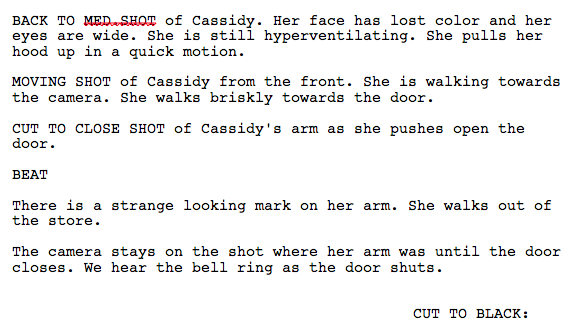
Click here to read the Pilot episode written by Chloe Ene, Sarah Robertson, and Jasmine Williams.
Check out the Official GASLIGHT WEBSITE HERE. (more…)

A Whole Universe Is Out There with Bigger Stuff To Deal With Than My Broken Phone
By Natalie Novak, VI Form
A Whole Universe Is Out There with Bigger Stuff To Deal With Than My Broken Phone
Editors’ Note: This is Natalie’s chapel speech, spoken to the community on 29 January 2016.
Sarah: A reading from Life of Pi by Yann Martel
“I saw my suffering for what it was, finite and insignificant, and I was still. My suffering did not fit anywhere, I realized. And I could accept this. It was all right. It was daylight that brought my protest: No! No! No! My suffering does matter. I want to live! I can’t help but mix my life with that of the universe. Life is a peephole, a single tiny entry onto a vastness – how can I not dwell on this brief, cramped view I have of things? This peephole is all I’ve got!”
Kat: A reading from The Hitchhiker’s Guide to Galaxy by Douglas Adams
“In the beginning, the Universe was created. This has made a lot of people very angry and has been widely regarded as a bad move.”
Good morning.
For those of you who don’t know me, I’m Natalie Novak. Also known as Natalie Novak. And if this still isn’t ringing any bells, I’m also the girl who threw up in chapel her freshman year. For all you freshmen that are afraid you’re gonna embarrass yourselves, I’m here to tell you that people forget about those things fairly quickly. Until they remember a year or so down the road, and then they never forget. So, my advice to you is, if you need to make a quick escape go out that door because this one is harder to open. (more…)

Defining Chaos
By Sean Kim, VI Form
Defining Chaos
Editors’ Note: As a part of a college dorm application, Sean wrote this essay with Mr. Lubick (English faculty). Sean attempted to answer what chaos might be after several sessions of intense discussion and joint writing/editing together with Mr. Lubick. {The prompt for the application appears after the essay.}
It’s interesting to consider whether chaos can be constructive or deleterious, however, the definition of chaos in the article is insufficient. The problem with defining “chaos” is that the very word represents what we don’t really understand. What appears to us as chaotic may in fact have pattern or cause or order beyond what we understand. Chaos is in the perception of the beholder. In terms of ideas, chaos is intellectual terra incognita. In other words, any positive or negative value that we impose upon the idea of chaos originates from our limited scope of understanding of the universe. (more…)

Working Together to Launch the Model UN Club
By Isabelle Kim, Jovin Ho, & Rachel Wang, IV Form and Matt Walsh, Stephanie Moon, & Alan Gao, III Form
Working Together to Launch the Model UN Club
To understand what the “Model United Nations Club” is, it is essential to know the concept of the “Model United Nations” or “MUN”. Model United Nations acts as a simulation of United Nations conferences, in which participants act as delegates. Delegates represent various countries and their ideals, and engage in formal debates over global issues as well as international affairs, through which a resolution is achieved that is, ideally, satisfactory for all parties involved. A couple of weeks prior to the conference, the delegates are assigned respective countries, councils, and issues that will be debated upon, thus allowing delegates ample time to research the topic at hand and formulate their arguments. A big part of MUN is the delegates recognizing that they are not representing themselves, but are a part of a larger picture, having to uphold their country’s beliefs. (more…)

A Novel of Reaction: Larsen’s Passing
By Charlotte Wood, V Form
A Novel of Reaction: Larsen’t Passing
W.E.B. Dubois wrote that “all Art is propaganda and ever must be…” He thought that artists and writers should try to make the world a better place through their work. Nella Larsen, the author of Passing, would not agree. Her novel centers on two light-skinned black women, Clare Kendry and Irene Redfield, and their respective decisions to pass as white or not. I believe she wrote this novel not to persuade the reader of something or to convince them to enact change, but rather to reflect the world how she sees it. The book is a reaction to society, not something for society to react to. Passing itself is portrayed as something that simply is, not wholly good or wholly bad. Both characters participate in it, and so the reader is not meant to side with one over the other. The relative passivity of its message is reflected in the passivity of its main character, Irene. Because she is not active, the intention of the novel is not active. Lastly, the ambiguity of the ending leaves the reader, like Irene, with more questions than answers. (more…)

Make Peace With the Day to Enjoy the Evening: Remains of the Day
By Gabriel Xu, V Form
Make Peace With the Day to Enjoy the Evening: Remains of the Day
There’s an old Chinese idiom that roughly translates to, “The person on the spot is baffled, the onlooker sees clearly”. Surely, this applies to the case of Mr. Stevens. As the aged butler in Remains of the Day travels farther away from the house he has been in service of for decades, he starts to see the truth of his former employer more clearly — a truth so dark and ugly that Stevens has tried very hard to escape. Although Mr. Stevens is forced to learn the tragic truth about his former lord and consequently his own small, yet undeniable contribution as butler to the evildoing his master was conducting, the meeting with Ms. Kenton, a former housekeeper, allows him to see value in his decades of service, to make peace with his past, and eventually to move forward into a hopeful future. (more…)

Akshaya Patra: Addressing Both Hunger and Education in India
By Yusra Syed, IV Form
Akshaya Patra: Addressing Both Hunger and Education in India
India is the world’s largest democracy and the second most populous country in the world – with over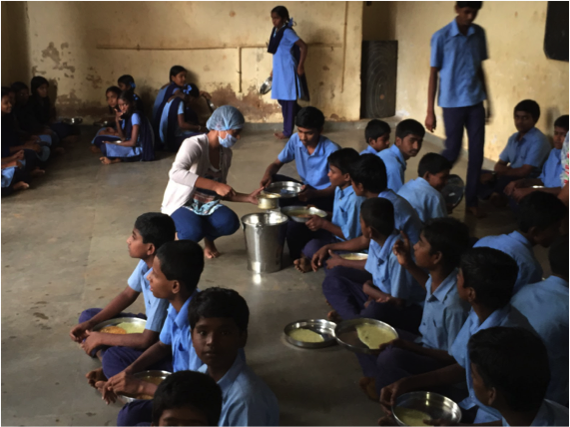 1.2 billion people. It is expected to be the most populated in the world by 2022. India is booming and, by many measures, is the world’s fastest growing big economy. Challenges of urban poverty in India are tied with the challenges of the country’s fast development. Cities are fostering poverty and hunger at a scale and extent unseen before. Nearly 70% of Indians live on less than $2 a day, with 61 million malnourished children – 1/3 of all the malnourished children in the world. This is causing too many children to choose food over education. (more…)

The Great Gatsby: Chapter 10
By Eric Zhang, V Form
The Great Gatsby: Chapter 10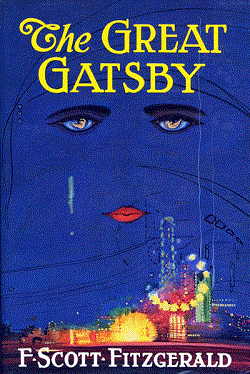
(Editors’ Note: In Ms. Matthews’ American Literature class, this assignment prompted students to create a 10th chapter of Fitzgerald’s The Great Gatsby, utilizing Nick Caraway’s melancholic tone and including some type of closure for the characters)
It had been five years since the funeral, and I finally returned to this city that I once thought was haunted. Everything was so depressing. There were no sounds of the orchestra playing or shimmering sights of the girls wearing fancy dresses with decorations on their shoes. The city of New York had changed since that October in 1929, what was later called Black October. I wandered the streets of New York, and ultimately, I was pulled back to the Eggs and Gatsby’s mansion. What was once a (more…)


 LEO
LEO 
