
Home » Posts tagged 'Innovation' (Page 5)
Tag Archives: Innovation

World War I Primary Sources Collection at the Library
By Marion Donovan, Assistant Librarian
World War I Primary Sources Collection at the Library
As a librarian at St. Mark’s this fall, I have begun to “weed” through our history collection and have taken a deep dive into time travel. In the past, I was a history teacher myself, so the primary sources that bring the past to life call out to me. A particular section in the library especially rich in those sources covers World War I. Both of my grandfathers fought in WWI on the Allied side, one as a doctor and the other as an engineer, so I grew up with stories and artifacts of “The Great War,” as it was first known. When I applied to graduate school for history at the University of Chicago, I discovered that La Verne Noyes, an American inventor and manufacturer of agricultural equipment, book holders, and windmills, had left the bulk of his fortune to scholarships for Allied veterans of WWI and their direct descendants. These scholarships have now expanded to include 48 colleges. April 6, 2017 will be the one-hundredth anniversary of the United States’ entry into WWI. The European side of the war began in 1914, so many newspaper and magazine articles have already examined new and old perspectives on those events. More will be coming with April 6 in view. We at St. Mark’s are lucky to have an extensive collection of first-hand material (diaries, letters, memoirs, news reports, propaganda, art, photographs) from marshals and generals to privates and civilians on wide-ranging aspects of this war. (more…)

Competing in the FIRST Robotics Challenge
By Kate Sotir, VI Form
Competing in the FIRST Robotics Challenge
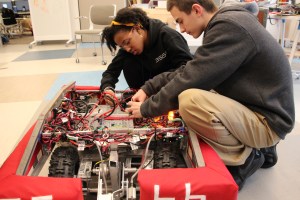
Working in the basement level of the STEM building, using lots of power tools, and occasionally throwing out words like “kickoff,” “drivetrain,” or “STEAMworks,” we are FIRST team 3566, also known as Gone Fishin’.
Gone Fishin’ competes in the FIRST Robotics Competition. FIRST stands for “For Inspiration and Recognition of Science and Technology.” The robotics competition, open to any high school student, was created in order to promote the STEM fields and offer a competitive yet collaborative atmosphere for robotics. In the FIRST Robotics Competition (FRC), teams are given a challenge, in the form of a game, and then have six weeks to build a 120 pound, $10,000 robot to meet this challenge. After those six weeks are up, teams compete in various regional events. The ultimate goal is to go to the world championship, held in St. Louis, where around 800 teams gather to play the game. (more…)

1-Take Video: Lactase Persistence
By Cordelia (Cricket) Dotson, V Form
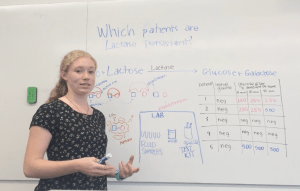
Editor’s Note: The students were charged with designing an experiment to determine if five individuals were or were not lactose tolerant. After designing and completing the experiment they were given instructions on publishing the results in a 1-take video (instructions at bottom of the article).
Please click here or on the image below to see Cricket’s video on lactase persistence:

Creating a Three-Minute Film
By Colin Capenito, IV Form
Creating a Three-Minute Film
Click Image for Film
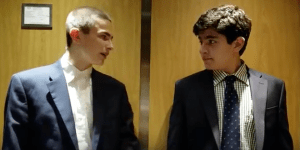
This past fall season, I participated in the“Three-Minute Film Project” course that as part of St. Mark’s Saturday. The goal of the course appears basic: each group of five to six students were to produce a complete three-minute film by the end of the seven-week Saturday course. What was not basic, however, was making a good complete film. Three minutes may like a blip of time; in fact, some might even wonder how seven weeks could be spent working on mere three-minutes of film. It’s challenging. (more…)

Lindsay Nielsen Photography: Remarkable in the Unremarkable and Exceptional in the Unexceptional
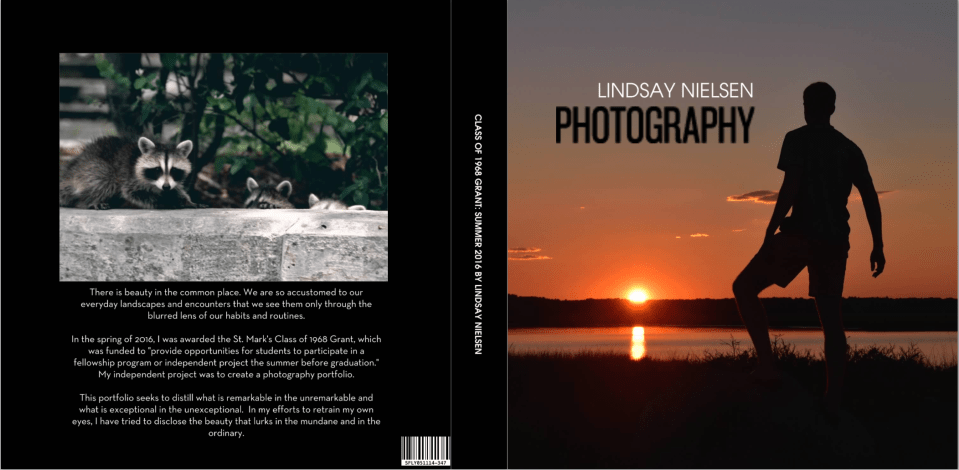 My first camera was a $200 Nikon Coolpix that I bought with all of my babysitting money the summer I turned 13. I had always loved photography and the idea of capturing moments we can’t get back. When I got older, I started watching Youtube videos and teaching myself how to take more advanced pictures. My mom was always asking me where her Canon DSLR was, because I would constantly borrow it to take photos of our two Vizslas. During sophomore year my godfather, Joseph Ratner, gave me his old Nikon D3100 and I was elated. It was my first serious camera, and I had every intention to make the most of it. Photography has always been a passion of mine and it was an amazing moment hearing that I was one of the recipients of the Class of 1968 Grant. I built this portfolio the summer after my junior year and I will continue to use my camera to capture everything around me.
The Future of Libraries and the St. Mark’s Library
By Coco Zephir, Head Librarian
The Future of Libraries and the St. Mark’s Library
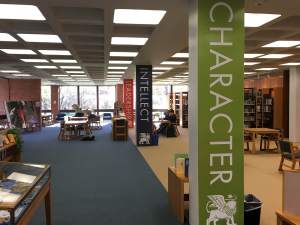 Libraries are ever changing in both form and function. One aspect currently at the center of library innovation is user-experience (UX). UX focuses on meeting the needs of patrons to improve their experiences by making them more impactful and meaningful. UX is a reiterative process that involves constant conversation with your community. Libraries using UX are implementing human-centered design, or design thinking, to better understand their patron base. Human-centered design, “focuses on defining and then resolving concerns by paying attention to the needs, aspirations, and wishes of people” (Peet 2016). (more…)

Voice in Guitar and in Literature…and in Me
By Shep Greene, VI Form
Voice in Guitar and in Literature…and in Me
The guitar is an integral part of who I am. As my skill has progressed, I’ve seen my appreciation and understanding of music progress as well. Over this past year, I began to delve into a more abstract form of music in improvisation. Within this form of my guitar playing, I began to find striking similarities between music and literature. Imagine every note as a letter and every note coming together to form a riff, with all of the respective letters coming together as one word. By the end of a piece, just as by the end of a novel, you’ll have a powerful message to send out to your listeners and readers. (more…)

Shakespeare’s The Tempest: Missing Piece Storyboards
By Daisy Williams, Steven Landry, Teagan Ladner, Grace Gorman, Sam Lauten, Riley Lochhead, Jess Adams, Tracy LeBlanc, Maeve McCuine, Caroline Bailey, and Kahler Mabbs, VI Form
Shakespeare’s The Tempest: Missing Piece Storyboards
Between Season Three and Season Four of LOST, the writers (for ABC and in 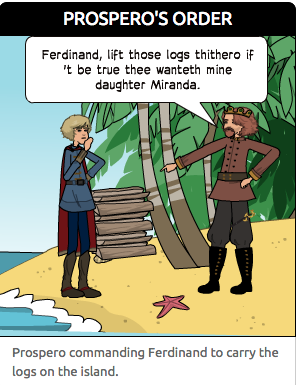 conjunction with Verizon) produced 13 short (< 4 minutes) “mobisodes” or “webisodes” that divulged scenes that didn’t appear in the first three seasons, but yet were considered part of the canonical narrative. These were called “Missing Pieces.” In Getting LOST, students were assigned to create a four-panel storyboard of a “Missing Piece” from Shakespeare’s The Tempest that they could imagine and create to be part of any aspect of the story from any point in history (from 5000 years ago to the unseen elements of Shakespeare’s plot to the present day ramifications of the characters’ actions). The storyboard–a graphic illustration that previews what would be staged or filmed by actors–could be crafted in any format or program.
Below are the varied storyboards created. Keep scrolling! (more…)


 LEO
LEO 