Home » Posts tagged 'Innovation' (Page 3)
Tag Archives: Innovation
Hosting the NACLO National Linguistics Competition
By John Camp, English Faculty & Director of Student Enrichment
Hosting the NACLO National Linguistics Competition
Alternate title: “When a Freshman Stops By Your Office and Two Weeks Later You’re a Site Host and Proctoring a Three Hour Linguistics Competition for Seven Students!”
While toiling over thesis statements and parallel structure in the writing of my IV Form students, I heard a knock on my office door and saw a smiling student. III Former Clara Hua introduced herself to me and asked if I knew anything about the NACLO linguistics competition. I said no, and then Clara explained it all to me. She wondered if I, through my Enrichment position, could potentially make St. Mark’s a site host so that she could compete. Since I am fascinated by cool ideas and I love when students want to compete in academic challenges, I told Clara that I would look into it. Soon, I sojourned down a rabbit hole of links and queries through the world of linguistics. Through NACLO (the North American Computational Linguistics Olympiad via http://nacloweb.org/), I learned how to establish St. Mark’s as a NACLO high school site and myself as a site coordinator. I emailed Clara to tell her, and while she set off to advertise the competition among students, I realized that I needed to know what the heck, in fact, a computational linguistics competition actually is! (more…)
Project Based Learning in The Global Seminar: The Zamibia Presentation
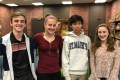
By Alicia Souliotis, Andrew Cheon, Elise Gobron, and Tommy Flathers, III Form
Project Based Learning in The Global Seminar: The Zamibia Presentation
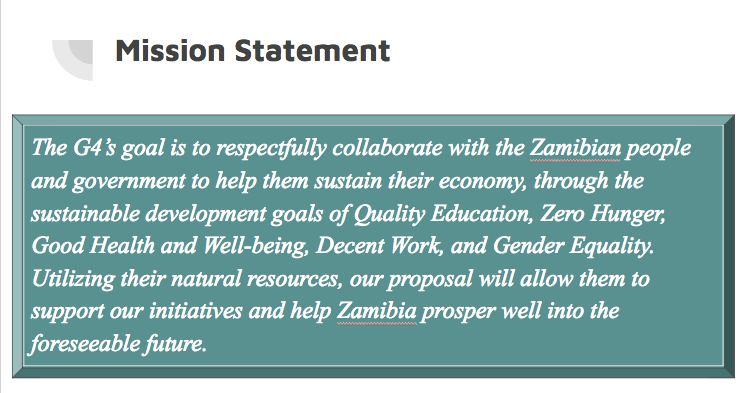
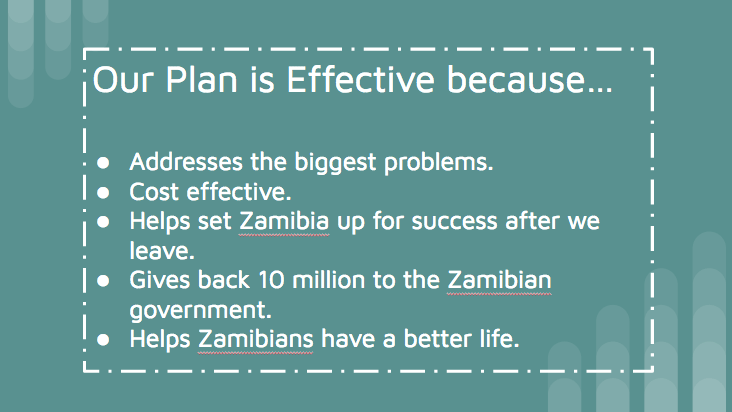
Editor’s Note: All III Formers took part in The Global Seminar’s project to create a proposal to improve the state of the fictitious country Zamibia. The students collaborated in groups as United Nations Development Programme Sustainable Development Teams. The artifact below is part of the presentation that the students delivered to their classmates, teachers, and visitors.
Please click here for entire presentation.
Self-Paced Learning in Latin III and III Honors
By Jeanna Cook and Dr. Heather Harwood, Classics Faculty
Self- Paced Learning in Latin III and III Honors
The Classics Department is trying something new this year: self-paced learning. We kicked off this departmental goal almost accidentally as we planned for separate courses in separate places this past summer. Dr. Heather Harwood was working on revamping the Latin III Honors course to better support students who continue with the language in Advanced Latin Readings thereafter. Jeanna Cook was looking for a way to restructure the Latin III course to better serve incoming students who place into Latin III. In our first department meeting of the year, we realized that we were attempting to solve different problems, but that we had designed curricula that pulled from the same methodology. Self-paced learning, assisted by the module structure in our LMS, Canvas, offered a common means by which we hoped that we could achieve our individual course goals. (more…)

The Pitch Project TV Show Winner: “The Second Reality”
By Summer Hornbostel, Pete Nugent, and Hailey DuBose, VI Form
The Pitch Project TV Show Winner: “The Second Reality”
Title: “The Second Reality”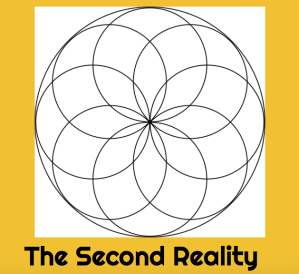
Logline: If the first reality fails, there will always be the second one.
Elevator Pitch: “The Second Reality” is a show about alternate realities, and how the decisions that characters make affect their futures. If you think about it, every decision that we make can have multiple different outcomes, meaning that there are multiple different realities that we could possibly live out. In our show, “The Second Reality”, there is no such thing as one reality. You live one reality, but some people are given the chance to go back and change their biggest mistake, thus leading to their second reality. However, characters don’t know that they have the opportunity to go back, otherwise they might live their first reality without care. While living their second reality characters are able to remember their first one in order to justify it as actually being reality.
Synopsis: In our show, “The Second Reality”, we explore what it would be like to have the opportunity to go back and change our biggest mistake. In the show, we follow four stories of four different people going through various times in their lives. They have to deal with the everyday struggles in life that we do, but there’s one catch. They’re able to go back and change their biggest mistake. As soon as the characters make a mistake that negatively alters their own life and the lives of others, the universe (more…)

Penny the Penguin: Parents’ Best Helper!
By Izzy Kim, VI Form
Penny the Penguin: Parents’ Best Helper!
This summer, I attended a tech + business program at MIT called LaunchX, formerly
TO ORDER PENNY:
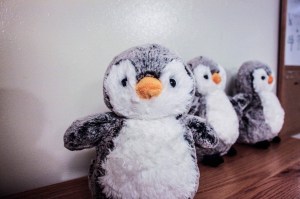
Please visit www.ami4kidz.com to adopt your own Penny! There you can learn more about Penny and the “Penny” Initative!
You don’t even have to be a parent to adopt a Penny–If you have ANYONE in your family who will love Penny, let them know that Penny is the PERFECT gift for Christmas or New Year’s!
We believe that every kid, no matter who they are, should experience the best childhood. So, for every five Pennies sold, we are donating one to a child fighting autism and order disorders.
known as MIT Launch. I was admitted as a “hacker,” with my specialities in app development and virtual reality. The ultimate goal of the camp was to create a start-up and pitch the business idea in four weeks. I worked with three other students and together we co-founded Ami. Ami has an ambitious vision of “keeping kids happy and healthy,” and we are taking a first shot at our vision with our pilot product Penny the Penguin. On the outside, Penny might seem like any other penguin plush. Yet, Penny is a kid’s best buddy and the parent’s best helper: Penny can speak parent-crafted messages through a phone-connected bluetooth speaker. Through these messages, children will adopt healthy habits, and parents will find parenting less of a difficulty and more of a joy. Busy parents who accidentally forget to remind kids to “brush their teeth” or “wash their hands” can simply set up a reminder on our accompanying app to have a message played specific times. We tested our products on families living in the greater Boston (more…)

ASL Sign Language to Popular Songs
By Samantha Sarafin, VI Form
ASL Sign Language to Popular Songs
In the spring term of St. Mark’s Saturdays, I created and taught this course: “In this course you will learn and practice the foundational elements of American Sign Language, from alphabet-based finger-spelling to more specific signs in vocabulary units. You will learn essential questions and phrases to communicate effectively in ASL and engage with various activities to practice ASL with your peers. You will also learn the history and social contexts of American Sign Language to develop an appreciation for the diversity and cultural richness of the deaf community.”
I designed the final project to be a video performance of an ASL song cover. Each student
Please click image for full video!
found resources and learned the signs to perform one whole song in ASL. Students spent time in and out of class working on the project and presented their videos in the final class. The goals of the assignment were to learn ASL vocabulary, understand how to sign songs, understand ASL word order, and practice sign fluency. This video is a compilation of each of the covers created by the students.
The School of Athens’ Tableau Vivant . . . & Memes!
By Keely Dion, Cooper Sarafin, Dylan Sotir, & Charlotte Wood, VI Form and Reevie Fenstermacher, IV Form
The School of Athens’ Tableau Vivant . . . & Memes!
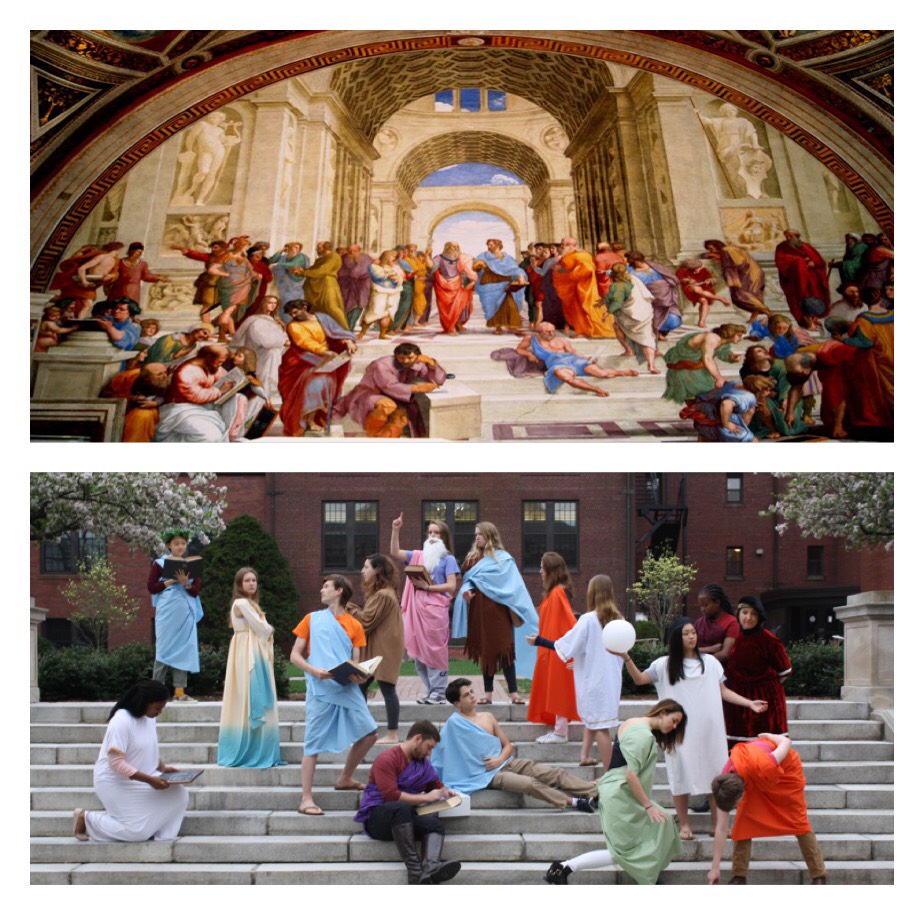 Χαιρετε! Over the course of this school year, we, the Greek II class have put together our Classics Diploma Project, an analysis and celebration of Raphael’s The School of Athens. Our inspiration for this project came from many different places. In class, we’ve read the works of great Greek writers, such as Aristophanes, Plato, and Xenophon, three authors who present different accounts of Socrates’ life. Charlotte Wood, one of the students in the class, had traveled to Rome in the summer of 2015, and while she was there she saw Raphael’s Rooms in The Vatican. She was awestruck by the scale, perfection, and beauty of each work, The School of Athens in particular. She then began studying the work in Art History, and her love for it grew. Once the class started learning about Plato and Aristotle, she shared her enthusiasm for the painting, and the class appreciated the work as much as she did. We then decided to frame the project around Raphael’s awe-inspiring masterpiece.
(more…)
20% Time (Genius Hour) With Freshmen: Civic Action
By Ms. Casey Pickett’s III Formers
20% Time (Genius Hour) With Freshmen: Civic Action
Editor’s Note: In Ms. Casey Pickett’s III Form English classes, her students pursue 20% Time (or “Genius Hour”) projects. Below are Ms. Pickett’s instructions, a student’s reflection, and several artifacts from the experience. Please keep scrolling!
Purpose:
The purpose of the project is to give you time to pursue something that you are passionate about, interested in, or something you’ve always wanted to do. It is a time for you to be creative and to take ownership of your learning AND your education. If it is important to you, it has value.
Essential Questions:
What does it mean to be a citizen (global, local, digital)?
What are civics? Why is it important that we are civically engaged?
How can I be a voice for and/or create social change?
Please click here for the full assignment explanation.
A Reflection by Paige LaMalva
As a student, I feel as though there isn’t enough time after academics and athletics to pursue something a student is interested in. At a school like St. Mark’s, for example, we are in class from 8:30am-3:00 pm and then at sports from 3:30-5:00 pm, which is followed by a short period of time to relax before study hall at 7:30 pm. With the 20% Time project, my fellow classmates and I were permitted to explore a topic of our interest. For me, I chose to research pancreatic cancer. Without the 45-minute block per week working on this, I wouldn’t have learned why pancreatic cancer is called “The Silent Cancer.” (more…)


 LEO
LEO 