
Home » Posts tagged 'Independent Projects' (Page 2)
Tag Archives: Independent Projects

History Fellowship: Civil War Monuments and Historical Memory
By Olivia Hammond, Matt Gates, and Matt Walsh, VI Form
History Fellowship: Civil War Monuments and Historical Memory
Editor’s Note: The project was part of a History Fellowship unit looking at the Civil War and historical memory. Students were asked to select a monument(s) and–1. Describe, in detail, your monument(s) (who, what, when, where, why, etc.); 2. Explain the question(s) that you are exploring about your monument(s); and 3. Describe the answer(s) to your question(s). They could use a medium of their choice (e.g., paper, movie, etc.) to present their analysis.
Olivia–Racial Attitudes in the Civil War Era: Seen Through Two Boston Monuments (video)
Matt G.–Confederate Statues in the Cherokee Nation (video)
Matt W.–Civil War Memory through Local Newspapers (essay)
SCROLL DOWN FOR ARTIFACTS (more…)

What Led to America’s Economic Prosperity After World War II?
By Samantha Wang, IV Form
What Led to America’s Economic Prosperity After World War II?
Editor’s Note: Samantha utilized funds from the Kean Fellowship in the spring of 2018 to finance videos, programs, and books for her independent research project.
Background Information
By the early 20th century, America had quietly become the world’s strongest industrialized country. But not for long. A huge crisis was brewing behind the exploding expansion of the U.S. economy: on October 24, 1929, a sudden storm swept across Wall Street, and an economic depression followed.[1]The United States, as the birthplace of the Great Depression, became a major disaster area. American industrial production shrank by a third from 1929 to 1932, the unemployment rate was horrendous, pessimism pervaded the whole society, and many people came to doubt the capitalist system.[2]In 1932, the Democratic Party candidate, Franklin Roosevelt, was elected President of the United States. Faced with a severe situation, President Roosevelt advocated for the repression of the domestic forces of Nazism and Communism and the execution of complete control over the national bourgeoisie through his New Deal policies. The American economy slowly got back on track afterward. (more…)

Poetry: Pouring Myself into the Pages
By Kendall Sommers, III Form
Introduction from the Poet:
I enjoy writing poetry because using words creatively is an art form that acts as an outlet for me. Depicting my emotions with strings of words allows me to be more in tune to my inner self and helps me to explore different forms of expression. I am often inspired when reading my poems over again. I thoroughly enjoy seeing myself grow emotionally as a writer and as a person. The fact that there truly is always room for improvement in writing is fascinating for me. This understanding of poetry is what drives me to keep pouring myself into these pages. In addition, I also explore poetry by reading the works of other people, whether these are poems in books or magazines or the portfolios that my friends have me read over. I learn something from every line I read, and I am inspired by how open and unique every word and every writer is. I especially love the creative genre in which I write: free verse. I choose to write in a narrative tone because it allows for the story I always have to shine through. Some of my stories are emotional, some are funny, and some are seemingly meaningless, but I use all of them as a method of exploring my thoughts and seeing how they appear to other people as text.
Below are some of my poems with explanations of how I crafted them. (more…)

“Two Worlds”–Drawing with Color Pencil and Gouache
By Leean Li, V Form
“Two Worlds”–Drawing with Color Pencil and Gouache
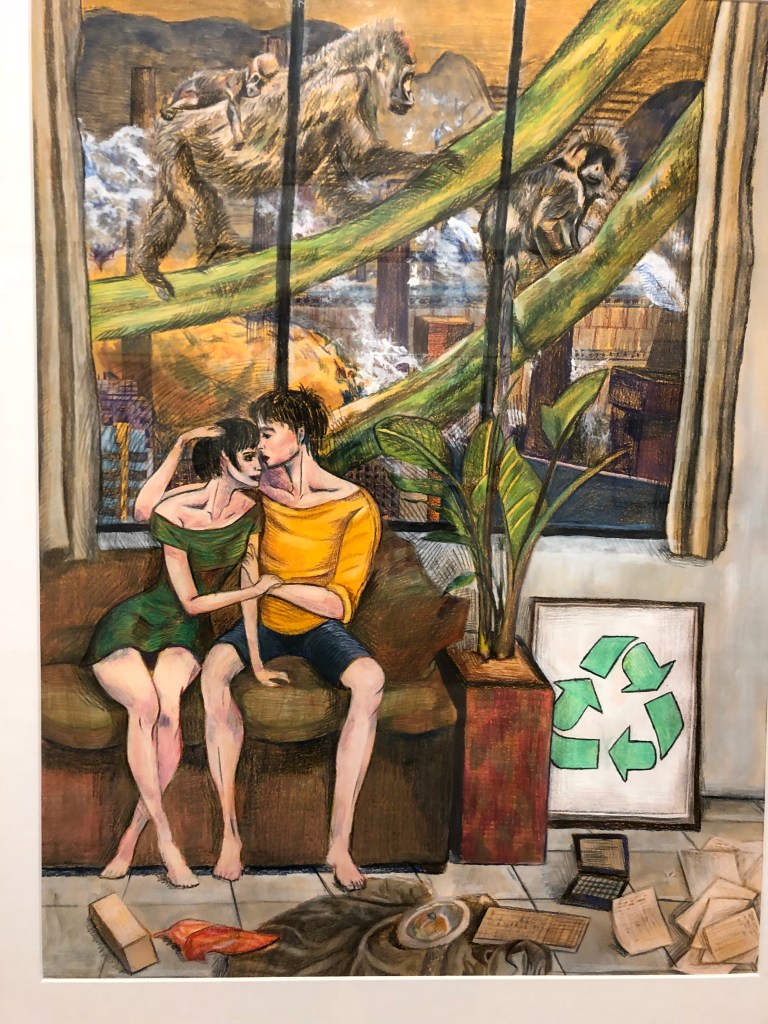 Made with color pencil and gouache (a type of paint) on bright orange paper, this drawing is called Two Worlds. It examines pollution, part of my concentration topic for my Studio III portfolio. I approached the subject from a third person perspective. Inside the apartment, a couple sits comfortably, while outside is a polluted world which animals have to escape. The depiction reveals a discrepancy between human and animals’ experience with pollution. We never realize the price the ecosystem paid for us to enjoy our daily conveniences, such as having electricity and running water. Additionally, since our general public regard pollution as distant and irrelevant, we often made little effort to change. Nevertheless, to accept a polluted world is our selfish decision, negligent of not only the future of humanity but also of the entire ecosystem. (more…)

Autonomous Navigation and Decision-Making Process Using Machine and Deep Learning
By Jeongyong Chris Yang, VI Form
Autonomous Navigation and Decision-Making Process Using Machine Learning and Deep Learning
Abstract
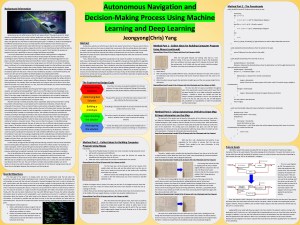
Please click the image to download/see the poster. Zoom in to read specifics.
Autonomous vehicles are self-driving cars that do not require human drivers. They use sensors that are attached to the vehicle as their vision to detect their environment. After the vehicle detects other objects or signals, computer programming (coding) allows them to react to the situations adaptively. Even though the sensors do not need to be improved, the millions of situations the cars can face on roads create difficulties for people to build a sophisticated computer program that makes the autonomous vehicles completely safe on roads.
First, I decided to build an algorithm pseudocode to help resolve this problem. During this process, I built mazes and followed the instructions based on the algorithm manually to check whether the algorithm is effective. I mainly used three different models for my mazes, each with different difficulty levels to ensure that the algorithm works every time. Then, I decided to record the information (velocity and displacement for both x and y directions) about the vehicle on the map so that the following vehicles can get a picture of the map automatically. However, if the subsequent vehicle detects a different or an altered map with its sensors, the new information will also be recorded on the map. Finally, the final vehicle will follow the path set by the first vehicle, but the map will guide the car with the most efficient path after completely learning and optimizing the possible paths.

20% Time Project: Longest Time Balancing A Shoe Upside Down On Top Of Your Head
By Ian Moore, III Form
20% Time Project: Longest Time Balancing A Shoe Upside Down On Top Of Your Head
Editors’ Note: In Ms. Amanda Hultin’s III Form English classes, her students pursue 20% Time (or “Genius Hour”) projects. Some essential elements include taking control of one’s own learning, choosing an individual topic, deciding how to learn and to produce a public product, and reflecting on the process.
Click on image to experience Ian’s Weebly pages.
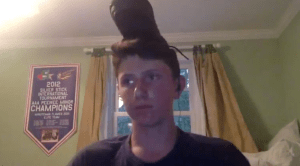
Click on this image to see Ian’s time-lapse with the shoe on his head!
Reflection on learning:
*What content/information did you learn during this project?
I learned a lot of valuable information throughout this project. First, I learned about breaking a world record. I now know that there are a couple different ways to break a world record. First, you can apply on Guinness World Record to have an employee from their office come and watch you break the record. Then, you may have the opportunity to get into the Guinness World Records book. However, you can also do it online using a website called recordsetter.com. This is a very useful website and is the one that I used for my record. It relies on videos to see if you actually break the record. I also learned how to make a blog throughout this project. I used weebly.com to make my blog. It is a website that teaches you how to make and use a blog. This was a fun and interactive public product to make.

20% Time Project: Gardening–The Long Process of Planting
By Eve Elkins, III Form
20% Time Project: Gardening–The Long Process of Planting
Editors’ Note: In Ms. Amanda Hultin’s III Form English classes, her students pursue 20% Time (or “Genius Hour”) projects. Some essential elements include taking control of one’s own learning, choosing an individual topic, deciding how to learn and to produce a public product, and reflecting on the process.
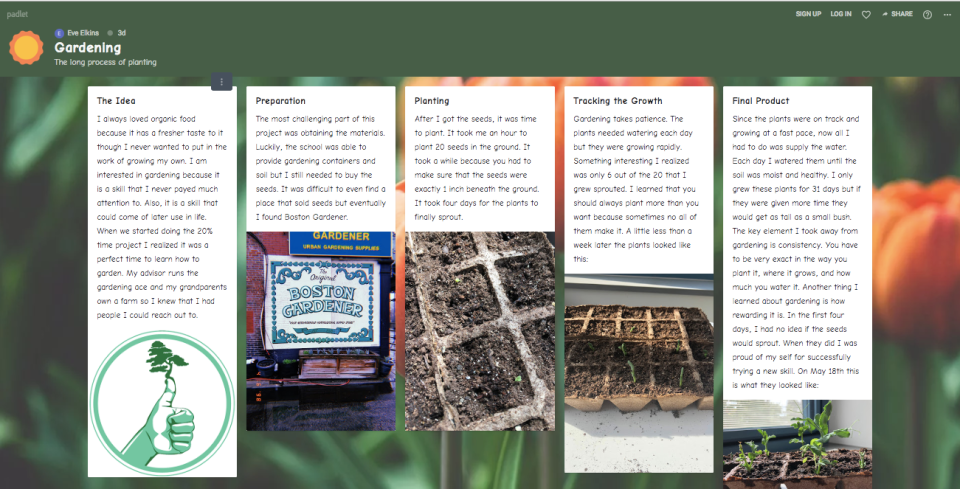
Click on image to view Eve’s Padlet.
Reflection on learning:
*What content/information did you learn during this project?
I learned about gardening. I learned that the perfect time to water the plants is in the afternoon. If you water them at night or early morning, they are more likely to grow fungus. I also learned that snap peas, which was the vegetable I was growing, grow best in mid-spring, which was when we started this project. They also have the quickest growing rate which was about two months. That is how I came to choose snap peas. When I contacted the manager of Chestnut Hill Farms, I was able to find out about the evolution about gardening. Now, in current times, gardening has shifted to being grown indoors all year round. Gardening used to be seasonal but now, due to modern technology, there have been trucks and trailers developed to sustain plants even in winter. Lots of people still garden but the way we do it has changed. (more…)

Critical Review of EA’s Battlefront II: A Rebel with a Cause
By Charles Mosse, VI Form
Critical Review of EA’s Battlefront II: A Rebel with a Cause
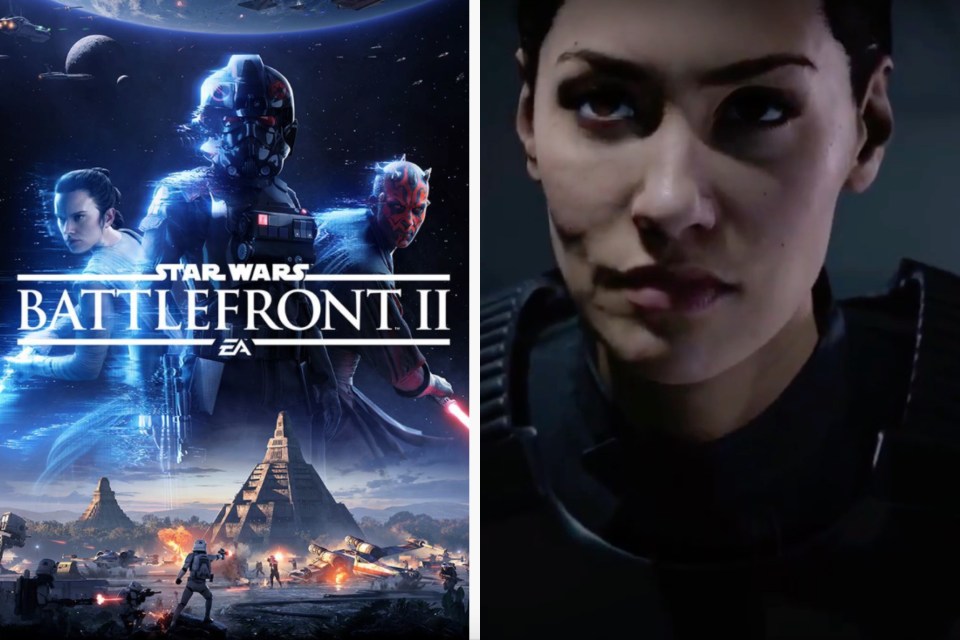
Click on image below for Voice Over video essay:


 LEO
LEO 