
Home » Posts tagged 'Immigration'
Tag Archives: Immigration
Faith and Negligence: Christian Perceptions and Interactions with Chinese Immigrants in 19th Century America
By Steven Zhang, VI Form
Faith and Negligence: Christian Perceptions and Interactions with Chinese Immigrants in 19th Century America
Editor’s Note: This paper was completed as a part of the History Research Fellowship, a one-semester course available to sixth form students.
Introduction
On one night in 1887 in San Jose, California, fires clawed at the sky. Smoke billowed from collapsing roofs of Chinatown apartments and stores, and winds sent trees into frenzies. Amidst this chaos, mothers, their clothes coated in ash, hustled their coughing children to safety. The origin of the fire, which uprooted the lives of approximately 1,400 Chinese residents, remained shrouded in mystery. However, clues to this destruction emerged in a solitary photograph that captured the aftermath of the devastation. In it, hundreds of white working men stood watching the destruction of one of San Jose’s Chinatowns (Figure 1).

Figure 1: The Burning of San Jose’s Chinatown
While the facts of this case are still obscure, the San Jose City Council a hundred years later would unanimously vote a resolution to apologize to Chinese immigrants and their descendants for the role the city played in “systemic and institutional racism, xenophobia, and discrimination.” Today such a terrifying act might be widely condemned, but at the time it was merely one of many incidents of anti-Chinese violence that went relatively unnoticed. In fact, the burning of San Jose Chinatown in history is often eclipsed by similar, anti-Chinese acts, such as the more devastating Santa Ana Chinatown fire. These incidents, lost in a history of anti-Chinese violence, marked the peak of hostility in the late 1800s.
(more…)The Ely Speech Prize for The Global Seminar: From Green, White, and Red to Red, White, and Blue; An Immigration Story
By Ellie Tesoro, IV Form
From Green, White, and Red to Red, White, and Blue; An Immigrant Story
Editor’s Note: Ellie Tesoro is the recipient of the 2023 Ely Prize in Public Speaking. Originally given by a member of the Class of 1892 in memory of his mother, the Ely Prize is presented to the student who gave the best speech in the Global Seminar Public Speaking Competition.
Student-Submitted Note: This is a speech written about my grandfather who immigrated from Italy during World War II and some of the challenges he overcame. The Global Seminar has a yearly speech competition which all students compete in, with 8 finalists reading their piece before the grade and one winner is picked. The 2023 ELY Speech prompt was “How was your view as a global citizen changed this year at St Mark’s and in The Global Seminar.”
Imagine having to wake up every day for the first four years of your life not knowing who your father was or if he was alive. My grandfather, Tony Tesoro, carried that burden for 1461 days. Today I am going to be telling his story and the lasting impact it has had on me and my family. The purpose of this speech isn’t to bore you with the details of how my family survived in a country completely foreign to them. It is rather on the patriotism and resilience that has been engraved into my family since my great-grandfather, Giovanni Tesoro, was first captured by the United States military 80 years ago.
For this to make better sense I am going to start from the beginning. My grandfather Antonio (Tony) Tesoro was born on April 11, 1941, in rural Italy by the countryside. He had a mother, a sister, and a father. His father, Giovanni, was drafted into World War II in 1941 a few months before Tony was born. Giovanni was captured by the British Army and then handed over to the United States military. He served as a cook, gaining alliances as well as true friendships with both POW and American soldiers. Giovanni spoke highly about the treatment he received from his captors and always said that he was lucky. Things could’ve been much worse than they were if it weren’t for the generosity of the US.
(more…)
DACA’s Uncertain Future
By Lauren Menjivar, VI Form
DACA’s Uncertain Future
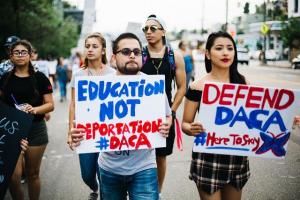 On September 5, 2017, Attorney General Jeff Sessions announced on behalf of the Trump Administration that it would rescind DACA after ten state attorneys general threatened to sue the administration if it didn’t end the program. Deferred Action for Childhood Arrivals, or DACA, is a program that allows DREAMers (Development, Relief, Education for Alien Minors) to avoid deportation for two years and make them eligible for a work permit. By ending DACA, 800,000 recipients are at a loss in their ability to work and live in the U.S., and they risk deportation. As a result, a debate on DACA has ensued on its value in American society after five years since the Obama Administration began the program. (more…)

Explaining the Immigration Crisis with Confucianism
By Alan Gao, IV Form
Explaining the Immigration Crisis with Confucianism
In recent years, news of immigrants and refugees flooding into Europe along with reports of violence and terrorist attacks have spread rapidly. As a result, many people have become more hostile towards immigrants, especially as Donald Trump appeared on the political stage. In Europe, which has been affected most by the refugee crisis, there was a rise in anti-immigrant supporters that led to an increase in support for many populist right-wing political parties. France, for instance, saw the National Front rise to be the second largest party in the nation. In Hungary, the leader of its current ruling party, Fidesz, has claimed that “[f]or us migration is not a solution but a problem … not medicine but a poison, we don’t need it and won’t swallow it” (The Guardian). In Netherlands, the “Dutch Donald Trump” Geert Wilders, led the Party for Freedom to be the second largest party in the nation as well. Not to mention, there are many countries, like Denmark, that have already instituted a strict immigration process in the past dozen years. What is the cause of the rise? (more…)

Trump’s Reform on Immigration Policies, Pros and Cons
By Jenny Shan, IV Form
Trump’s Reform on Immigration Policies, Pros and Cons
Editor’s Note: For this module in Social Justice class, students worked individually and/or collaboratively on a specific topic related to immigration policy or the refugee crisis. A Final Artifact of Learning (FAoL) should demonstrate understanding of the topic and “answer” the driving question in a comprehensive way. It should synthesize learning by organizing and applying understanding on the topic/question.

Click Image To Play Video

William Peck and Nativist Fears
By Jack Foley, VI Form
William Peck and Nativist Fears
From 1883 to 1894, William E. Peck was the first layman to be Head of St. Mark’s, a conservative, Episcopalian school. Many Trustees at the school believed that Peck was leading the school away from its religious roots. At the same time, in the late nineteenth century, Catholic immigrants came to the U.S. in huge numbers and threatened its Protestant elites. The changing nature of St. Mark’s and the U.S. threatened the Board of Trustees, which led to Peck’s dismissal. (more…)


 LEO
LEO 