
Home » Posts tagged 'History' (Page 6)
Tag Archives: History

A Looming, Dreary Cloud to a Calamitous Crash: Roosevelt, Keynes, and Their Responses to the World’s Greatest Economic Catastrophe
By Matthew Gates, VI Form
A Looming, Dreary Cloud to a Calamitous Crash: Roosevelt, Keynes, and Their Responses to the World’s Greatest Economic Catastrophe
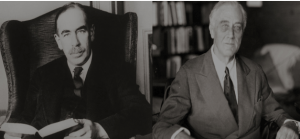
During the “Roaring Twenties,” the United States’ economy boomed; by 1923, the U.S. unemployment rate dropped to an unprecedented 2.4%.[1] In fact, at the end of the decade, the U.S. boasted the largest economy in the world.[2] The laissez-faire economic policies of Republican Presidents Warren G. Harding, Calvin Coolidge, and Herbert Hoover were extremely popular among business owners and Americans during the 1920s, as lowering taxes granted businesses more money to grow and put more money in the pockets of ordinary American citizens.[3] Additionally, Harding’s signing of the Fordney-McCumber Tariff Act, which imposed a tax on foreign goods, caused imported products to be far more expensive than domestic goods. As a result, the tariff incentivized citizens to buy American goods, increasing the profits of American businesses and resulting in an overwhelming expansion in production and jobs.[4] These Republican Presidents believed that government intervention not only hindered personal economic freedom, but they also believed it was wrong and a danger to freedom.[5]

Minnie Vautrin and John Rabe: The Beacons of Humanity during the Nanking Massacre
By Amy Wang, VI Form
Minnie Vautrin and John Rabe: The Beacons of Humanity during the Nanking Massacre
Introduction
On a cold winter morning, about thirty soldiers came to a house. As soon as the landlord answered the door, the soldiers shot him with a revolver. When the landlord’s wife knelt down, asking why they killed her husband, they shot her as well. Upon entering the house, the soldiers dragged a female tenant Mrs. Hsia out from under a table, where she tried to hide with her one-year-old baby. After stripping and raping her, the soldiers bayoneted Hsia in the chest. They then stabbed the baby to death. Meanwhile, some soldiers went to the next room, where Mrs. Hsia’s parents and her two daughters, aged sixteen and fourteen, were hiding. They shot the grandmother when she tried to protect the girls. As the grandfather grasped the body of his wife, they killed him, too. Five to six soldiers raped the two girls and bayoneted both, along with their younger sister, who was also in that room. Before they left, the soldiers murdered the two children of the landlord, the elder bayoneted and the younger split down through the head with a sword.[1]
This was not a horror movie made for the sake of violence and gore. It was one of the countless cases of unspeakable atrocities that took place during the Nanking Massacre in the winter of 1937. (more…)

Red Guards During the Great Proletarian Cultural Revolution
By Justin Zhang, VI Form
Red Guards During the Great Proletarian Cultural Revolution
Introduction
Following Japanese surrender in 1945, China emerged as the victor of the Second Sino-Japanese War after decades of Japanese occupation and eight years of total war. A new series of military struggle for control of China between the Nationalist forces under Chiang Kai-Shek and the Communists under Mao Zedong, who were reluctant co-belligerents allied during the Second Sino-Japanese War. After four years of military conflict, the Chinese Civil War concluded with the triumph of the Communists in 1949 with almost all of mainland China falling under communist control and the remainder of Nationalists escaping to the island of Taiwan.[1] After the proclamation of the People’s Republic of China (PRC), Mao initiated extensive cooperation with the Soviet Union under Stalin’s lead to transform China’s war-ravaged economy into a planned economy closely following the Soviet model.
As Nikita Khrushchev came into power after Stalin’s death in 1953, however, relations between the PRC and the Soviet Union worsened. Khrushchev began engaging in a process of de-Stalinization, criticizing many aspects of Stalin’s leadership, in particular, the confrontation of the West and his cult of personality.[2] Mao, who emulated Stalin’s style of leadership as he developed his own cult of personality, denounced de-Stalinization as Marxist revisionism, a pejorative term used to describe an abandonment of Marxist principles such as the worldwide struggle for communism as the Soviet Union sought peaceful coexistence with the West.[3] The term was later widely used during the Great Proletarian Cultural Revolution as a justification for the persecution of “counter-revolutionaries.” (more…)

National Identity in The Golden Fish Hook
By Lora Xie, V Form
National Identity in The Golden Fish Hook
Prompt:
Research and write about a foundation myth that has influenced the country’s national identity or that continues to influence its identity.
On April 24, 1970, the People’s Republic of China (PRC) used the Long March 1 rocket to launch its first satellite into Low Earth orbit, becoming the fifth nation to achieve independent launch capability.[1]Long March 1 belonged to a family of rockets named after the “Long March” (长征), a year-long military retreat is undertaken by the Red Army of the Communist Party of China (CCP) from 1934 to 1936 to escape from the pursuit of the Kuomintang (KMT or Chinese Nationalist Party) army.[2]The trek was apotheosized by the American chronicler Edgar Snow in his 1937 officially endorsed “Red Star over China.”[3]When the Communist Party founded the PRC in 1949, it adopted the legends about the tribulations and demonstrations of heroism that took place on the Long March as some of its most important foundation myths. These legends are taught in schools and broadcasted through media to promote the so-called “Spirit of Long March,” summarized by Jiang Zemin, the fifth president of the PRC, as “loyalty,” “sacrifice,” “practicality,” “collectivism,” and “popularism.”[4]This essay will analyze how one specific myth, “The Golden Fish Hook,” promotes those ideologies, offers citizens consolation and motivation for adversities, and cultivates patriotism through pride and gratitude.

History Fellowship: Civil War Monuments and Historical Memory
By Olivia Hammond, Matt Gates, and Matt Walsh, VI Form
History Fellowship: Civil War Monuments and Historical Memory
Editor’s Note: The project was part of a History Fellowship unit looking at the Civil War and historical memory. Students were asked to select a monument(s) and–1. Describe, in detail, your monument(s) (who, what, when, where, why, etc.); 2. Explain the question(s) that you are exploring about your monument(s); and 3. Describe the answer(s) to your question(s). They could use a medium of their choice (e.g., paper, movie, etc.) to present their analysis.
Olivia–Racial Attitudes in the Civil War Era: Seen Through Two Boston Monuments (video)
Matt G.–Confederate Statues in the Cherokee Nation (video)
Matt W.–Civil War Memory through Local Newspapers (essay)
SCROLL DOWN FOR ARTIFACTS (more…)

Delinquency: It Comes from Within (Rebel without a Cause Juxtaposed with Cycle of Outrage)
By Matt Walsh, VI Form
Delinquency: It Comes from Within (Rebel without a Cause Juxtaposed with Cycle of Outrage)
Although its production was fraught with promiscuity, Nicholas Ray’s Rebel Without a Cause promotes a moralistic Cold War agenda. Protagonist Jim Stark, portrayed by James Dean, is a new kid in town with a history of delinquency. Because his parents struggle to exert authority over Jim and are quick to forgive him for his wrongdoing, Jim, albeit well-intentioned, finds himself associated with a group of delinquents. Included in the group is Judy, a sixteen-year-old girl whose misbehavior is driven by her father’s reluctance to reciprocate her love for him. Jim also develops a friendship with Plato, whose absent parents make him the most delinquent of the three protagonists. Rebel Without a Cause blames their misbehavior on their lack of emotional connection with their respective parents, and likewise, James Gilbert’s 1986 book A Cycle of Outrage suggests that many Americans viewed a stable domestic setting as the panacea for all forms of juvenile delinquency. Nonetheless, the film Rebel Without a Cause suggests that only emotional connections between children and parents can curb the epidemic of juvenile delinquency whereas A Cycle of Outrage suggests that the public viewed delinquency as an epidemic that originated outside of the family. (more…)

What Led to America’s Economic Prosperity After World War II?
By Samantha Wang, IV Form
What Led to America’s Economic Prosperity After World War II?
Editor’s Note: Samantha utilized funds from the Kean Fellowship in the spring of 2018 to finance videos, programs, and books for her independent research project.
Background Information
By the early 20th century, America had quietly become the world’s strongest industrialized country. But not for long. A huge crisis was brewing behind the exploding expansion of the U.S. economy: on October 24, 1929, a sudden storm swept across Wall Street, and an economic depression followed.[1]The United States, as the birthplace of the Great Depression, became a major disaster area. American industrial production shrank by a third from 1929 to 1932, the unemployment rate was horrendous, pessimism pervaded the whole society, and many people came to doubt the capitalist system.[2]In 1932, the Democratic Party candidate, Franklin Roosevelt, was elected President of the United States. Faced with a severe situation, President Roosevelt advocated for the repression of the domestic forces of Nazism and Communism and the execution of complete control over the national bourgeoisie through his New Deal policies. The American economy slowly got back on track afterward. (more…)

Macroeconomics: “Easy Key” Product for Campus Safety and Convenience
By Colin Boylan and Jonathan Noel, VI Form
Macroeconomics: “Easy Key” Product for Campus Safety and Convenience
Editor’s Note: As a final project in Macroeconomics, students had to find an issue within St. Mark’s and the world and then find the solution to it by “creating” a product. They had to find the costs associated with making the startup business, pitch the idea to Mr. Rob Calagione, and ask the venture capitalist for money in exchange for royalty.
On American educational campuses and specifically the St. Mark’s campus, campus safety and individual convenience are issues. All campus buildings are now being locked for safety reasons, but unfortunately, this is leaving students and faculty locked out of the buildings as well. Yes, key cards are a solution. However key cards are easily forgotten or lost, are likely to be broken, and are simply outdated. Our product, Easy Key, addresses both issues by providing students with a convenient way to access locked buildings in addition to allowing students to pay for school products. (more…)


 LEO
LEO 