
Home » Posts tagged 'History Fellowship' (Page 8)
Tag Archives: History Fellowship

Minnie Vautrin and John Rabe: The Beacons of Humanity during the Nanking Massacre
By Amy Wang, VI Form
Minnie Vautrin and John Rabe: The Beacons of Humanity during the Nanking Massacre
Introduction
On a cold winter morning, about thirty soldiers came to a house. As soon as the landlord answered the door, the soldiers shot him with a revolver. When the landlord’s wife knelt down, asking why they killed her husband, they shot her as well. Upon entering the house, the soldiers dragged a female tenant Mrs. Hsia out from under a table, where she tried to hide with her one-year-old baby. After stripping and raping her, the soldiers bayoneted Hsia in the chest. They then stabbed the baby to death. Meanwhile, some soldiers went to the next room, where Mrs. Hsia’s parents and her two daughters, aged sixteen and fourteen, were hiding. They shot the grandmother when she tried to protect the girls. As the grandfather grasped the body of his wife, they killed him, too. Five to six soldiers raped the two girls and bayoneted both, along with their younger sister, who was also in that room. Before they left, the soldiers murdered the two children of the landlord, the elder bayoneted and the younger split down through the head with a sword.[1]
This was not a horror movie made for the sake of violence and gore. It was one of the countless cases of unspeakable atrocities that took place during the Nanking Massacre in the winter of 1937. (more…)

Red Guards During the Great Proletarian Cultural Revolution
By Justin Zhang, VI Form
Red Guards During the Great Proletarian Cultural Revolution
Introduction
Following Japanese surrender in 1945, China emerged as the victor of the Second Sino-Japanese War after decades of Japanese occupation and eight years of total war. A new series of military struggle for control of China between the Nationalist forces under Chiang Kai-Shek and the Communists under Mao Zedong, who were reluctant co-belligerents allied during the Second Sino-Japanese War. After four years of military conflict, the Chinese Civil War concluded with the triumph of the Communists in 1949 with almost all of mainland China falling under communist control and the remainder of Nationalists escaping to the island of Taiwan.[1] After the proclamation of the People’s Republic of China (PRC), Mao initiated extensive cooperation with the Soviet Union under Stalin’s lead to transform China’s war-ravaged economy into a planned economy closely following the Soviet model.
As Nikita Khrushchev came into power after Stalin’s death in 1953, however, relations between the PRC and the Soviet Union worsened. Khrushchev began engaging in a process of de-Stalinization, criticizing many aspects of Stalin’s leadership, in particular, the confrontation of the West and his cult of personality.[2] Mao, who emulated Stalin’s style of leadership as he developed his own cult of personality, denounced de-Stalinization as Marxist revisionism, a pejorative term used to describe an abandonment of Marxist principles such as the worldwide struggle for communism as the Soviet Union sought peaceful coexistence with the West.[3] The term was later widely used during the Great Proletarian Cultural Revolution as a justification for the persecution of “counter-revolutionaries.” (more…)
History Fellowship: Civil War Monuments and Historical Memory
By Olivia Hammond, Matt Gates, and Matt Walsh, VI Form
History Fellowship: Civil War Monuments and Historical Memory
Editor’s Note: The project was part of a History Fellowship unit looking at the Civil War and historical memory. Students were asked to select a monument(s) and–1. Describe, in detail, your monument(s) (who, what, when, where, why, etc.); 2. Explain the question(s) that you are exploring about your monument(s); and 3. Describe the answer(s) to your question(s). They could use a medium of their choice (e.g., paper, movie, etc.) to present their analysis.
Olivia–Racial Attitudes in the Civil War Era: Seen Through Two Boston Monuments (video)
Matt G.–Confederate Statues in the Cherokee Nation (video)
Matt W.–Civil War Memory through Local Newspapers (essay)
SCROLL DOWN FOR ARTIFACTS (more…)

Words, Legacy, and Memory: What We Can Learn From the Inscriptions on Civil War Monuments
By Mo Liu and Katherine Wass, VI Form
Words, Legacy, and Memory: What We Can Learn From the Inscriptions on Civil War Monuments
In the first month of History Research Fellowship, we looked at symbols and memories, specifically
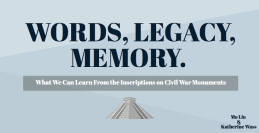
Click image for full Piktochart
those tied to the Civil War. We were particularly drawn to the difference in sentiments in the North and the South in the decades following the end of the Civil War and how they are reflected in the monuments. With access to the 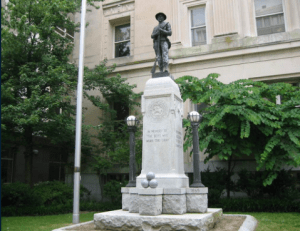 monument database in Maine and North Carolina, we picked these two states to be the representative of the Union and the Confederacy, respectively.
Katherine and Mo’s fullInfographic can be found here (more…)
Memorialization, Memory, and the Civil War
By Joseph Lyons, IV Form
Memorialization, Memory, and the Civil War:
The Evolution of Civil War Memory through the Monuments of North Carolina and Maine
Introduction:
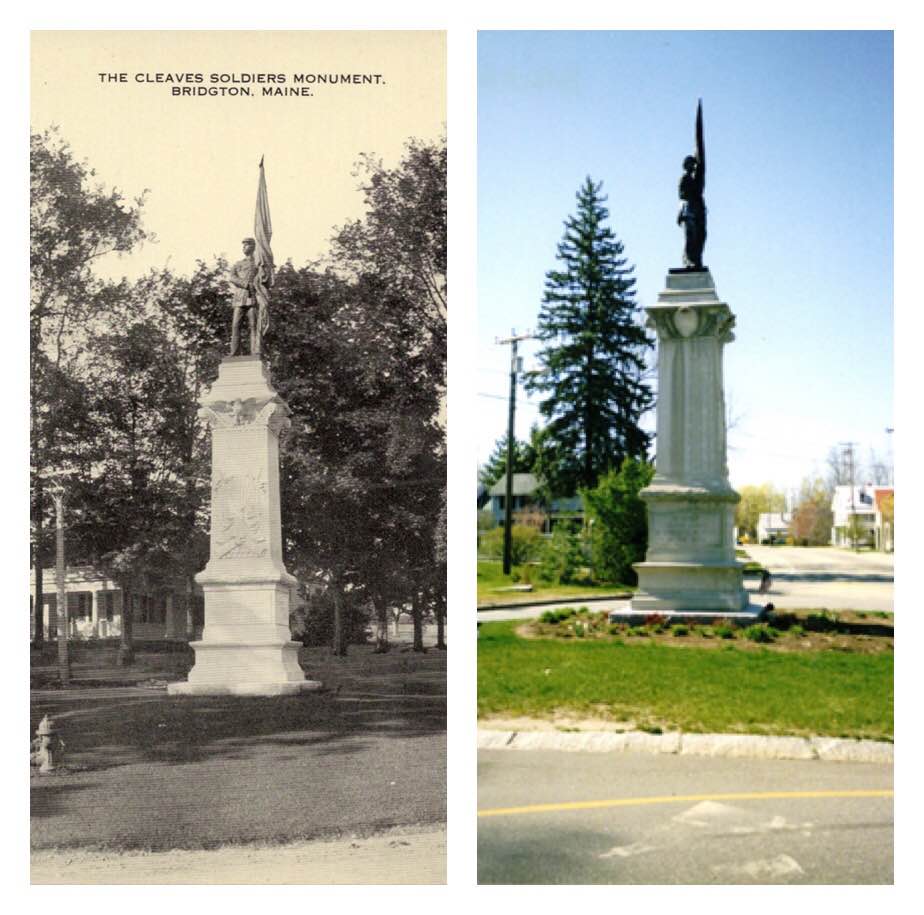 Driving up the hill from downtown Bridgton, Maine, one sees a towering Civil War monument looming on the horizon. The monument itself is unremarkable, as there are at least 144 other Civil War memorials in the state. Given the imprint that this conflict left on America’s collective memory, the prolific memorial-building efforts in Maine are no surprise. However, the way Maine memorials portray the conflict is rather puzzling. Despite the fact that the Union fought the war, at least in part, for emancipation and racial equality, Mainers constructed monuments, like the one in Bridgton, that largely disregarded the significance of slavery to the conflict. The inscription on the Bridgton monument reads: (more…)
The Second Amendment Debate
By Joey Lyons, VI Form
The Second Amendment Debate
“A well regulated Militia, being necessary to the security of a free State, the right of the people to keep and bear Arms, shall not be infringed.” – Second Amendment to the United States Constitution
In the 1960s, the assassinations of renowned public figures, such as Martin Luther King and President John F. Kennedy, sparked an intense, national debate over gun control. The debate between gun control supporters and gun rights advocates continued into the twenty-first century and continues in the present day. Gun control supporters argue that unrestricted gun rights cause avoidable atrocities and that the Second Amendment does not guarantee an individual the right to bear arms. Gun rights advocates believe the right to bear arms is not only necessary for self-defense, hunting, and security against tyranny, but is also protected by the Second Amendment.


 LEO
LEO 