Home » Posts tagged 'Experiential Learning' (Page 13)
Tag Archives: Experiential Learning

The Creativity of Throwing on the Wheel in Ceramics
By Eliza Wyckoff, V Form
The Creativity of Throwing on the Wheel in Ceramics
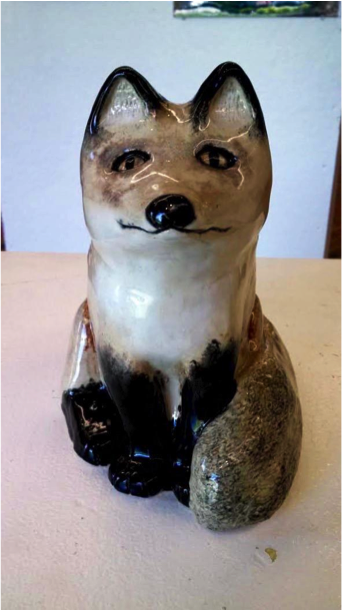 I was always intrigued by the different mediums of art. I loved painting and tried my best at drawing, even though that was a real struggle. When looking over the art electives the summer before my first year at St. Mark’s, I thought Studio would be a fun class to take, but, after I saw Ceramics, I changed my mind. I have always loved to work with my hands, especially if I am able to create something unique and beautiful in its own way. I had no idea what I was really signing up for; the only experience I had with throwing on a wheel was an afterschool club when I was in 8th grade. After my first class with Ms. Belt, I was slightly intimidated, but more curious about the skills and techniques you needed to use in order to throw good pots and bowls. Being able to go down to the ceramics room and work became an escape from homework and the stress of classes for me. I learned about the whole process that goes into throwing: recycling clay, flipping it so it dries out evenly, wedging it to blend the clay and get rid of air bubbles, and finally getting it on a wheel. (more…)
Schooling, Inquiry, and the Promise of the “St. Mark’s Saturdays” Program
By Nat Waters, Associate Dean of Academics
Schooling, Inquiry, and the Promise of the “St. Mark’s Saturdays” Program
One of the more transformative developments in my teaching practice in recent years has been the addition in each of my courses of essential questions — formulations that, in the words of Understanding by Design author Grant Wiggins, inspire, “deep thought, lively discussion, sustained inquiry, and new understanding as well as more questions.”
In that same spirit, I’d like to offer an essential question for this LEO piece on the exciting new developments in the St. Mark’s Saturdays program. Begin by thinking of your own high school experience, whether that is as immediate as May 2015, or farther removed than you would care to admit, even in close company:
“Which of the many academic lessons that comprise your high school experience are most memorable, most enduring, and most valuable to life and work in the ‘real world’?” (more…)

The Orchestra Coalesces (incl. a video of “Ashokan Farewell”)
By Jonathan Qu, VI Form
The Orchestra Coalesces (incl. a video of “Ashokan Farewell”) (click on photo or scroll to bottom for the video link)
Have you ever wondered what it was like to do four things at the same time? Well, all members of the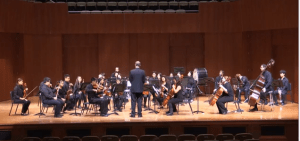 orchestra do. To effectively coalesce and produce a song that is pleasing to the ear, members must read the music, translate the music, play the music, and then listen to the music. This may not seem difficult at first, but simply playing the music and then listening to the music takes a lot of skill. Take the cello for example. Not only do you have to translate the notes on the page, but you also have to pay attention to what kind of combination those notes tell your fingers to do. You then also have to keep in your mind how you (more…)
Video: A Study in Kiva Micro-Loans (en Español)
Video: A Study in Kiva Micro-Loans (en Español)
 This Window, Ms. Ramirez’ Advanced Spanish Language and Culture students have been studying the challenges facing many families and communities in the developing world. Lack of access to resources hinders many communities’ ability to improve their economic standing. Traditionally, charitable organizations have made the mistake of forcing their help upon the locals and these organizations tend to ignore the culture and the opinions of the locals, making the situation worse. NGOs (Non-Governmental Organizations) often fail to realize that the best way to aid locals is when they want help and ask for it. These organizations should allow the locals to take the lead with ideas and then help to implement them. This strategy yields the greatest success because the people provide practical local knowledge to solve their own problems and the NGOs can help with connecting people and providing technical assistance. (more…)

The Power of Grants in Student Development
By Camille Banson, VI Form and Ryan Lee, VI Form
Editor’s Note: The Matthews Educational Fund provides grants to students of any form who are good citizens and solid students. Grants are made for special needs such as tutoring assistance, special instruction, seminars, academic experiences of a national or international nature, and personal growth and advancement opportunities. Awards are based on merit and need as determined by a faculty committee. Last year, Camille Banson and Ryan Lee received the Matthews Fund Award to pursue their educational endeavor. Here is an overview of their experience.
Camille Banson:
Over the summer, I participated in a Boston University Summer Program. It ran for two weeks (more…)

A Vegan’s Manifesto
By Henry Hirschfeld, IV Form
A Vegan’s Manifesto
“Are you sure you’re getting enough protein?” and “Humans were designed to be omnivores” are common reactions when I tell people I eat vegan. A vegan diet is where one must abstain from all animal products, including meat, dairy products, eggs, and even honey. I became a vegan after working at an organic farm for the first time in the Northeast Kingdom of Vermont. Working in the soil and taking care of the vegetables every day showed me the tremendous amount of work it takes to feed people. At farmer’s markets on the weekends, I was fortunate enough to interact with my customers, and I witnessed first-hand how much they appreciate fresh produce. Mary, my mentor on the farm, helped me realize that 75% of today’s farms are polluted with harmful chemicals which affect the soil quality as well as the (more…)

The Double Entendre of “Shelter Crazy”
By Jessica Hutchinson, VI Form
The Double Entendre of “Shelter Crazy”
Becoming shelter crazy is not a myth. I have seen it happen too many times. Lily remained crouched in the back of her kennel, growling at anyone who came near her. After spending over a year at the shelter, Blitz would lunge at anyone he did not know, and after losing one leg, his other failed him. Goji stayed at the shelter for months before he was adopted but was soon returned. All three dogs were put down because they could not handle the stressful shelter environment. We invested our time and hearts in them, hoping the right person would come along and give them a good home. Unfortunately, all three were euthanized.
While I will remember the sad stories of Lily, Blitz, and Goji, I will also remember my joyous times at the shelter. A man came into the shelter with his two young boys looking for a playful
adult cat; they wanted to simultaneously rescue an animal and welcome a new family member (more…)

III Form Physics: First Engineering Design Challenge
By Lindsey Dumond, III Form
III Form Physics: First Engineering Design Challenge
Units 1, 2, and 3 all focused on the same design challenge, which was to create an object with the highest average velocity over two meters. The object also had to be self-propelled and could not leave contact with the track at any time, or it would be disqualified. At the end of unit one, we chose several materials that we thought would be most useful in creating an object that could complete the challenge. We created a first design based on what we knew about physics at that point. In unit two, we built a model of our first design and tried to make it self-propelled. After facing challenges during this step we redesigned and rebuilt. As we redesigned, we were also learning more about physics and concepts that (more…)


 LEO
LEO 