
Home » Posts tagged 'Culture'
Tag Archives: Culture
Chicanismo: Examining Mexican-American Culture, History, and Perspectives Through Photography
By Jonathan Hernández, VI Form
Chicanismo: Examining Mexican-American Culture, History, and Perspectives Through Photography
Editor’s Note: This project was made possible with the support of the Class of 1968 V Form Fellowship. At their 25th reunion, the Class of 1968 created a fund to provide grants to V Form students for independent study during the school year or, more commonly, during the summer between V and VI Forms. Their intent in establishing this fund was to reward independent thinking, ingenuity, and planning and to encourage the student in exploring non-traditional fields of inquiry or using non-traditional methods of investigation.
Student-Submitted Note: This past summer, I took part in The Class of 1968 V Form Fellowship and used my grant funds to travel to Los Angeles to look at Latinidad and Mexican-American identities and spaces through a photographic lens. I compiled what I learned (in addition to a bit of research I completed) in an academic reflection uploaded below.
“We cannot seek out achievement for ourselves and forget about progress and prosperity for our community… Our ambitions must be broad enough to include the aspirations and needs of others, for their sakes and for our own.” — Cesar Chavez.
Chicana/o/x or Xicana/o/x (both pronounced the same way) refer to persons of Mexican descent who grew up in the United States. The experiences of these Chicana/o/x persons are notably different from the experiences of simply American or Mexican individuals as neither identity has wholly encapsulated their background. Chicanismo, what this grant project was built around, is pride in one’s Chicana/e/o/x heritage. With the completion of this project, it is my hope to share what I have learned about the spaces I visited to provide insight into Mexican-American history, culture, and perspectives.
It is believed that Chicanos descend from indigenous groups who lived in Aztlán – the American Southwest region encompassing Arizona, California, Texas, New Mexico, Colorado, and parts of Oklahoma. As part of Spain’s colonial efforts, a racial hierarchy was instituted through a caste system called the “Castas” system. The Castas system unlike America’s system of race accounted for cultural mixing and recognized that Spain’s colonization of the Americas promoted cross-cultural interactions and allowed different groups of people to interact, trade, and marry with each other. Yet, the Castas system did not only organize persons based on their outward appearance but also on their parents’ individual races. For instance, a child with a West African father and Indigenous mother would most likely work as a laborer or farmer. Still, a child with an Anglo father and Meztic mother would most likely live an educated noble life. In fact, the practice of interracial marriage was so popular or so prominent that in the First Census of Los Angeles in 1978 a significant majority of the citizens identified as Mestizaje or of “mixed blood” (Webber 33-34). Thus, for many Mexicans and Latinos, it has proven difficult to identify wholly with one race over another because of interracial marriage and mixing throughout the decades.
After the Mexican Cession and the signing of the Treaty of Guadalupe Hidalgo, the US gained territory in what is today the American Southwest. In states like Texas, New Mexico, California, Colorado, Arizona, and Nevada which belonged previously to Mexico (and before that the Native American peoples in the region), about one hundred thousand people who decided to stay in the territories became U.S. citizens. Thus, began the formation of the Mexican-American identity.
(more…)Our Drumbeat, Our Heartbeat
By Kelly Yang, Class of 2023
Our Drumbeat, Our Heartbeat
Student-Submitted Note: The installation is designed for Native American Literature class. The assignment requires the student to design an installation for a boarding school or college in Massachusetts that educates the community about the local tribe’s past, present and future presence.
Our Drumbeat, Our Heartbeat is an interactive art installation designed for Brown University that celebrates the survival and thriving of the Wampanoag community in the present and future. Brown has long committed to Indigenous people’s rights. It started a year-long exploration in 2021 into the relationship between the university, the land on which it sits on College Hill, and the local Indigenous Wampanoags, who were once the land’s sole occupants (Brown). However, from the Wampum Granoff Center exhibit in 2021 to the Native Enslavement display in 2022, Brown has focused more on showcasing the ancient history of local Native people than on demonstrating their vitality and prosperity now and in the future (Kimball). I choose Brown University for my installation because, in addition to the annual Powwow celebration at Brown, which similarly only focuses on traditional ceremonies and costumes, futuristic interactive installations can make a more persistent and visual statement about Wampanoags’ present and future existence on campus. I intentionally place the interactive installation on Brown’s College Green, a grassy park serving as a student hub for activities and games. Its open spaces have an advantage over closed buildings in that they allow maximum access to alumni, students, professors, and visitors. The grass and trees of the College Green also echo the Wampanoag spiritual beliefs of protecting Mother Earth and “car[ing] for the land” (Avant 429).
Our Drumbeat, Our Heartbeat consists of four drums triggering waves of light traveling towards a four-meter medicine wheel floating above the area. The interactive design invites Brown students, alumni, professors, and visitors on the Main Green to drum in unison to create an audio-visual extravaganza, the intensity of which is dependent on the pace and intensity of the drumming. Drumming is an indispensable part of Wampanoag culture and practice; it helps the Wampanoags to “live by the rhythms of Mother Earth” and reinforces Wampanoags’ “special relationship to the superior spiritual forces which governed the universe” (Avant 429). Similarly, the medicine wheel in the middle of the installation honors the Wampanoags’ belief in balancing life’s four stages, elements, and seasons. An interactive drumming installation helps the students and faculty understand where their school’s land comes from and the history and spiritual beliefs in this sacred place in a more engaging way.
(more…)
A Preliminary Probe into the Impact of Confucianism on China
By Amanda Wang, V Form
A Preliminary Probe into the Impact of Confucianism on China: How is a thought from two thousand years ago still relevant today?
Confucianism was born out of a disturbed and divided era, with wars plunging people into the abyss of misery and suffering. Different from the Taoists who observed the way and legalists who committed to harsh punishments, Confucius sought to restore a harmonious social order to China. The most prosperous dynasties of China applied Confucianism to state administration, and Confucius himself was known by the highest institutions down to the grass-root workers. The open sentence of The Analects: “Is it not pleasant to learn with a constant perseverance and application? Is it not delightful to have coming from distant quarters? Is he not a man of complete virtue, who feels no discomposure though men may take no note of him?” is a proverb to all Chinese (Xue Er). It renders in my memory since the age of four. At that time, my friends and I could correctly recite around a hundred of those, without knowing what they actually meant. But every grown Chinese knows, through the Five Ideals of jen, chun-tzu, li, te, and wen, the sage influenced China profoundly in society, politics, and culture for thousands of years and beyond.
(more…)
Autism-Vaccine Controversy: Video
By Izzy Kim & Riya Shankar, VI Form and Haley Dion & Laura Drepanos, V Form
Autism-Vaccine Controversy: Video
Editors’ Note: In Advanced Biology, students were encouraged to tell the story that they felt compelled to relate about their Public Health issue (click here for assignment). In this video, the students integrated a given Case Study with relevant information gathered through independent research. Their integration of the Case Study with additional research reflects an advanced understanding of, and ability to convey, scientific content.
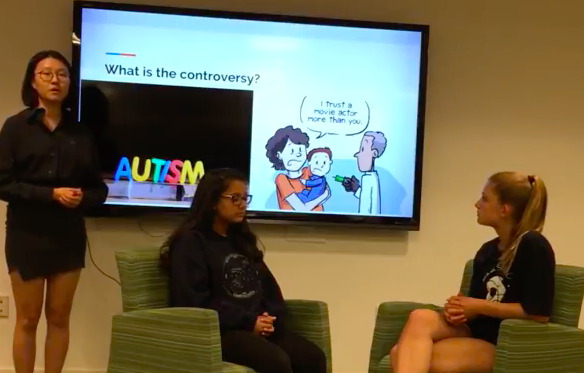
Click on Image for Video
Project Based Learning in The Global Seminar: The Zamibia Presentation
By Alicia Souliotis, Andrew Cheon, Elise Gobron, and Tommy Flathers, III Form
Project Based Learning in The Global Seminar: The Zamibia Presentation
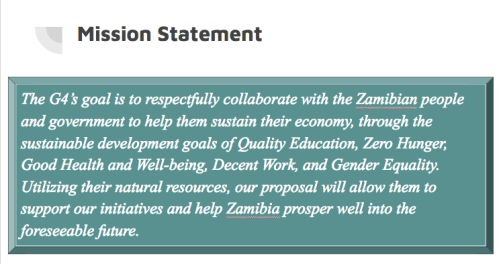
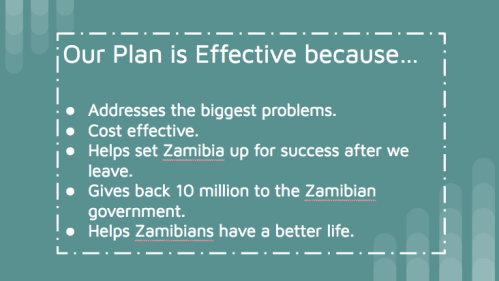
Editor’s Note: All III Formers took part in The Global Seminar’s project to create a proposal to improve the state of the fictitious country Zamibia. The students collaborated in groups as United Nations Development Programme Sustainable Development Teams. The artifact below is part of the presentation that the students delivered to their classmates, teachers, and visitors.
Please click here for entire presentation.
The Beauty of Carnatic Music
By Anishka Yerabothu, IV Form
The Beauty of Carnatic Music
I was first drawn to Carnatic music when I heard a friend singing and I loved listening to the different songs and melodies.
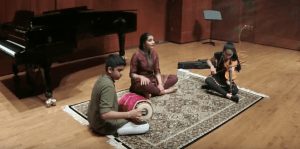
In the words of Yehudi Menuhin, who is considered the greatest violinist of the 20th century, “I knew neither its nature nor its richness, but here, if anywhere, I found vindication of my conviction that India was the original source. The two scales of the West, major and minor, with the harmonic minors as variants, the half-dozen ancient Greek modes, were here submerged under modes and scales of (it seemed) inexhaustible variety.” Carnatic music is an intricate and complex classical music system from South India that dates back to the 12th century.
This music system is based on four core concepts: swaram, ragam, talam and sruthi. Swarams are solfa syllables sung much like the do-re-mi-fa-so-la-ti and do of Western music. A ragam is a scale that can have up to seven different swarams in various patterns. Talam is the rhythmic beat structure to which compositions are set and is maintained by the vocalist’s hand while singing. Sruti is the pitch at which one sings. This is maintained by the Tanpura, a stringed drone instrument. (more…)

On Being American, Latina…On Being Me
By Lauren Menjivar, VI Form
On Being American, Latina…On Being Me
I am a first-generation American. I am Latina. I am a child of a mother and a father who each came to America for unique reasons. I am Lauren Menjivar.
Being first-generation American is a trait I value dearly, but it also has been a challenge. Because I am the eldest child and a native English speaker, I have acquired a huge responsibility to attend to important matters for myself and my family. At the start of my education, my parents helped me learn the alphabet and count, but as I progressed through school, my parents’ ability to assist me dwindled until they never checked if I completed my work. They fully trusted that I finished each assignment to my best capability. When my younger brother enrolled in school, my parents relied on me to assist him with his homework because I had completed that grade. I have become their “secretaria” in completing paperwork and translating conversations. When my father took the American citizenship test, I was the one to help him study and quiz him on questions. When my mother does the same in three years, I will take on the same role. Whenever the school sent papers for my parents to fill out and sign, I would fill them out. I never complained about it once; in fact, I actually enjoyed filling out forms, and I understood at that point that I was the only person capable of doing it. I learned to handle responsibility, by doing things on my own, and through that I gained independence from my parents. (more…)

Baseball: A Diplomatic Tool Between the U.S. and Cuba
By Matt Walsh, IV Form
Baseball: A Diplomatic Tool Between the U.S. and Cuba
When Mr. Calagione, our varsity baseball coach, first mentioned the prospect of visiting Cuba in the spring of 2017, I was dubious. Although President Obama had shown signs of improving diplomatic relations with Cuba in 2014, I had believed that American travel to Cuba would have to wait several years. The opportunity to immerse myself in the culture of Cuba, a country impoverished by many regimes of cruel dictators and gripped by the historical intervention of the United States and the Soviet Union, intrigued me. I never considered Mr. Calagione’s idea to visit Cuba as a realistic proposal. It was not until he gathered all members of the baseball team in October that the prospect of visiting Cuba became legitimate. The appearance of the word “Cuba” on that piece of paper immediately enlivened me. While I looked forward to playing baseball, enjoying the warm weather, and interacting with locals using my Spanish, the learning aspect of the trip was what excited me the most. The historical context of Cuba from colonialism to the revolution created a unique social, cultural, and political landscape that I was excited to learn about. My eagerness to learn about the livelihoods of those with different social and cultural backgrounds often drove me to engage in what I call “research frenzies”: the hectic act of researching a topic of interest by delving into articles, videos, and photos on the internet using more than thirty tabs. This was often a time consuming (and battery consuming) endeavor that acted in place of actual traveling, and it fulfilled my desire to learn about other cultures. I would always choose travel over feverishly scouring the internet, so the opportunity to visit Cuba for a week energized me. (more…)


 LEO
LEO 