
Home » Posts tagged 'Biology' (Page 5)
Tag Archives: Biology

Migraine Mania: Exploring the Link Between Disorder and Diet
By Marissa Huggins, VI Form
Migraine Mania: Exploring the Link Between Disorder and Diet
Abstract
Migraine is a debilitating neurological condition associated with symptoms including: intense pressure in the head, nausea, blurred vision, vomiting, and extreme sensitivity to light, sound, touch and smell.11 Migraine disorder, wherein an individual suffers from a migraine episode at a minimum of two times per month, affects approximately 12% of the population of the United States.1 When an individual suffers from a migraine episode, their mental and physical capabilities are inhibited, making daily tasks extraordinarily challenging, if not impossible. Migraines cause normal neurotransmission – communication between neurons – to be disrupted, and the role of the central nervous system becomes compromised. Treatment options are limited and often ineffective thus exploration of new treatment options would greatly benefit migraine sufferers. The goal of this investigation was to explore the potential relationship between migraine disorder and diet using the model organism C. elegans. The Unc-2 C. elegans genotype is known to mimic human migraine disorder; every abrupt directional change in an Unc-2 C. elegans organism is equivalent to a human migraine. C. elegans consume bacteria as their primary source of nutrition, thus two strains of C. elegans, wildtype (N2) and Unc-2, were fed one of three different bacterial strains and their behavior was observed for one minute. This procedure was repeated three times for each organism. Based on the data collected, it can be concluded that Unc-2 C. elegans grown on a diet of either Comamonas testosteroni (C. testosteroni) or Bacillus subtilis (B. subtilis) experienced a decrease in migraine frequency as compared to those grown on Escherichia coli (E. coli). (more…)

Tuskegee Syphilis Study
By Hans Zhou, VI Form
Tuskegee Syphilis Study
The Tuskegee Syphilis Study symbolizes the oppression towards African Americans in the medical field. This inhumane study conducted by the U.S. Public Health Services (USPHS) lasted for 40 years until an Associated Press story revealed it.

The European Green Crab
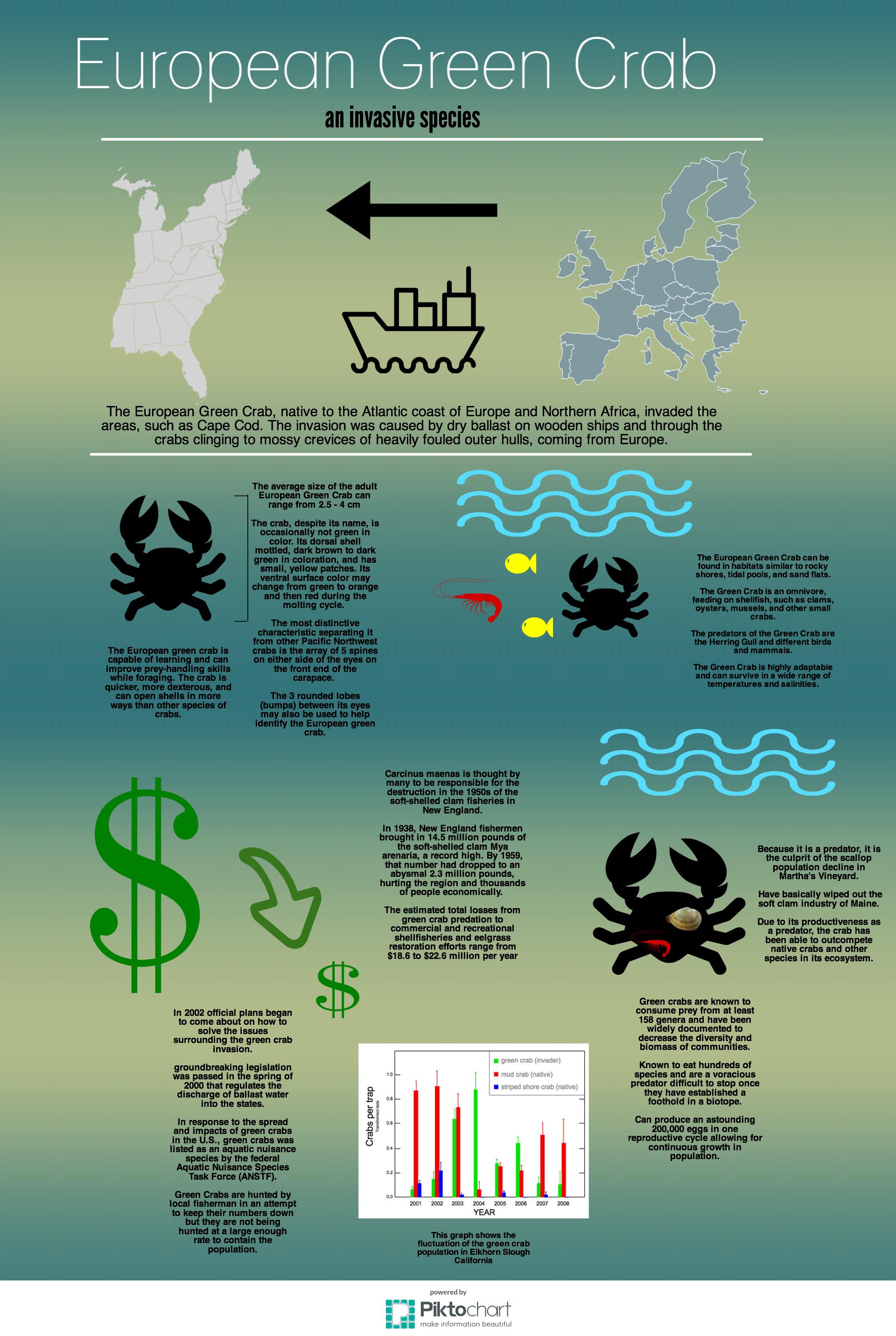
A note from the creators, Ellie Hedison (V Form) and Marcus Permatteo (V Form):
While creating our infographic, we wanted to strike a balance between being informative and visually appealing. The European Green Crab, an invasive species, has transformed ecosystems and communities along the eastern coast of the United States. We hoped to address the main aspects of the Green Crab as an invasive species and how it puts ecosystems in danger through visuals and graphs instead of simply just writing a paper. The European Green Crab was an appealing topic for us because it has a local effect, infiltrating the coasts of Maine and Cape Cod. (more…)

Environmental Blog: Can We Blame Cows for Climate Change?
By Emma Plumb, VI Form
Environmental Blog: Can We Blame Cows for Climate Change?
Editors’ Note: The following piece is one of many blog posts written by Advanced Environmental students; check out the blog here–https://2015enviroblog.wordpress.com/
We all know that burning fossil fuels releases greenhouse gasses into the atmosphere. We can, and should, buy hybrid cars, ride our bikes and put up solar panels to help solve the problem of climate change. But did you know coming home to a steak dinner also contributes to greenhouse gas emissions? Livestock is responsible for 27% of greenhouse gas emissions in the U.S., and 18% of emissions worldwide through enteric (microbial) fermentation and manure management, not even taking into account transportation. (more…)

The Circadian Clock and The Adverse Effects of Elevated CAT Level
By David Baek, VI Form
The Circadian Clock and The Adverse Effects of Elevated CAT Level
Introduction: This project probes into the molecular mechanism of the circadian clock of Drosophila Melanogaster. The circadian clock exists in all living things and regulates the daily rhythm of organisms’ metabolism, behavior, and other outputs that affect the organisms’ development (CH Ko, 2006). The circadian clock is a field that researchers and scientists have yet to fully understand due to the ambiguity of how circadian clock affect invertebrates and vertebrates. To uncover one small aspect of this obscurity, this study seeks to find the effect of sleep deprivation on antioxidant defense in fruit flies. If there were to be a link, the investigation would be significant as the effect will explain how sleep deprivation in humans can lead to the weakening of their antioxidant defense, leading to multiple cardiovascular diseases and pathological conditions such as plaque formation in vessels (Takeda, 2011) (Dominguez-Rodriguez et al, 2009). (more…)

From Classroom To Lab: My Work With T Cell Therapy
By Lilly Drohan, VI Form
From Classroom To Lab: My Work With T Cell Therapy
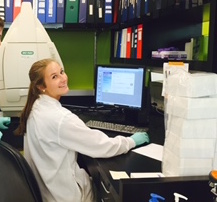 This summer, I traveled to Seattle, Washington to work in the Ben Towne Center for Childhood Cancer Research at the Seattle Children’s Research Institute. My biology teacher presented me with the opportunity, and I immediately got my hands on it. Studying cancer at the microbiological level in Advanced Biology my junior year really challenged me and stimulated my curiosity, but what I experienced during August turned my attraction into almost an obsession. Dr. Michael Jensen, the director of the lab, takes an approach to pediatric cancer therapy that not many take: using the body’s own immune system to fight off the cancer. Dr. Jensen and his team reprogram immune cells called T cells using virus technology to give the cells specific properties that help them proliferate and target specific molecules expressed on cancer cells. This form of therapy is incredibly innovative and creative, and it was so captivating to be at the forefront of the further development of the treatment for just a brief month.
(more…)
Drunk Worms: My Internship and Research on Alcoholism
By Marissa Huggins, VI Form
Drunk Worms: My Internship and Research on Alcoholism
Alcoholism is a serious disease that affects 7.2 % of the United States adult population.¹ This illness is often influenced by genetics; more people are predisposed to develop alcoholism, or alcohol addiction, based on their DNA. While significant discoveries have been made, there is room for growth in the scientific research field surrounding the genetic factors that contribute to the development of alcoholism.This past summer, I engaged in an eight-week long internship at Rosalind Franklin University under the mentorship of Dr. Hongkyun Kim. Dr. Kim’s work focuses on researching muscular dystrophy, ion channel localization, and alcohol and excitability using Caenorhabditis elegans (C. elegans) as a model organism. (more…)
The Horrific Nazi Experiments During World War II
By Lucy Holland, VI Form
The Horrific Nazi Experiments During World War II
Presently, informed consent is a widely used and understood term – the process of receiving consent from patients before administering a medical intervention on them. But before a court case in 1957[1], only 58 years ago, informed consent was not required in medical practices, which meant that medical practitioners could do almost anything to their patients without them knowing or realizing that it was ethically wrong. In The Immortal Life of Henrietta Lacks, Henrietta’s cells were taken for a culture when she went into Johns Hopkins because of what the doctors eventually discovered was (more…)


 LEO
LEO 