
Home » Season 3 (Page 6)
Category Archives: Season 3

Northern Pacific Seastar Asterias amurensis & My Zone as an Artist
By Mei-Mei Arms, III Form
Northern Pacific Seastar Asterias amurensis & My Zone as an Artist
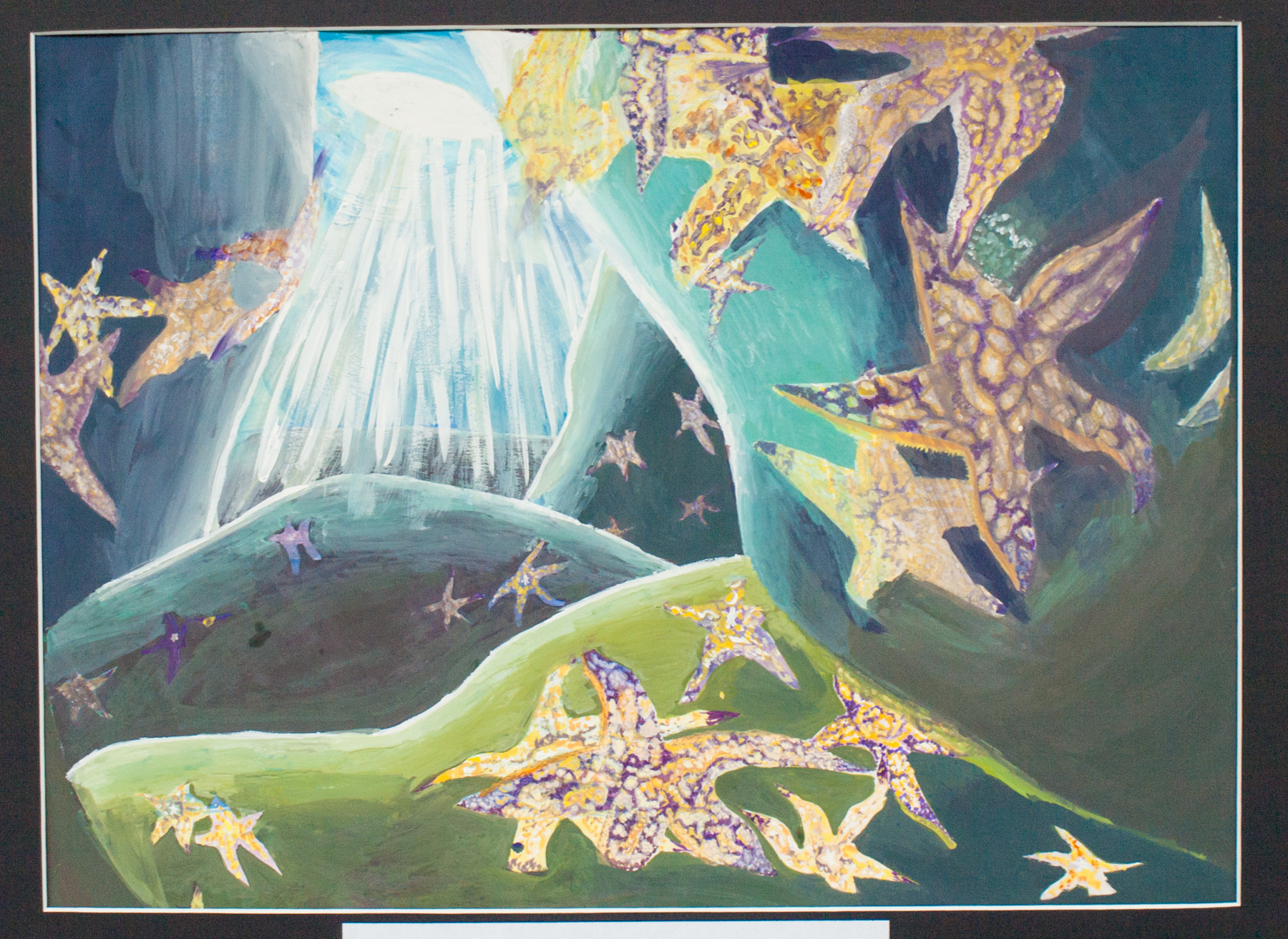
(See larger image below)
This seastar originated in Japan, Korea, China and Russia, about 20-40 metres deep off the coasts of these countries. It was introduced by the ballast waters of cargo ships as they returned from these countries and used ocean water to replace the weight of cargo. They can reproduce without the aid of another sea star and can multiply in the thousands. Due their rough exterior, the Northern Pacific Seastar does not have many natural enemies. Their larvae are so small that we cannot find a way to capture them and nothing appears to eat them at that stage in their life cycle. The Sea stars eat crustaceans and due to their numerous population, when they enter a new area, their numbers can wipe out the whole population of crustaceans. They can break off limbs and these limbs can grow in to new Sea Stars, but this process does take years. (more…)

The Art of Calligraphy
By Sean Kim, VI Form
The Art of Calligraphy
 As the Western Hemisphere settles down from all the hubbub of the new year, many nations in East Asia and their diaspora communities recently celebrated their new year: the Lunar New Year. Even with all the “westernization,” celebrating holidays based on the lunar calendar and tradition that come with the holidays have stayed an integral part of communities throughout East Asia and beyond. One of the traditions of the holidays is calligraphy. Calligraphy, which began as a crude pictogram in Ancient China, has been considered a work of art for millennia. Just as art did, calligraphy in East Asia developed and evolved, spawning numerous styles of writing that came and went as centuries passed. (more…)

The European Green Crab
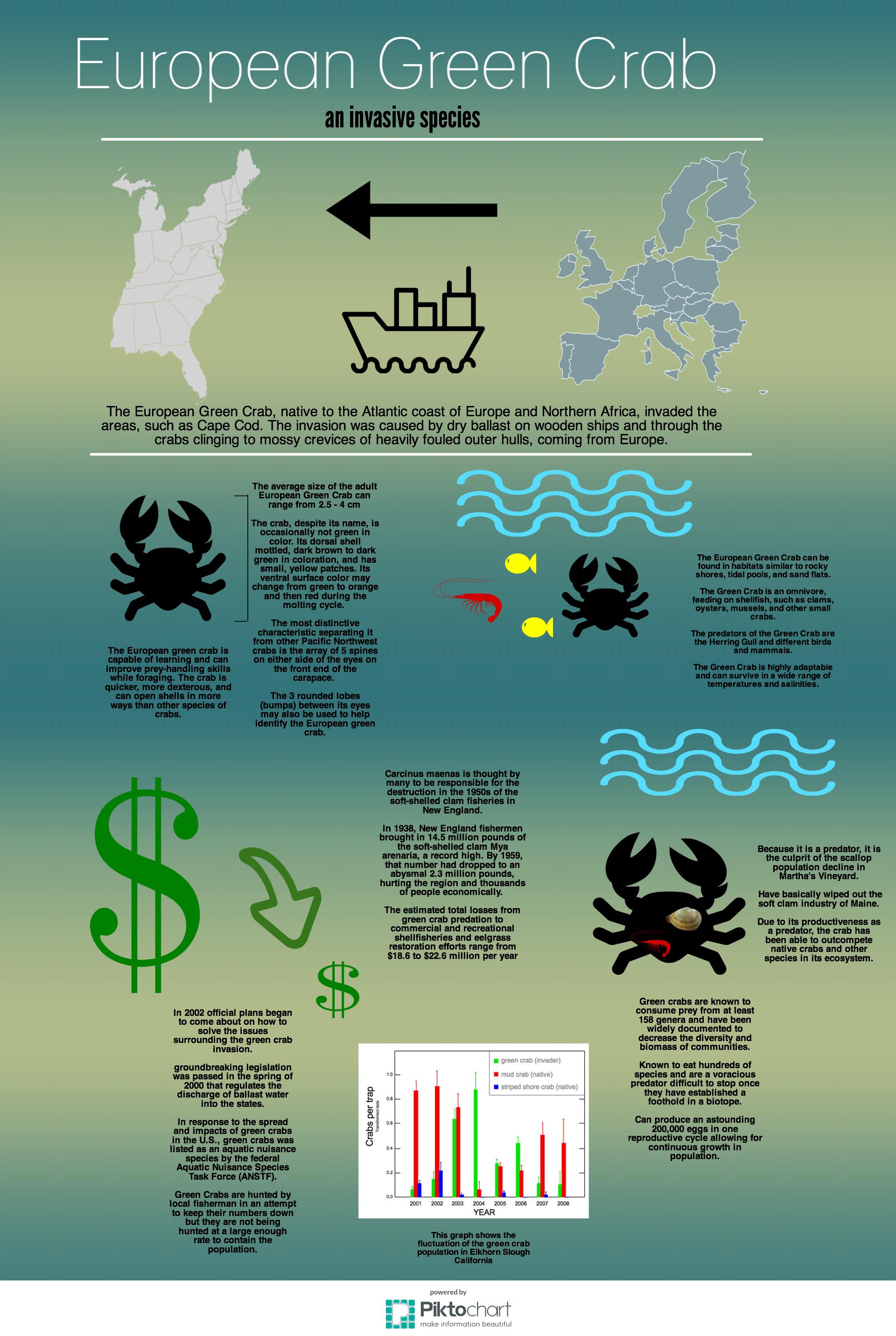
A note from the creators, Ellie Hedison (V Form) and Marcus Permatteo (V Form):
While creating our infographic, we wanted to strike a balance between being informative and visually appealing. The European Green Crab, an invasive species, has transformed ecosystems and communities along the eastern coast of the United States. We hoped to address the main aspects of the Green Crab as an invasive species and how it puts ecosystems in danger through visuals and graphs instead of simply just writing a paper. The European Green Crab was an appealing topic for us because it has a local effect, infiltrating the coasts of Maine and Cape Cod. (more…)
Racial Integration at St. Mark’s: The Experience and Legacy of Ethan Anthony Loney
By Joey Lyons, VI Form
Racial Integration at St. Mark’s: The Experience and Legacy of Ethan Anthony Loney
On May 17, 1954, the Supreme Court ruled in Brown v. Board of Education that segregation in public schools deprived minority children of equal protection under the Fourteenth Amendment.[1] The Court’s decision in Brown repudiated the “separate but equal” principle, a principle that had prevailed in the United States since Plessy v. Ferguson (1896). In his unanimous opinion, Chief Justice Earl Warren stated that “separate educational facilities are inherently unequal.”[2] After a second decision a year later, in Brown II, the Court demanded that public schools integrate “with all deliberate speed.”[3] However, the desegregation of public schools proceeded slowly, particularly in the South, which engaged in “massive resistance” and passed laws declaring the Brown decision invalid.[4] Unlike southern states, northern states did not reject the Court’s ruling outright. Instead, northern school boards drew school zones that reflected white and black neighborhoods, thus maintaining segregated school systems.[5] (more…)

The Architecture of New England’s Boarding Schools and Its Significance
By Claudia Chung, VI Form
The Architecture of New England Boarding Schools and Its Significance
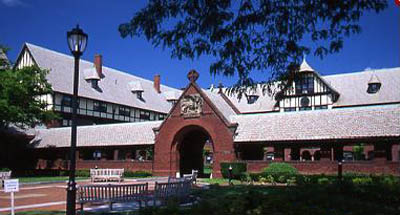
Post Revolutionary War boarding schools focused on educating America’s elites. These schools were products of their time; their values reflect a set of specific principles that their founders deemed admirable. Although these values evolved over time, they often included concepts of leadership, service to the nation, and dedication to one’s family. Schools built in the mid- to late- eighteenth century, the “Academies”, seem to reflect vastly different values than those of their “Episcopal” counterparts founded in the mid- to late- nineteenth century. Following the religious teachings of the Episcopalian tradition, episcopal schools boasted community and family based values; while the academies prided themselves on their focus on classical academics and service. The architecture of these schools closely follows architectural trends of their time and, at the same time, serves as powerful testament to the schools’ founding values. Despite each school founding with different affiliations, purposes, and people, the architectures of these schools deeply reflect the principles valued by the school —from its founding to present day.

The History of Coeducation in America and at St. Mark’s
By Sarah Robertson, VI Form
The History of Coeducation in America and at St. Mark’s
Gender inequality has been an enduring issue in America. In 1848, there was a call to end discrimination when women signed the Declaration of Sentiments at the the first women’s rights convention in Seneca Falls, New York.[1] But, it was not until 1920, seventy-two years later, voters ratified the 19th Amendment, the right for women to vote. In 1972, Congress passed Title IX, prohibiting discrimination, exclusion, and denial of benefits based on sex in all federally funded education programs.[2] It took until 1972 for coeducation, for the government to protect education of students of both sexes together. Though these strides were positive, they were certainly drawn out. The progression towards coeducation, both in the United States as a whole and at St. Mark’s School in particular, was similar: slow, always a step behind. However, both America and St. Mark’s ultimately have become strong, healthy, coeducational environments.

A War Hero Beyond the War
By Hans Zhou, VI Form
A War Hero Beyond the War
In the fall of 1931, a boy with dark hair from Manchester, Massachusetts, who was fairly short for his age, joined the St. Mark’s School Class of 1936 as a new second former.[1] His name was Henry Nichols Ervin, but many people used his nickname, Skip.[2] Born on October 21, 1918, in San Diego, California, Ervin and his family moved several times and attended schools in California, Nebraska, and Massachusetts prior to enrolling at St. Mark’s.[3] Ervin had a brother named Robert Gilpin Ervin, Jr., who was two years ahead of him at St. Mark’s, and a younger sister named Adele Ervin, who is still alive today.[4] Today’s St. Markers might know Henry Nichols Ervin as the abbreviated name “H. N. Ervin” on the board outside the dining hall marked with a star, indicating that he died in the war, among a long list of other people who also fought in this war. When waiting in line outside the servery, few people would look at the name on the wall and think of the life stories of these war heroes. However, Henry Nichols Ervin had a lasting impact on St. Mark’s School through his character. He was a student leader, he volunteered at Brantwood, and his family and friends funded various prizes to honor his character.

St. Mark’s Wartime Views
By Wendy Hirata, VI Form
St. Mark’s Wartime Views
With St. Mark’s School’s emphasis on service, the St. Mark’s student body shaped its wartime views based on the general atmosphere of World War I and the Vietnam War. Such student perspectives did not always agree with the general views of the public. Both St. Mark’s students and the American public showed less support for U.S. war effort from World War I to the Vietnam War. St. Markers shared the patriotic national preparedness and humanitarian mission with the general public during the World War I, but had more of an aloof, elitist attitude towards the Vietnam War and the anti-war movements of the time. (more…)


 LEO
LEO 