
Home » 9th Season (2021-2022) (Page 2)
Category Archives: 9th Season (2021-2022)
The American Eugenics Movement and its Influence on Nazi Germany
By Caroline Sullivan, VI Form
The American Eugenics Movement and its Influence on Nazi Germany
It’s the early 1930s. A young woman, twenty years old, is out to lunch with her mother when all of the sudden she feels sharp stomach pains tearing through her abdomen. She dismisses them as merely an upset stomach, but they grow worse. Her driver rushes her to a hospital. When she arrives at the hospital, the doctors barely examine her before diagnosing her with appendicitis. They inform her that she must undergo emergency surgery to remove her appendix before it ruptures. However, upon waking up from the surgery she notices that something was different. All around her, doctors were whispering and acting suspiciously. New doctors, ones that she had never seen before, were coming in to observe her as if she was a sort of experiment. Confused, the girl begins searching for answers as to what had happened during surgery. She listened and overheard the doctors calling her offensive names such as “dumb,” “feebleminded,” and “idiot.” Finally, she connected the dots. While in surgery, the doctors had sterilized her, stripping her of her right to have children.
It’s 1958, and the parents of a four-year-old child admit their son, Mark, to a mental hospital for Cerebral Palsy. His mother goes to the hospital every Wednesday to visit, but one week the hospital tells her she cannot come anymore. A few days later, the family receives a devastating call: their six-year-old boy has passed away. Upon requesting further information about his death, the hospital refuses to share anything. It even fails to provide a death certificate when the family asks for one. The family is destroyed, his parents lost a child, and his three sisters lost their little brother. Even worse, they struggle to find closure as the hospital gave them so little information about his death. Their quest for answers finally gets results decades later when the government declassifies records from the state hospital. The family is horrified to learn that their, innocent, six-year-old child died an excruciatingly painful death from radiation poisoning at the state hospital.
These two stories have more in common than their raw horror. They did not occur in some far away totalitarian country overseas. Instead, they took place within the United States, under the jurisdiction of the U.S. government. These tragedies occurred in the very country that idealizes its democracy, grounded in the ideal of freedom. These procedures were legal under the U.S. justice system, a system created to promote liberty. Instead, The Constitution allowed states to deprive the most vulnerable members of society of liberty under a program called eugenics.
(more…)Women in Ancient Greek Literature
by Suha Choi, Michael Ferlisi, Riley Jahnle, Liam Mulvihill, Lauren Tran, Arden Williams, and Arjun Yerabothu
Women in Ancient Greek Literature
Instructor’s Note: During the second and third windows in Greek II, students read two ancient texts that offer a window into the lives of ancient Greek women of the Archaic period: the Hymn to Demeter and fragments of verses by the female poet Sappho. For the assignment on Sappho, students were asked to read, scan, and recite a fragment of Sappho’s poetry and then to imagine the complete poem this fragment might have once lived in, and compose a poem in five Sapphic stanzas in English. For the Hymn to Demeter students were asked to translate and analyze a portion of the hymn and, in a close reading of the text, to show how it contrasted with themes of heroism and masculine forms of agency found in Homer’s Iliad.
Part I: Sapphic Stanzas
Fragment 34
ἄστερες μὲν ἀμφὶ κάλαν σελάνναν
ἂψ ἀπυκρύπτοισι φάεννον εἶδος
ὄπποτα πλήθοισα μάλιστα λάμπη
Γᾶν
Suha Choi, Fragment 34:
stars around the beautiful moon
hide back their luminous form
whenever all full she shines
on the earth leaking droplets of
silver.
clouds around the beautiful sun
cover up its hazy form
whenever all out she shines
on the earth, bringing drops, oh so
golden.
rocks around the beautiful pond
provide a cozy frame
whenever I pass by she reflects
my face and holds liquids of
diamond.
soils around the beautiful lily
gently hug her in warmth
whenever she blossoms
into birth, infusing dues of
sweetness.
bad days around one good one
though mundane and ordinary
whenever it comes to me
I rejoice, thanking even the bad for
one beauty at last.
Researching Foreign Aid with the Help of The Thomas H. Kean ’53 Fellowship
By Kanav Sahani, V Form
Researching Foreign Aid with the Help of The Thomas H. Kean ’53 Fellowship
Thomas H. Kean ’53 Fellowship:
The Class of 1962, at their 25th Reunion in 1987, established the Thomas H. Kean ’53 Fellowship Program to honor Tom Kean, their teacher, advisor, mentor, and friend. The purpose of this fellowship is to enable students to explore important public policy topics and to embark upon exemplary lives of public service in the spirit of Governor Kean.
Kean Fellowships will be conferred upon a small number of highly well-qualified students who propose and undertake independent research and study in the field of public service, exploring meaningful domestic public policy issues. Once selected, and on the basis of their topic, Fellows will work with a faculty mentor and find meaningful connections with academicians and leaders in the field of public policy. The Fellowship will engage the students in cutting-edge topics and in a manner that is serious and capitalizes upon what they have learned at St Mark’s.
I chose to attend the economics policy academy at Georgetown University because it teaches a unique combination of economics and political science and how to use this knowledge to solve real-world problems. I find these topics interesting because they have so much influence on how the world works, so once I found this course online, I knew I would want to join it. My interest in the more political side of the world started with the social justice class I took with Dr. Worrell during the spring semester of my sophomore year. In addition, my interest in the economic side started with learning about the legendary investor Warren Buffet. Following his story on how gained investing fame by sticking to his strategy has increased my interest in the finance and economic sectors.
(more…)U.S. Campaign Ethics Video Lesson
By Mandy Hui and Steven Yang, V Form
U.S. Campaign Ethics Video Lesson
This video lesson was created as part of the Ethics and Morality course.
What impact has the pandemic had on women’s rights in the developing world?
By Sitong Hui, IV Form
What impact has the pandemic had on women’s rights in the developing world?
Introduction
Throughout human history, movements advocating equal rights between men and women have made up humanities. Women who seek independence and equality have countless devotions on this arduous journey. From Africa to America, abolishing slavery, winning suffrage, and gaining political power are main aspects of female rights. While the feminist movements around the world have made tremendous progress in the past few decades, the recent COVID-19 pandemic has posed challenges and resulted in major drawbacks to women’s status in many parts of the world.
The essay is aimed to provide information and analysis on the impact of the COVID-19 pandemic on women’s rights in developing countries. It also explains some exemplary methods certain countries are using to soothe the situation faced by women. The essay will outline three major threats to women with detailed supporting evidence, and give out a final conclusion that incorporates a short analysis of prospective development.
COVID-19 Pandemic’s Impact on Women’s Rights
● Women’s Economic Rights in the Asymmetric Unemployment Shock
One of the most immediate impacts on women brought by the pandemic is the economic disadvantage. According to data released by the European Parliament (2021), about 84% of working women are facing the threat of being unemployed. The recession following the virus outbreak has caused considerable unemployment in many countries, but this effect was largely asymmetric across genders.
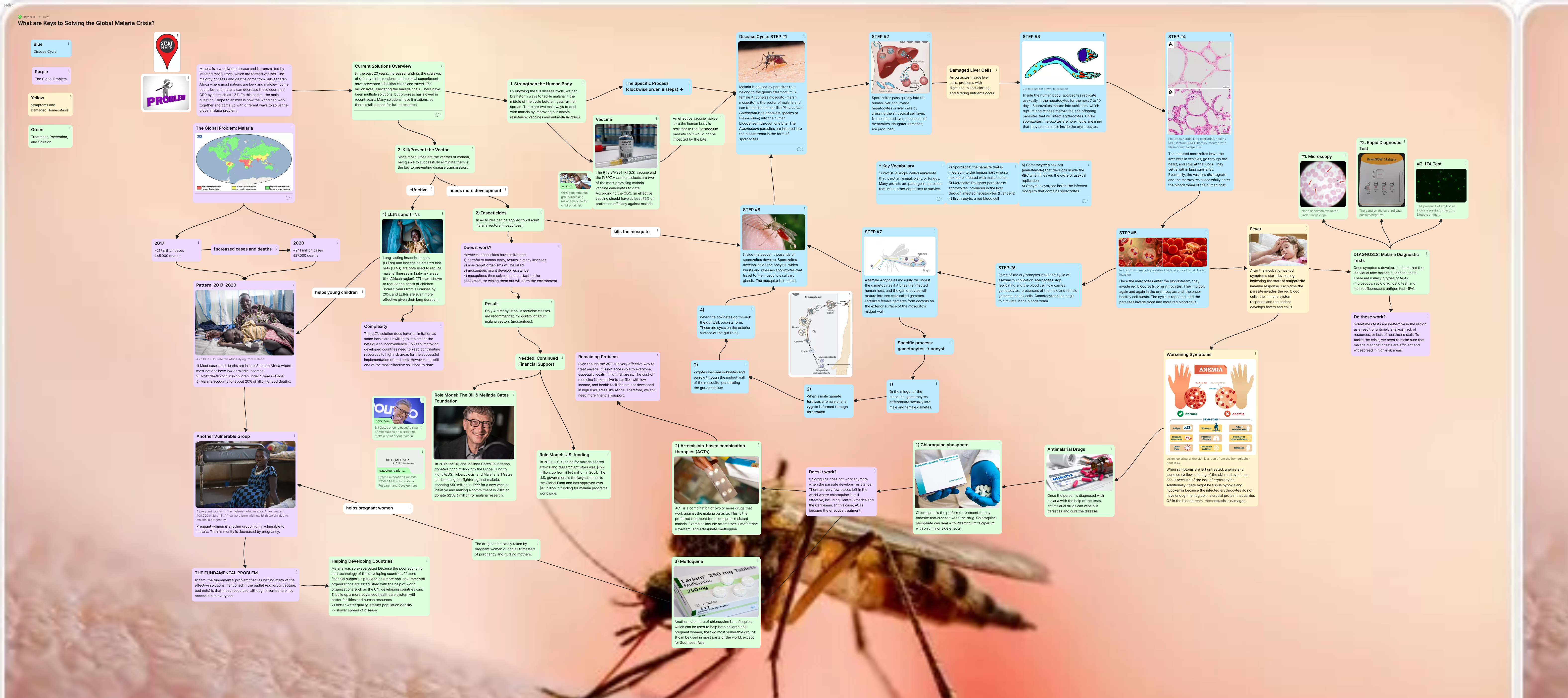
(more…)Two Biology Projects: Malaria and Hemispherectomies
By Coco Xia, IV Form
Two Biology Projects: Malaria and Hemispherectomies
Coco Xia offers insights into her work in biology by submitting two different types of assignments: a flowchart on Malaria and a case study recommendation about Rasmussen’s Syndrome.
Malaria Flow Chart:
Women in Naxi Ancient Music
By ZiYue (Kelly) Yang, V Form
In 2020, ZiYue founded the Naxi Music foundation, which aims to preserve, empower, and inherit Naxi Ancient Music. She directed the following documentary, Women in Naxi Ancient Music (2021) as part of her ongoing mission to preserve the NaXi ancient music and raise questions about ways in which minoritized cultures from around the world survive can under conditions of rapid modernization and globalization.
Personal Finance for Beginners
By Yichen (Anna) Xing, IV Form
After graduation, many get their first formal job and start making money, but only a small percentage of young adults have the intention to manage their savings. Various reasons lead to the unawareness of the topic of personal finance, including the lack of financial education in high school, help from parents, or people who are simply ignorant of the benefit of having a lifelong savings plan. Some may question the necessity of developing a savings plan because they think they can live without worrying about going bankrupt, however, life is full of variables and uncertainties. As an introduction for beginners, this essay will provide an overview of topics related to personal finance, covering tax and benefits, tax deferred savings, interest rates, cost of living, investing, insurance, and housing.
To make a lifetime consumption plan, tax and benefits are always crucial factors to incorporate into your calculations because they are influential in many aspects of life. The most common tax categories include income tax, employment tax, sales tax, property tax, and estate and gift taxes. Personal income tax applies to most forms of income and increases with income. To calculate one’s after-tax income or the available amount for consumption, both federal and state tax rate needs to be incorporated based on the corresponding bracket. For example, if one earns $100,000 annually and lives in Massachusetts, that person will pay $14,605.50 plus 24% of the amount over $85,525, which is $18079.5 for federal tax and 5% of $100,000, which is $5000 for state tax. Employment taxes are used to fund social security and Medicare, also called FICA. For employment tax, employers and employees split the tax, each paying 6.2% for social security and 1.45% for Medicare, totaling up to 7.65% of their income. In this case, the hypothetical person will pay $7650 for employment taxes. For those earning high incomes, employment taxes have an upper limit of $142,800. Unlike income and employment taxes, sales tax is mainly based on state levels. Sales tax applies to most goods and services in the form of a given percentage of the price but with many exemptions. Alaska, Delaware, Montana, New Hampshire, and Oregon currently have no sales tax. There are also tax-free weekends in 16 other states with different dates and rules. Property taxes include both residential and commercial properties and follow the state’s tax system with various percent based on the local city or town. This is a key aspect to put into consideration when deciding where to buy or rent because owning a property brings an extra financial burden. Estate and gift taxes are paid upon death and are applied at the federal and state levels. It is a relatively minor topic because according to the federal system, only gross assets that exceed $11,700,000 are subject to paying estate and gift taxes, with one exception of Florida, which has no estate tax.
(more…)

 LEO
LEO 