
Home » 5th Season (Page 4)
Category Archives: 5th Season

Taboo or Taking a Stand? Why Sexual Assault Needs More Attention
By Lucy Martinson, V Form
Taboo or Taking a Stand? Why Sexual Assault Needs More Attention
Editors’ Note: In Dr. Worrell’s Social Justice course, students identified an issue that they wanted to take a stand on and then researched to write an evidence-based editorial to demonstrate that they have built knowledge and skills. This assignment was modeled on The New York Times Learning Network Student Editorial Contest.

Image from CBC News
Sexual assault has always existed but became more visible recently with actresses such as Ashley Judd, Gwyneth Paltrow, and Angelina Jolie accusing acclaimed director Harvey Weinstein of sexual assault. The outbreak of these allegations brought the nation’s attention to the issue of sexual assault and harassment. Following this, actress Alyssa Milano started the hashtag #MeToo on Twitter, encouraging women to speak out and share their stories. This movement gained rapid popularity and snowballed across various means of social media, with thousands of women (and men) replying with their experiences and/or their support. Yet, even with these recent high profile cases, there is still work to be done to raise awareness regarding the prevalence of sexual assault. (more…)

Comparing Korean Forced Labor on Hashima to the U.S.’s Internment of Japanese-Americans
By Izzy Kim, VI Form
Comparing Korean Forced Labor on Hashima to the U.S.’s Internment of Japanese-Americans
Soon after the arrival of Commodore Matthew Perry, Japan underwent a major industrial revolution. The new Meiji government altered political, cultural, and educational sectors of Japan and even drafted a new constitution to embrace westernization. The rapidly westernizing Japan expanded its sphere of influence in Asia and overpowered China which did not adopt western ideals and technologies. Although the road to Japanese Imperialism in the 1930s to its grand wartime strategies in 1945 are certainly notable, Japan had a blank check in committing unspeakable atrocities during this period. The history of modern slavery and comfort women in Hashima, one of the most crucial industrialization sites of the Imperial Japan, is the very embodiment of the abominable and often ignored history behind Japan’s rise to power.
The example of forced labor of Koreans on Hashima can be compared to U.S. internment of Japanese-Americans since in both cases, a foreign group was suppressed during wartime to ensure security of the “stronger” nation. However, how Japan and the U.S. reacted to their historical atrocities is vastly different. America later acknowledged how they infringed upon the rights of Japanese-Americans with an executive order and apologized, while Japan chose to ignore the existence of Korean forced laborers on the island during World War II. In fact, Japan went as so far as to acquire a UNESCO World Heritage Site status for Hashima in 2015 in a decade-long struggle to register the island as a momentous site of industrial revolution. UNESCO’s decision to grant the island a World Heritage Site status faced many controversies leading to the production of the 2017 Korean film The Battleship Island. (more…)
Leadership from All Directions – The Collaborative Effort of Lion Term
By Liz McCulloch, Director of Lion Term and French Faculty
Leadership from All Directions – The Collaborative Effort of Lion Term
Editors’ Note: This piece originally appeared in the gcLi’s Leadership blog on 2 April. You can further seek the Gardner Carney Leadership Institute on Facebook by clicking here.
Last Spring, our entire community experienced the first ever St. Mark’s Lion Term, a two-week experiential education program that ends the school year. During Lion Term, each grade has its own unique focus and all 10th grade students work with local organizations to promote community engagement. We adopted a modified version of the African Leadership Academy’s BUILD model, a form of design-thinking adapted for social entrepreneurship. The ideas were iterated and tested first, and students came away with the confidence that working together, they can play a role in their communities.
One of my favorite stories from last year’s Lion Term involves a group of 10th grade students who worked at Daniel’s Table, an organization committed to ending hunger in Framingham, MA and beyond. After volunteering to serve meals and talking to the founders and clients at Daniel’s Table, our group recognized that it would be helpful to list the ingredients in multiple languages for those who do not speak English or who are not familiar with the local produce. The group decided to make laminated cards with ingredients in English, Spanish, and Portuguese on one side and recipe ideas on the back. In working to understand the needs that the organization was meeting, our students were able to offer a solution that helped the organization to improve its service. (more…)

Language Immersion Trips: A Must-Have For A Student’s Bucket List
By Paige LaMalva, IV Form
Language Immersion Trips: A Must-Have For A Student’s Bucket List
I have loved the French language ever since I was in sixth grade. My middle school French teacher, Mrs. Okacha, made French my favorite subject because her class was both engaging and interactive. When I was in eighth grade, I helped lead one of her younger classes because I appreciated and enjoyed French so much.
After arriving at St. Mark’s and hearing about the French language trip offered every other year, I wanted to pursue it. I still loved the language, and I was to speaking a lot more French with my teacher, Ms. McColloch. I kept telling myself, “I can’t wait to be a sophomore and communicate in a real-world scenario.” I was exhilarated to find out that I got a spot on the trip. My French education would be applied in a real-world setting! Reading and speaking French was going to be challenging, but I was ready to take it on. (more…)

The Fight for Women’s Rights in Haiti
By Bannon Jones, III Form
The Fight for Women’s Rights in Haiti
Haiti has had a long, rigorous history starting in 1492 when the Spanish Inquisition conquered Haiti and ruled until 1697. After 1697 the French took control of Haiti, they brought enslaved people from Africa and also enslaved the native people of Haiti. France used them to produce sugar cane, soon making Haiti the richest colony in the world at the time. In 1790 there were 40,000 white French people, 30,000 freed slaves, and 450,000 enslaved people. The Haitian Slave Revolts began in 1791 and, due to how outnumbered the French were by the enslaved people, it became one of the few successful slave revolutions in history. Haiti soon after gained full independence in 1804. Throughout Haiti’s history, they have not had much time to focus on their own people, which may explain the reason why women’s rights in Haiti are gravely lacking. NGOs like USAID, Doctors Without Borders, MicroCredit, and WomenOne are slowly helping to change this through strengthening laws around women’s rights, increasing women’s healthcare, helping women to have small businesses, and increasing women’s education. (more…)

Evolution and Revolutions in Physics (with Tiki-Toki)
By Tony Banson, Colton Bullard, John Cho, Thayer Cornell, Alan Gao, Jovin Ho, Izzy Kim, Ivy Li, Helynna Lin, Sada Nichols-Worley, Cooper Schmitz, Jonathan Shakespeare, Leon Shi, Alex Song, Alan Yang, Justin Zhang
Evolution and Revolutions in Physics (with Tiki-Toki)
Editors’ Note: In “Advanced Physics: Modern Topics in Physics,” the class is collaborating on a “Timeline” of physics, utilizing the online tool Tiki-Toki. The timeline is an ongoing work in progress throughout the course, hence moments, details, and explanations are added as completed.
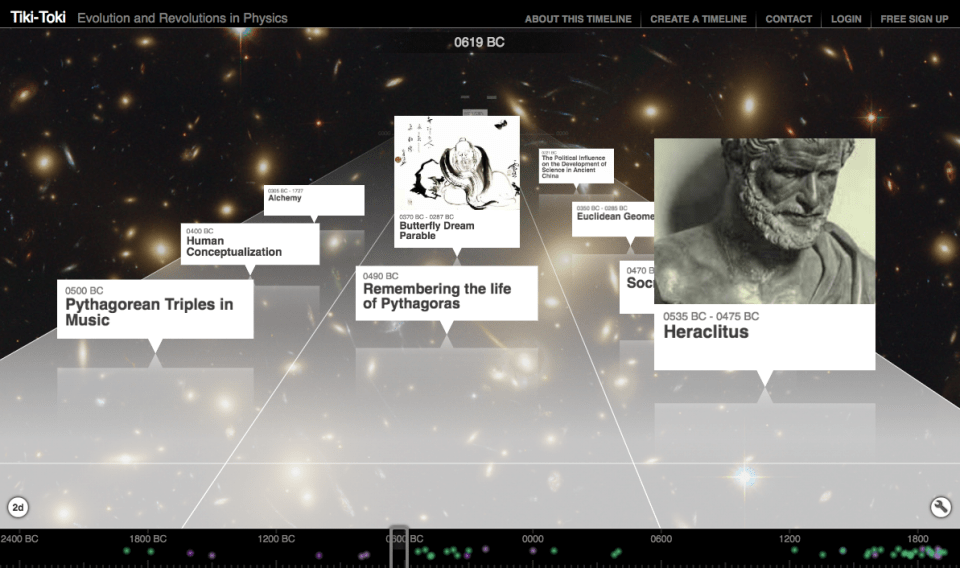
Click on the image or here to go the Tiki-Toki site for the timeline.
The best way to view it is as a 3D “highway (look for the round 3d button on the lower left of  your screen), but it is also visible as a conventional 2D side-scrolling timeline. (more…)

The Blueprint Hackathon and Finding Your Scientist Doppelgänger
By Luc Coté, Filip Kierzenka, Connor Browder, V Form and Jason Chen, IV Form
The Blueprint Hackathon and Finding Your Scientist Doppelgänger
On February 17th and 18th, the annual Blueprint Hackathon was held at MIT. You may wonder what exactly a Hackathon is, and we certainly wouldn’t blame you. A Hackathon is essentially a “Hacking” Convention, although “Hacking” is used very liberally to make the name sound cooler than “Computer Science” Convention. On the first day, we had the Learnathon, which is devoted entirely to learning about computer science, specifically about App Development, Web Design, or Basics of Coding. Taking the Web Design course, we learned a lot about a style of programming our JAVA based classes have not exposed us to.
The first day was an appetizer of new knowledge. The second day gave the main course: The Buildathon. This is where we put our knowledge to the test, working as a team to create a final project in 9 hours. Our idea was to build a program that matches a user’s face to a famous scientist doppelgänger. (more…)

Defining Leadership: Through Peace in the Sport of Squash
By Alan Gao, V Form
Defining Leadership: Through Peace in the Sport of Squash
Recently, when I was playing squash with my partner, we both felt exhausted after an hour of intense training. Seeing that there were still a few more minutes before dinner, we decided to relax a bit instead of playing competitively. We came up with the idea of “peace-squash,” and its purpose is to play the game at ease and develop a social relationship. Each player needed to serve the ball as much as they can to the other’s position, allowing him or her to move less. The one who fails to “serve” the other loses the game.
At the very beginning, we found peace-squash relaxing. We stood there casually and hit the ball to the wall. To many outsiders, the way we played the game was seemed foreign, as we didn’t intend to win the game. Gradually, the extra minutes allowed me to have the Zen moment and reflect how squash players come together as a community. Sometimes the ball is hard to catch, like near a wall or in a corner, yet we try our best to return the ball to the position where the other players feels comfortable to reach, no matter where the other is. It is pretty challenging, and as the game continues, there are often occasions where one fails to catch the ball. When that happens, the person who hit the ball previously apologizes immediately. (more…)


 LEO
LEO 