The Broken Pieces Made Into Germany
By Harrison Chapman, VI Form
In the spirit of No-Shave November, I feel inclined to honor some of facial hair’s greatest sponsors. Many leaders throughout history grew impressive beards and mustaches: Lincoln, Darwin, Roosevelt, Twain, and, of course, Chuck Norris. But, one man not only rocked a handle bar mustache incredibly well, but he was also able to unite the individual pieces of the broken Holy Roman Empire into what we now know as Germany. This man was Otto von Bismarck. (more…)
Fortitude Transpires Amid Devastation in the Philippines
By Camille Banson, V Form
On November 8, 2013, Typhoon Haiyan tore through the Philippines with 197mph winds and relentless floods that consumed homes. An estimated 5,000 people died, 18,000 injured, and over 1,000 still unaccounted for, but numbers do not fully describe the devastating situation. Corpses hung from trees and were scattered on sidewalks. Desperate residents in search of food, water, and fuel looted grocery stores and gas stations. People lost their lives, livelihoods, homes, children, parents. (more…)
Why Speech and Debate Matter
By David Eacho, VI Form and Jane Cho Watts, IV Form
Why does the United States Constitution’s First Amendment grant us the right to free speech if we don’t know how to use it? Up until the 1970s, St. Mark’s had mandatory Public Speaking class for IVth formers and form-wide debates and speech competitions across the entire school. Since then, oratory has been limited to a Third Form Seminar event. The quality of presentations across the school has deteriorated to the point where school meeting announcements cause dread among the student body. It’s time for all that to change. (more…)
Notes from a History Research Paper Purist
By Caitlin Jones, History Faculty
Lately, I have been giving a lot of thought to the value of the traditional history research paper. Has the shift towards instantaneous, accessible information made historical research skills obsolete or has it made the role of the historian that much more important in wading through the sea of information that is readily available at our fingertips? In all of this discussion about global citizenship and twenty-first-century skills, is the history research process relevant and valuable? (more…)
The Role of STEM in a Liberal Arts Education
By Michael Wirtz, Assistant Head of School and Dean of Faculty
“In my perspective … science and computer science is a liberal art, it’s something everyone should know how to use, at least, and harness in their life. It’s not something that should be relegated to 5 percent of the population over in the corner. It’s something that everybody should be exposed to and everyone should have mastery of to some extent, and that’s how we viewed computation and these computation devices.” – Steve Jobs, from a 1996 interview with NPR’s Terry Gross
At St. Mark’s, a school with a proud and strong liberal arts tradition, there has been a fair share of head scratching and hand wringing about the role of the school’s STEM (science, technology, engineering, and mathematics) education initiative in our future. During the early evolution of this (more…)
A New, Future Cure: RNAi
by Lizzy MacDougall, VI Form
St. Mark’s is in its second year of running the STEM fellowship, a class that allows eleven students the ability to pursue a research project in an area that interests them. The projects range from irrigation systems to plant growth hormones to biological studies. This last area of study is what I am researching for the year. My classmate, Hughie Auchincloss, and I are spending the year experimenting on the possibilities of using RNA interference as a cure to many kinds of diseases, such as cancer, in people who are nutrient deficient. Hopefully, our work will be the first step in helping our sister school in Haiti, St. Marguerite’s, have access to effective and affordable medicine. (more…)
Double Inverted Pendulum in 2D and 3D Space
by Ryan Lee, V Form
 This summer, I went to Mathematica Summer Camp. Mathematica is computer software made by Wolfram Research. This tool is commonly used by mathematicians and scientists. In the camp, each student completes a project through Mathematica.
During the first week, we met our mentors and chose what we would create during the camp. At that time, I was particularly interested in Chaos Theory, a field of study in mathematics that focuses on “chaotic” behaviors that are sensitive to initial conditions, one example of which is the butterfly effect. When I was learning about Chaos Theory, the double inverted pendulum and Swinging Atwood’s Machine interested me. There were a few videos on the internet recording this type of (more…)
Drawing the History of Technology
by Lucy Cao, III Form and Rory Colburn, IV Form
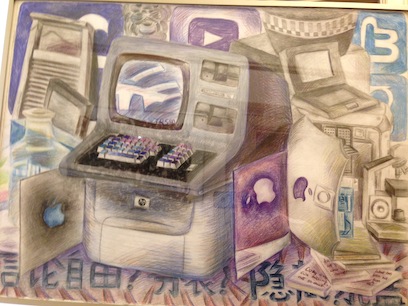 In Art Studio II, students read an article in Harvard Magazine called “The Digitization of the Humanities.” They looked critically at a large still life of objects representing the history of technology, including objects we do not readily associate with today’s lightning speed of information gathering and synthesis. The assignment was to make a drawing from this group of essentially black and white objects using color, line, and surface metaphorically. Choosing what to emphasize and identifying issues and ideas about the role of technology in their lives was a major part of the assignment, and, at times, it became necessary to depart from observational reality to make visible their personal point of view. (more…)


 LEO
LEO 