

American Sign Language to “Youth” by Troye Sivan
By Sarah Bechard, III Form
American Sign Language to “Youth” by Troye Sivan
Editor’s Note: In the St. Mark’s Saturdays’ course “American Sign Language,” the students found resources and learned the signs to perform one whole song in ASL. The goals of the assignment were to learn ASL vocabulary, understand how to sign songs, understand ASL word order, and practice sign fluency. The subtitles reflect ASL word choice and grammar, rather than spoken English grammar.

PLEASE CLICK ON IMAGE TO VIEW VIDEO

Spread No More: The Effect Global Aid Has on the Spread of Tuberculosis
By Reina Wang, Maya Scully, Michael Fisher, Arthur Gao, III Form and Grace Zawadzki, V Form
Spread No More: The Effect Global Aid Has on the Spread of Tuberculosis
Editor’s Note: The Global Seminar teaching team works with all III Formers on an infectious disease project. This is a complex project that involves group work with other members of the III Form and with V Form biology mentors. The final result is exhibited in a poster session, allowing for visitors to do a gallery walk and have questions answered by the poster’s creators.
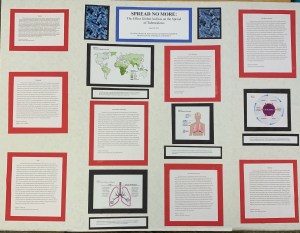
Please Click on Poster Image to See Slides of the Articles
ABSTRACT: Tuberculosis is an infectious disease that threatens health and life throughout the history, but with the help of global aid, there has been a solution to decrease the number of contagious people, especially in developing countries. It is a disease caused by Mycobacterium tuberculosis, which is a bacteria mainly attacking lung surfaces since it spreads through air. Latent and active tuberculosis are two types of the disease, in which latent tuberculosis does not show any symptoms while active tuberculosis does. The most common treatment is a prescribed combination of isoniazid and rifampin, but it only works if the patient completes the procedure and takes the medicine regularly. With the assistance of global aid, there have been many non-governmental organizations (NGO) dedicated to the treatment of tuberculosis worldwide. They offer treatments and technologies to developing countries which does not have access to them. Even if the volunteers who work at the NGOs have the possibilities to carry the bacteria when traveling and spread it to other places, global aid has made huge progress in dealing with tuberculosis. Global aid will influence more and more countries so that tuberculosis will slowly be dissolved in the near future.
Click here to view the articles, images, and graphics in a Google Slide presentation. (more…)

Explaining Length Contraction
By Danny Ciccarello and Helen Huang, V Form
Explaining Length Contraction
Editor’s Note: In “Modern Topics Physics,” students created videos to explain different topics associated with Einstein’s Theory of Relativity. The aim of the assignment included explaining the chosen topic in simple terms while avoiding the use of complicated equations.

CLICK ON THE IMAGE TO VIEW THE VIDEO

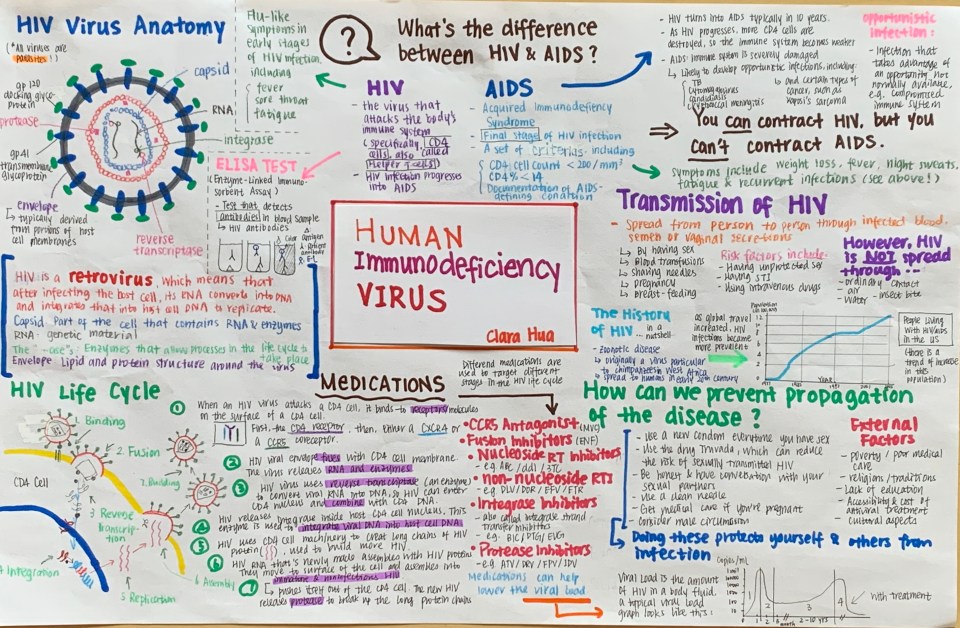
Annotated Diagram: Human Immunodeficiency Virus
By Clara Hua, IV Form
Annotated Diagram: Human Immunodeficiency Virus
Editor’s Note: The “Biology 30” class zoomed in to examine the cellular (and sub-cellular) impacts and zoomed out to consider some of the economic, geo-political, environmental and cultural factors that have an influence on the spread of this disease. An Annotated Diagram is a formal sketchnote that aims to demonstrate understanding of the information by presenting how the information (the full story of HIV/AIDS) was processed.

“Das Brotchen”: The ‘Flouring’ of Culture All Across the Globe
By Alan Gao, VI Form
“Das Brotchen”: The ‘Flouring’ of Culture All Across the Globe
“Das Brotchen.”
I remember learning this phrase in one of my first German classes. This word could be separated into two parts, “Brot” for bread and “-chen” for referring to smaller versions of things. “Das Brotchen” just refers to little bread.
 Yet when my German teacher, Frau Wells, told my class that word, it seemed to carry much more than the simple meaning. She told us with great excitement about her time in Germany when the sweet smell of the roasted fresh wheat flowed over the streets and the bakeries presented their newest baked bread. As an American who had no family relations with Germany, she amazed me with her love and passion for German culture. At the time, I was surprised how this daily word created such a deep impact on her.
Before then, bread, or pastry, didn’t mean much to me. Although Shanghai is a very international city with chain bakeries like Paris Baguette and Lilian Cake, I never paid much attention to them and bought them only in times when I’m rushing down subways and hurrying to classes, paying no attention to their characteristics. (more…)

Survival With God: On Piers Paul Read’s Alive
By Lindsay Davis, IV Form
Survival With God: On Piers Paul Read’s Alive
Alive by Piers Paul Read, a survival story of a plane crash in the Andes Mountains, recounts how the survivors’ trust in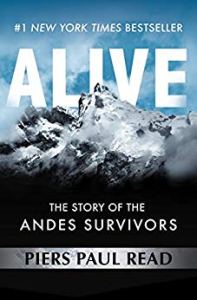 God influenced their resilience during a crisis of life and death. In 1972, a plane carrying Uruguayan rugby players and other Uruguayan citizens crashed in the middle of the Andes. While the travelers suffered many injuries or died from the crash, the fight on the mountain came most from their will to survive and the actions needed to outlast the miserable conditions of the Andes. The rations of food, sleeping conditions, injuries, and pre-existing relationships affected the mental status of each survivor. Their bond with God helped them to make life at the Fairchild fair and optimistic. The survivors who boarded the Fairchild came close to death in the Andes, but their hope for survival and reliance on God pushed them through the mental pain and helped inspire their faith in physical recovery.
The survivors ate the flesh of their dead companions knowing that was their only way to survive. God had inspired the courage to engage in repugnant cannibalism. Over the course of the seventy-two days, while the survivors’ mentality fluctuated, food supplies ran out and the concern of starvation became apparent. The injuries and losses suffered by some of the Fairchild passengers would not matter if they could not feed themselves. Although most of the boys were expecting the point at which they would need the protein of their fellow dead friends and passengers, Canessa was the first to discuss aloud with the group. After eliminating the idea of eating the seat cushions and digging deep for grass, the bodies that surrounded them on and in the snow were the last plan. (more…)

Sexism in the Workplace Through a Critical Social Justice Lens
By Anu Akibu, V Form
Sexism in the Workplace Through a Critical Social Justice Lens
Writer’s Note:
This was an essay I wrote for the class Social Justice. We were tasked to “write an analytical essay that evaluates [a] resource through a critical social justice lens, applying the terms, ideas, and concepts we studied in this module.” The article analyzed in this essay is Boston Has Eliminated Sexism in the Workplace. Right?, so the issues presented focus on American society. I am still learning about critical social justice and challenging the way I view the world around me.
The Boston Magazine article explores the gender-wage gap in prestigious jobs at presumably equitable areas of the United States such as Boston. Highlighted within the article are the narratives of various women’s experiences with discrimination and microaggressions in their workplace. Although the companies have taken action against sexism in the workplace, there are still numerous ways for society’s cultural and ideological nature to align with its progressive efforts. (more…)

An Examination of the Ethics of Examining with Hitchcock and Foucault
By Jason Zhang, VI Form
An Examination of the Ethics of Examining with Hitchcock and Foucault
Surveillance requires two groups: those who are watching and those who are being watched, which brings up the  morality of surveillance. Is it appropriate for someone to observe another person intentionally? Does a person’s behavior change if they know that they are being watched? How is a person affected when their privacy is stripped away from them? Both the film Rear Window by Alfred Hitchcock and the essay “To Discipline and Punish” by Michel Foucault attempt to answer these questions. In Rear Window, Jeff is a brave man who has a history of racing sports cars and being in the military. Unfortunately, his adventurous life comes to a halt when he injures his leg. Jeff is forced to remain in his small, New York City apartment for weeks. Besides the occasional visit from his caretaker and his girlfriend, Jeff’s life is unbearably uneventful until he begins to watch his neighbors from the rear window. Likewise, Foucault’s essay “To Discipline and Punish” tries to understand the consequences of surveillance, but from the perspective of a prison’s architectural design. The prison cells of a Panopticon are arranged so that they all surround one viewing tower placed at the center of the circular building. Therefore, a person inside the viewing tower can see every cell and every person in a cell can see the person inside the viewing tower. Although it is never explicitly said whether or not surveillance is good or bad, both Rear Window and “To Discipline and Punish” come to the conclusion that surveillance is a powerful action. (more…)


 LEO
LEO 