

March 1st of 1919: A Big Step Towards Unity and Freedom in Korea
By Suha Choi, III Form
March 1st of 1919: A Big Step Towards Unity and Freedom in Korea
“A day goes so slow, but a week seems to fly.”
This seems to be a famous saying during the academic year. Time goes so quick, and the third month of the year feels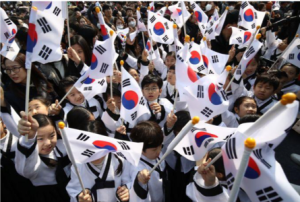 like it flipped on the calendar soon after New Year’s Day. For many, March evokes thoughts about women’s history or the March Madness. For many others, the start of March signals the blessed Senior Spring season. To me, one more thing comes to mind: the March 1st Movement (or the Sam-il Independence Movement).
I ask my parents whether they have put up the Korean flag at our veranda back home yet. Then, I start wondering what my home country would have looked like just 100 years ago. I suddenly see my great grandparents and millions of my ancestors marching on the flat dusty streets of Seoul, where now countless tall and polished buildings stand. (more…)

Mitotic Cell Division Artifact of Learning
By Matt Walsh, VI Form, Laura Sabino, V Form, and Maddie Wass, V Form
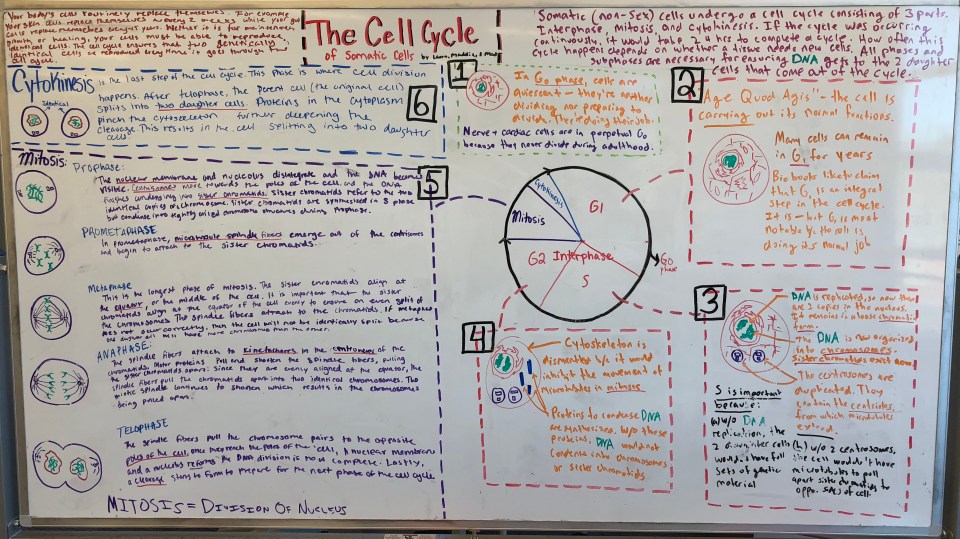
Mitotic Cell Division Artifact of Learning
Editor’s Note: See the image below of the whiteboard artifact images for the description of the assignment in Advanced Biology.

Siddhartha: Children’s Story
By Lina Zhang, IV Form
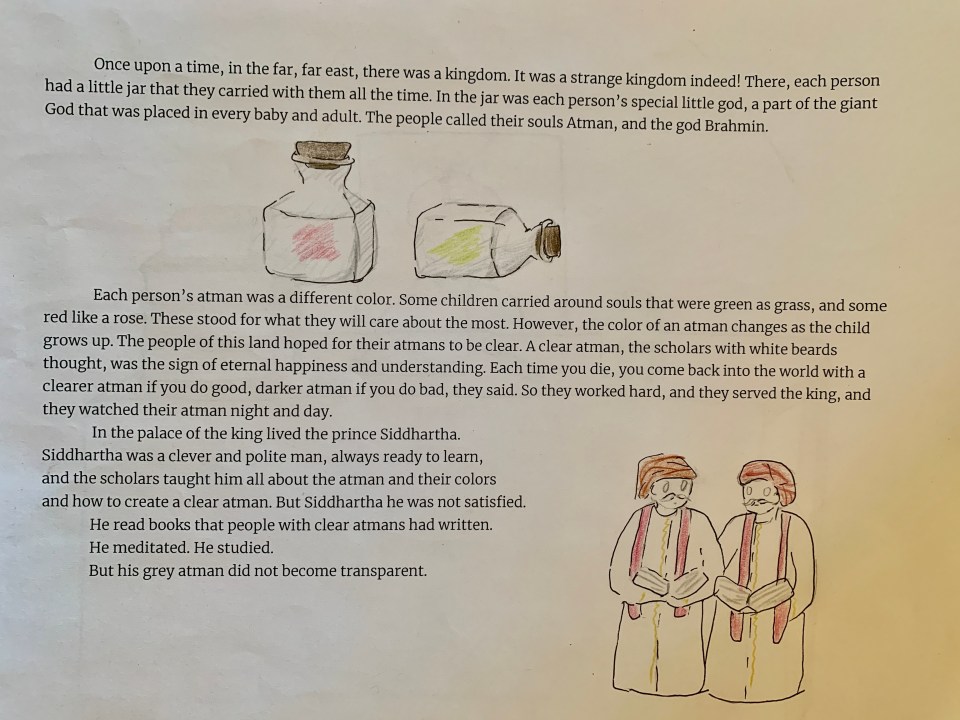
Siddhartha: Children’s Story
Editor’s Note: In Reverend Solter’s religion elective “The Quest,” this was the prompt for the assignment: Write a children’s story about Siddhartha’s quest for spiritual enlightenment. Your story must include 1. 10 quotations from Herman Hesse’s Siddhartha–distilled to a level appropriate for children (the quotations should follow Siddhartha’s journey along the Noble Eightfold Path); 2. Illustrations–you can use images from the web or your own illustrations; 3. A teaching on understanding the basics of Hinduism and/or Buddhism.

International Brain Bee Neuroscience Competition
By Samantha Wang, IV Form
International Brain Bee Neuroscience Competition
What is Brain Bee?
Brain Bee is a neuroscience competition for teenagers from around the world. The initiative of this competition, according to its founder Dr. Norbert Myslinski, is to find better solutions for brain disorders. Every year, Brain Bee is first held at the state level. Winners of each state then compete in the country’s Regional Brain Bee, and one representative from each Regional Brain Bee will be sent to the International Brain Bee World Championship. This competition assigns a variety of tasks to its participants. The first part of the Brain Bee is to answer multiple-choice questions, which have around thirty questions about either the brain’s structure and function or pathology and treatment of brain disorders. Participants are then given brain models, where they are asked to distinguish parts of a brain and state the functions they perform. The last part involves the most interesting task I have ever experienced in any competition: four “patients” with different brain disorders, with acting from the volunteers of the organization, tell the specific life experience with their diseases. The participants are asked to diagnose their neurological or psychiatric conditions. (more…)



Serving Up Equality: The Quest in Women’s Tennis
By Tate Frederick, IV Form
Serving Up Equality: The Quest in Women’s Tennis
With the rampant gender inequality in professional sports, tennis could easily be considered one of the least sexist due to its recently equalized prize money. In fact, the World Economic Forum recently wrote that “the Women’s Tennis Association [is] pushing the women’s game and pioneering gender equality” (Edmond). Contrary to public perception, the professional tennis circuit still has to make significant improvements in order to achieve gender equality. The financial distribution still heavily favors men, some of the rules perpetuate sexist values, and unfair stereotyping of female players is frequent.
 Despite the fact that prize money became equal in 2007, women still make far less than male players. On the Forbes’ list of top-earning athletes, Serena Williams only comes in 51st, behind five male players, even though she has won more grand slam titles than any player, regardless of gender, in history, and holds endorsements with companies such as Nike, Gatorade, and JPMorganChase (Wang). Williams has earned tens of millions of dollars less than Novak Djokovic even though she has won many more titles than he has (Macur), due to the overall amount of prize money. If Williams, arguably one of the greatest athletes of all time, can’t achieve equal pay in comparison to her less-winning counterparts, where is the hope for women in less acclaimed positions? By maintaining this inequality, the tennis circuit is discouraging and discrediting the achievements of women in the sport. (more…)

On Sherman Alexie’s “Clean, Cleaner, Cleanest”
By Cara Mulcahey, IV Form
On Sherman Alexie’s “Clean, Cleaner, Cleanest”
The short story “Clean, Cleaner, Cleanest” focuses on the grueling conditions motel maids face every day. It follows the
life of a motel maid named Marie who despises cleaning but does it for the money it provides. Marie gets physically assaulted by her coworkers, sees horrific sights in motel rooms, cleans revolting messes guest leave behind, and does not complain about the dehumanization she faces on a daily basis. Sherman Alexie, the author of “Clean, Cleaner, Cleanest,” utilizes Marie’s self vs. self-conflict about her job as a way to display the horrors motel maids face every day and why they should be appreciated in society.
Marie loathes being a hotel maid because cleaning repulses her and her coworkers have mistreated her. While she had gotten used to cleaning abhorrent bathrooms, making beds, and vacuuming, the idea of cleaning people’s leftover (more…)

Green Sea Turtle – Chelonia mydas & Marine Turtle Exhibition
By Cadence (Catie) Summers, IV Form
Green Sea Turtle – Chelonia mydas & Marine Turtle Exhibition

Green Sea Turtle – Chelonia mydas
Stage in Maturity – Adult (more…)


 LEO
LEO 